
在美国处于健康体重、超重和肥胖范围内的亚裔成年人中,糖尿病前期和糖尿病的患病率因种族而异:一项电子健康记录研究。
Prevalence of prediabetes and diabetes vary by ethnicity among U.S. Asian adults at healthy weight, overweight, and obesity ranges: an electronic health record study.
机构信息
Department of Medicine, Kaiser Permanente Oakland Medical Center, Oakland, CA, USA.
Division of Research, Kaiser Permanente Northern California, 2000 Broadway, Oakland, CA, 94612, USA.
出版信息
BMC Public Health. 2022 Oct 22;22(1):1954. doi: 10.1186/s12889-022-14362-8.
BACKGROUND
Asian adults develop Type 2 diabetes at a lower body mass index (BMI) compared to other racial/ethnic groups. We examined the variation in prevalence of prediabetes and diabetes among Asian ethnic groups within weight strata by comparing middle-aged Chinese, Filipino, South Asian, and White adults receiving care in the same integrated healthcare delivery system.
METHODS
Our retrospective cross-sectional U.S. study examined data from 283,110 (non-Hispanic) White, 33,263 Chinese, 38,766 Filipino, and 17,959 South Asian adults aged 45-64 years who were members of a Northern California health plan in 2016 and had measured height and weight. Prediabetes and diabetes were classified based on laboratory data, clinical diagnoses, or diabetes pharmacotherapy. Age-standardized prevalence of prediabetes and diabetes were compared by race/ethnicity within healthy weight, overweight, and obesity categories, using standard BMI thresholds for White adults (18.5 to < 25, 25 to < 30, ≥ 30 kg/m) and lower BMI thresholds for Asian adults (18.5 to < 23, 23 to < 27.5, ≥ 27.5 kg/m). Prevalence ratios (PRs) were used to compare the prevalence of diabetes and prediabetes for Asian groups to White adults in each weight category, adjusted for age and BMI.
RESULTS
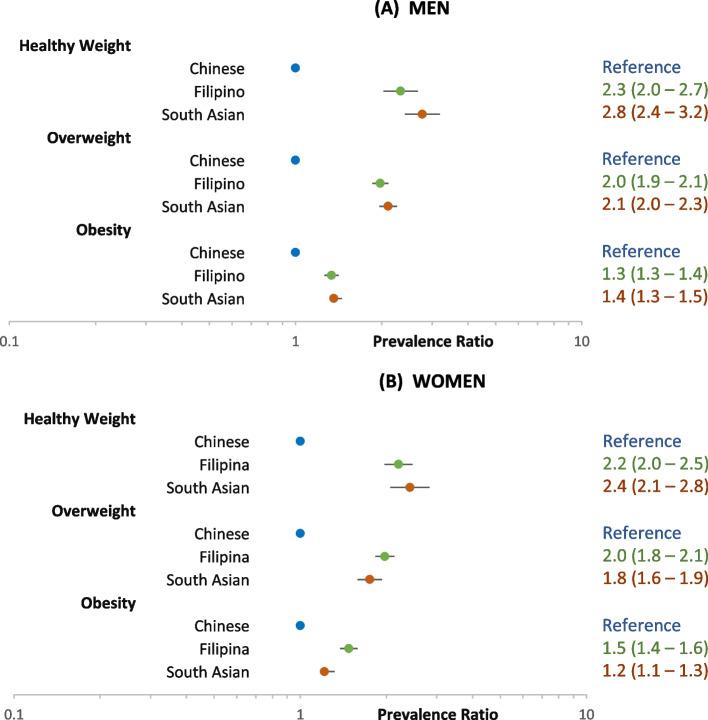
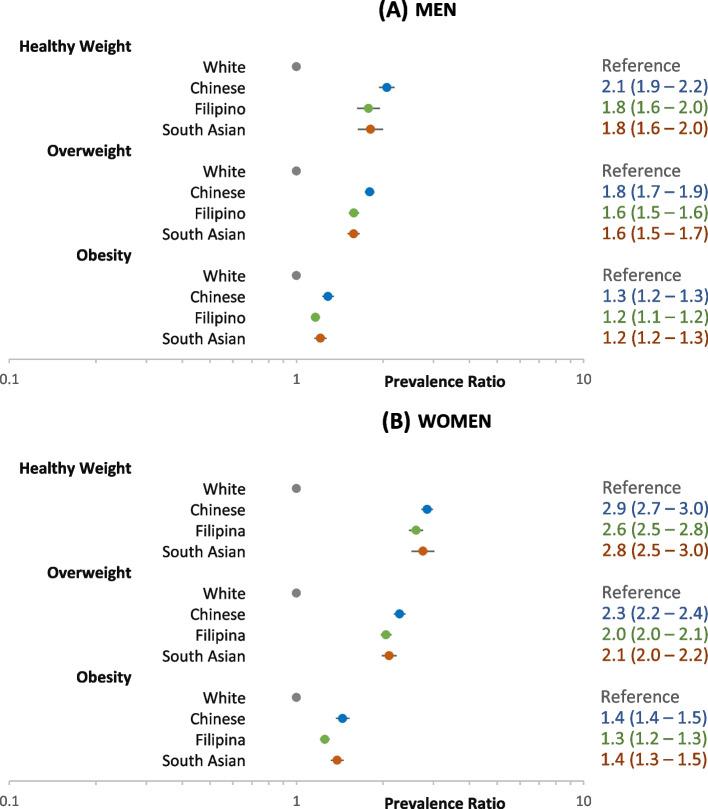
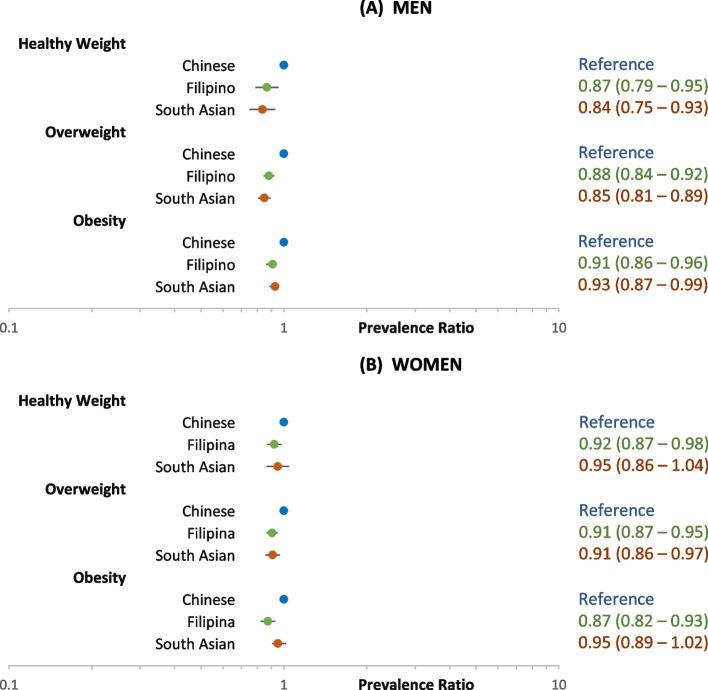
Across all weight categories, diabetes prevalence was higher for Asian than White adults, and among Asian groups it was highest for Filipino and South Asian adults. Compared to White, PRs for South Asian men/women at healthy BMI were 1.8/2.8 for prediabetes and 5.9/8.0 for diabetes, respectively. The PRs for Filipino men/women at healthy BMI were 1.8/2.6 for prediabetes and 5.0/7.5 for diabetes, respectively. For Chinese men/women at healthy BMI, the PRs for prediabetes (2.1/2.9) were similar to Filipino and South Asian, but the PRs for diabetes were lower (2.1/3.4).
CONCLUSION
Chinese, Filipino, and South Asian adults have higher prevalence of prediabetes and diabetes than White adults in all weight categories, despite using lower BMI thresholds for weight classification in Asian groups. Within Asian ethnic groups, Filipino and South Asian adults had considerably higher diabetes prevalence than Chinese adults. Our data emphasize the disproportionate metabolic risk among middle-aged Asian adults and underscore the need for diabetes screening among high-risk Asian groups at healthy BMI levels.
背景
与其他种族/族裔群体相比,亚洲成年人的 2 型糖尿病发病体重指数(BMI)较低。我们通过比较在同一综合医疗服务系统中接受治疗的中年中国人、菲律宾人、南亚人和白人成年人,检查了不同体重阶层的亚裔人群中糖尿病前期和糖尿病的患病率差异。
方法
我们的这项美国回顾性横断面研究,分析了 2016 年加州北部一家健康计划中 283110 名非西班牙裔白人、33263 名中国人、38766 名菲律宾人以及 17959 名南亚成年人的数据,这些成年人的年龄在 45-64 岁之间,且均有身高和体重的测量值。根据实验室数据、临床诊断或糖尿病药物治疗情况,对糖尿病前期和糖尿病进行分类。在健康体重、超重和肥胖类别中,使用白人成年人的标准 BMI 阈值(18.5-<25、25-<30、≥30kg/m)和亚洲成年人的较低 BMI 阈值(18.5-<23、23-<27.5、≥27.5kg/m),按种族/族裔比较糖尿病前期和糖尿病的年龄标准化患病率。使用患病率比(PR),比较每个体重类别中亚洲人群与白人成年人的糖尿病前期和糖尿病患病率,同时调整年龄和 BMI。
结果
在所有体重类别中,亚洲成年人的糖尿病患病率均高于白人成年人,且在亚洲人群中,菲律宾人和南亚成年人的糖尿病患病率最高。与白人成年人相比,健康 BMI 的南亚男性/女性的 PR 分别为糖尿病前期的 1.8/2.8 和糖尿病的 5.9/8.0;健康 BMI 的菲律宾男性/女性的 PR 分别为糖尿病前期的 1.8/2.6 和糖尿病的 5.0/7.5。对于健康 BMI 的中国男性/女性,糖尿病前期的 PR(2.1/2.9)与菲律宾人和南亚人的 PR 相似,但糖尿病的 PR 较低(2.1/3.4)。
结论
尽管在亚洲人群中使用了较低的 BMI 分类阈值,但所有体重类别中,中国、菲律宾和南亚成年人的糖尿病前期和糖尿病患病率均高于白人成年人。在亚裔人群中,菲律宾人和南亚成年人的糖尿病患病率明显高于中国人。我们的数据强调了中年亚裔成年人不成比例的代谢风险,并突出表明需要在健康 BMI 水平的高风险亚裔人群中进行糖尿病筛查。


 Zotero 插件