
接触者追踪揭示了纽约市 COVID-19 的社区传播。
Contact tracing reveals community transmission of COVID-19 in New York City.
机构信息
Department of Environmental Health Sciences, Mailman School of Public Health, Columbia University, New York, NY, 10032, USA.
Department of Epidemiology, Mailman School of Public Health, Columbia University, New York, NY, 10032, USA.
出版信息
Nat Commun. 2022 Oct 23;13(1):6307. doi: 10.1038/s41467-022-34130-x.
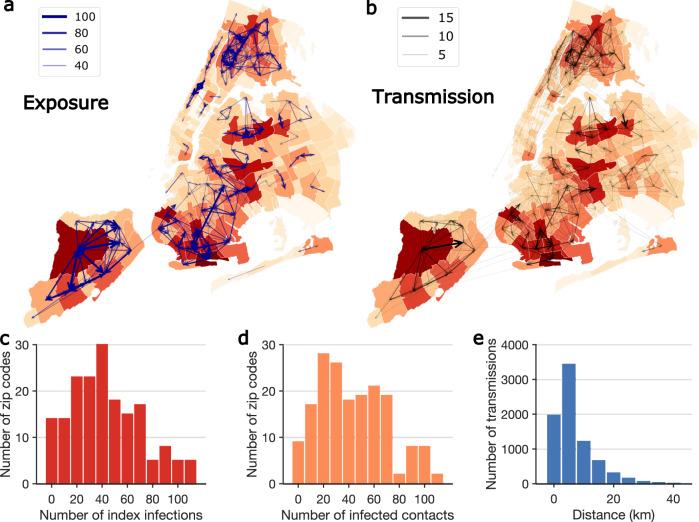
Understanding SARS-CoV-2 transmission within and among communities is critical for tailoring public health policies to local context. However, analysis of community transmission is challenging due to a lack of high-resolution surveillance and testing data. Here, using contact tracing records for 644,029 cases and their contacts in New York City during the second pandemic wave, we provide a detailed characterization of the operational performance of contact tracing and reconstruct exposure and transmission networks at individual and ZIP code scales. We find considerable heterogeneity in reported close contacts and secondary infections and evidence of extensive transmission across ZIP code areas. Our analysis reveals the spatial pattern of SARS-CoV-2 spread and communities that are tightly interconnected by exposure and transmission. We find that locations with higher vaccination coverage and lower numbers of visitors to points-of-interest had reduced within- and cross-ZIP code transmission events, highlighting potential measures for curtailing SARS-CoV-2 spread in urban settings.
了解社区内和社区之间的 SARS-CoV-2 传播对于根据当地情况调整公共卫生政策至关重要。然而,由于缺乏高分辨率的监测和检测数据,对社区传播的分析具有挑战性。在这里,我们使用了第二次大流行浪潮期间纽约市 644029 例病例及其接触者的接触者追踪记录,详细描述了接触者追踪的运行性能,并在个人和邮政编码规模上重建了暴露和传播网络。我们发现报告的密切接触者和二次感染存在相当大的异质性,并且证据表明邮政编码区域之间存在广泛的传播。我们的分析揭示了 SARS-CoV-2 传播的空间模式以及通过暴露和传播紧密相互关联的社区。我们发现,疫苗接种覆盖率较高且前往兴趣点的访客人数较少的地点,其内部和跨邮政编码的传播事件减少,这突出了在城市环境中遏制 SARS-CoV-2 传播的潜在措施。


 Zotero 插件