
炎症性肠病中的心理压力:双向肠脑通讯的心理神经免疫学见解。
Psychological stress in inflammatory bowel disease: Psychoneuroimmunological insights into bidirectional gut-brain communications.
机构信息
Shandong Provincial Key Laboratory for Rheumatic Disease and Translational Medicine, The First Affiliated Hospital of Shandong First Medical University & Shandong Provincial Qianfoshan Hospital, Jinan, China.
School of Clinical and Basic Medical Sciences, Shandong First Medical University & Shandong Academy of Medical Sciences, Jinan, China.
出版信息
Front Immunol. 2022 Oct 6;13:1016578. doi: 10.3389/fimmu.2022.1016578. eCollection 2022.
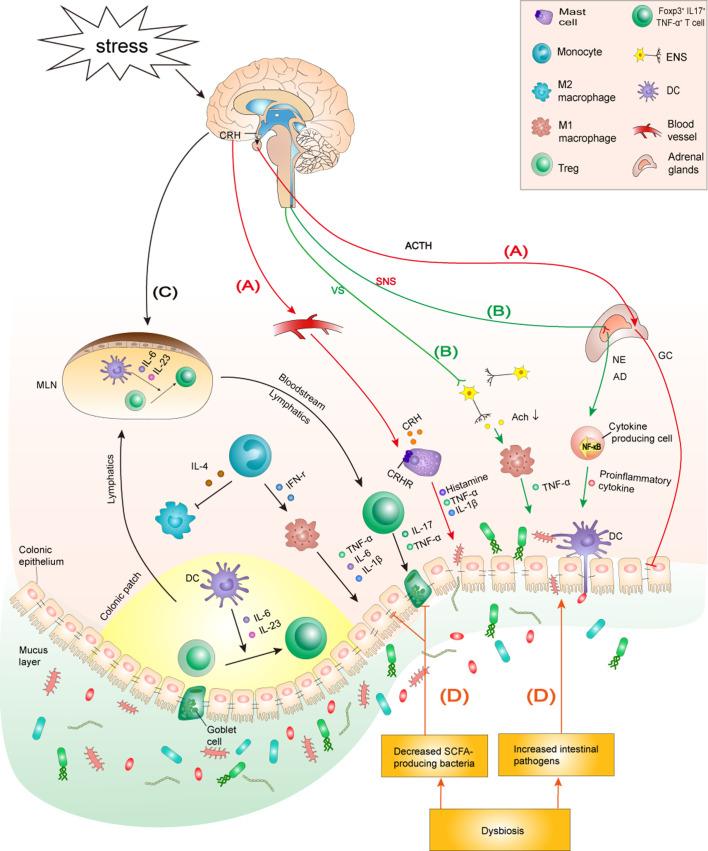
Inflammatory bowel disease (IBD), mainly including ulcerative colitis (UC) and Crohn's disease (CD), is an autoimmune gastrointestinal disease characterized by chronic inflammation and frequent recurrence. Accumulating evidence has confirmed that chronic psychological stress is considered to trigger IBD deterioration and relapse. Moreover, studies have demonstrated that patients with IBD have a higher risk of developing symptoms of anxiety and depression than healthy individuals. However, the underlying mechanism of the link between psychological stress and IBD remains poorly understood. This review used a psychoneuroimmunology perspective to assess possible neuro-visceral integration, immune modulation, and crucial intestinal microbiome changes in IBD. Furthermore, the bidirectionality of the brain-gut axis was emphasized in the context, indicating that IBD pathophysiology increases the inflammatory response in the central nervous system and further contributes to anxiety- and depression-like behavioral comorbidities. This information will help accurately characterize the link between psychological stress and IBD disease activity. Additionally, the clinical application of functional brain imaging, microbiota-targeted treatment, psychotherapy and antidepressants should be considered during the treatment and diagnosis of IBD with behavioral comorbidities. This review elucidates the significance of more high-quality research combined with large clinical sample sizes and multiple diagnostic methods and psychotherapy, which may help to achieve personalized therapeutic strategies for IBD patients based on stress relief.
炎症性肠病(IBD),主要包括溃疡性结肠炎(UC)和克罗恩病(CD),是一种以慢性炎症和频繁复发为特征的自身免疫性胃肠道疾病。越来越多的证据证实,慢性心理压力被认为是引发 IBD 恶化和复发的因素。此外,研究表明,IBD 患者出现焦虑和抑郁症状的风险高于健康个体。然而,心理压力与 IBD 之间的联系的潜在机制仍知之甚少。本综述从心理神经免疫学的角度评估了可能的神经内脏整合、免疫调节和 IBD 中关键的肠道微生物组变化。此外,还强调了脑-肠轴的双向性,表明 IBD 病理生理学增加了中枢神经系统的炎症反应,并进一步导致焦虑和抑郁样行为共病。这些信息将有助于准确描述心理压力与 IBD 疾病活动之间的联系。此外,在治疗和诊断伴有行为共病的 IBD 时,应考虑功能性脑成像、靶向微生物组治疗、心理治疗和抗抑郁药的临床应用。本综述阐明了结合大样本量和多种诊断方法及心理治疗进行更多高质量研究的意义,这可能有助于根据缓解压力为 IBD 患者制定个性化的治疗策略。

 Zotero 插件