
大气中的微(纳)塑料:对人类健康日益增长的未来担忧。
Atmospheric micro (nano) plastics: future growing concerns for human health.
作者信息
Bhat Mansoor Ahmad, Gedik Kadir, Gaga Eftade O
机构信息
Faculty of Engineering, Department of Environmental Engineering, Eskişehir Technical University, 26555 Eskişehir, Turkey.
Environmental Research Center (ÇEVMER), Eskişehir Technical University, 26555 Eskişehir, Turkey.
出版信息
Air Qual Atmos Health. 2023;16(2):233-262. doi: 10.1007/s11869-022-01272-2. Epub 2022 Oct 17.
ABSTRACT
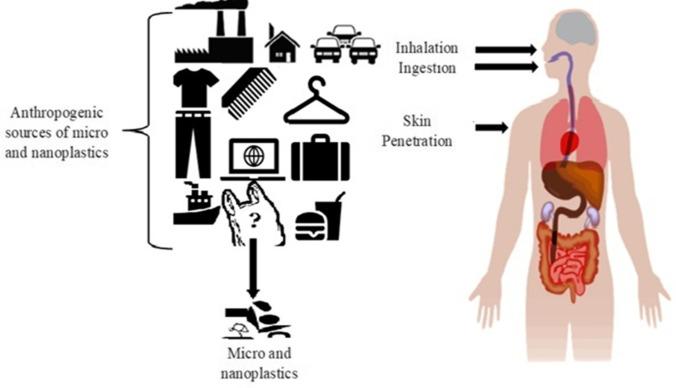
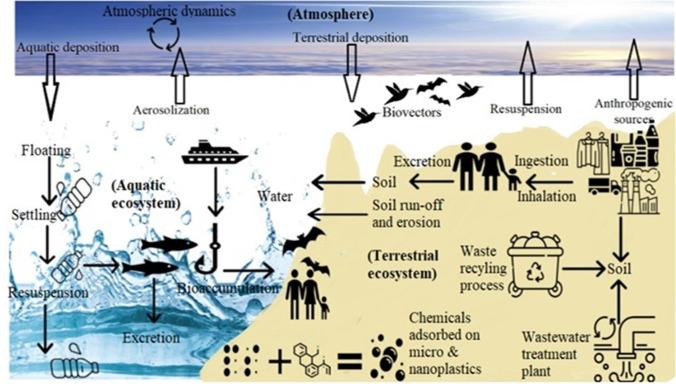
Plastics are an integral but largely inconspicuous part of daily human routines. The present review paper uses cross-disciplinary scientific literature to examine and assess the possible effects of nanoplastics (NPs) concerning microplastics (MPs) on human health and summarizes crucial areas for future research. Although research on the nature and consequences of MPs has seen a substantial rise, only limited studies have concentrated on the atmospheric nanosized polymeric particles. However, due to the intrinsic technological complications in separating and computing them, their existence has been difficult to determine correctly. There is a consensus that these are not only existing in the environment but can get directly released or as the outcome of weathering of larger fragments, and it is believed to be that combustion can be the tertiary source of polymeric particles. NPs can have harmful consequences on human health, and their exposure may happen via ingestion, inhalation, or absorption by the skin. The atmospheric fallout of micro (nano) plastics may be responsible for contaminating the environment. Apart from this, different drivers affect the concentration of micro (nano) plastics in every environment compartment like wind, water currents, vectors, soil erosion, run-off, etc. Their high specific surface for the sorption of organic pollutions and toxic heavy metals and possible transfer between organisms at different nutrient levels make the study of NPs an urgent priority. These NPs could potentially cause physical damage by the particles themselves and biological stress by NPs alone or by leaching additives. However, there is minimal understanding of the occurrence, distribution, abundance, and fate of NPs in the environment, partially due to the lack of suitable techniques for separating and identifying NPs from complex environmental matrices.
HIGHLIGHTS
Micro (nano) plastics generated may reach the soil, water, and atmospheric compartments.Atmospheric currents serve as a way to transport, leading to micro (nano) plastics pollution.Exposure to micro (nano) plastics may happen via ingestion, inhalation, or absorption by the skin.Nanoplastics may be environmentally more harmful than other plastic particles; the focus should be on defining the exact size range.Visual classification of micro (nano) plastics is poor in reliability and may also contribute to microplastics being misidentified.
摘要
塑料是人类日常活动中不可或缺但大多不显眼的一部分。本综述文章运用跨学科科学文献来研究和评估纳米塑料(NPs)与微塑料(MPs)对人类健康可能产生的影响,并总结未来研究的关键领域。尽管关于微塑料的性质和后果的研究有了大幅增加,但仅有有限的研究关注大气中的纳米级聚合物颗粒。然而,由于分离和计算它们存在内在的技术难题,其存在难以准确确定。人们一致认为这些颗粒不仅存在于环境中,而且可以直接释放出来,或者是较大碎片风化的结果,并且燃烧被认为是聚合物颗粒的第三大来源。纳米塑料会对人类健康产生有害影响,其暴露途径可能是经口摄入、吸入或通过皮肤吸收。微(纳)塑料的大气沉降可能导致环境污染。除此之外,不同的驱动因素会影响每个环境介质中微(纳)塑料的浓度,如风、水流、载体、土壤侵蚀、径流等。它们具有高比表面积,可吸附有机污染物和有毒重金属,并可能在不同营养级的生物之间转移,这使得对纳米塑料的研究成为当务之急。这些纳米塑料可能会因其自身颗粒造成物理损伤,也可能单独通过纳米塑料或通过浸出添加剂造成生物应激。然而,对于纳米塑料在环境中的存在、分布、丰度和归宿了解甚少,部分原因是缺乏从复杂环境基质中分离和识别纳米塑料的合适技术。
重点
产生 的微(纳)塑料可能会进入土壤、水和大气介质中。
大气环流是一种传输方式,会导致微(纳)塑料污染。
微(纳)塑料的暴露途径可能是经口摄入、吸入或通过皮肤吸收。
纳米塑料在环境中可能比其他塑料颗粒危害更大;应重点确定确切的尺寸范围。
微(纳)塑料的目视分类可靠性较差,也可能导致微塑料被误认。
 Zotero 插件