
醛固酮刺激的内皮上皮钠通道(EnNaC)在大鼠冷暴露诱导的高血压中起作用。
Aldosterone-stimulated endothelial epithelial sodium channel (EnNaC) plays a role in cold exposure-induced hypertension in rats.
作者信息
Tang Liang-Liang, Yang Xu, Yu Shu-Qi, Qin Qi, Xue Rong, Sun Yu, Xiao Han, Shang An-Qi, Liu Jia-Qun, Han Song-Qi, Liang Chen, Lou Jie, Wang Qiu-Shi, Yu Chang-Jiang, Wu Ming-Ming, Zhang Zhi-Ren
机构信息
Departments of Pharmacy and Cardiology, Harbin Medical University Cancer Hospital, Institute of Metabolic Disease, Heilongjiang Academy of Medical Science, Heilongjiang Key Laboratory for Metabolic Disorder and Cancer Related Cardiovascular Diseases, Harbin, China.
Department of Cardiology, the 1st Affiliated Hospital of Harbin Medical University, NHC Key Laboratory of Cell Transplantation, Harbin Medical University and Key Laboratories of Education Ministry for Myocardial Ischemia Mechanism and Treatment, Harbin, China.
出版信息
Front Pharmacol. 2022 Oct 6;13:970812. doi: 10.3389/fphar.2022.970812. eCollection 2022.
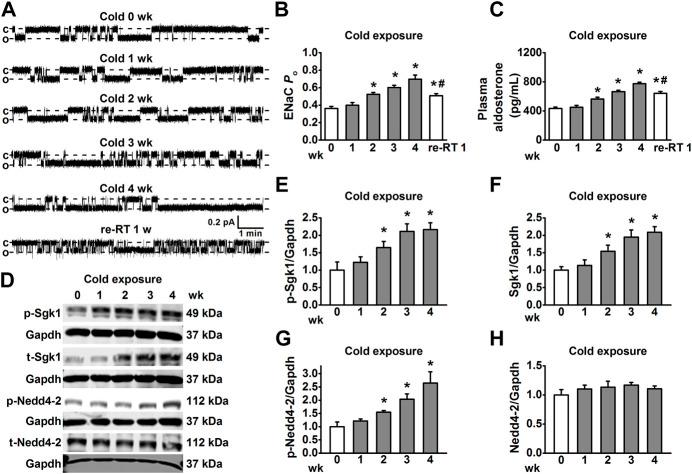
Previous studies have demonstrated that activated endothelial epithelial sodium channel (EnNaC) impairs vasodilatation, which contributes to salt-sensitive hypertension. Here, we investigate whether mesenteric artery (MA) EnNaC is involved in cold exposure-induced hypertension (CIH) and identify the underlying mechanisms in SD rats. One group of rats was housed at room temperature and served as control. Three groups of rats were kept in a 4°C cold incubator for 10 h/day; among which two groups were administrated with either benzamil (EnNaC blocker) or eplerenone (mineralocorticoid receptor antagonist, MR). Blood pressure (BP), vasodilatation, and endothelial function were measured with tail-cuff plethysmography, isometric myograph, and Total Nitric Oxide (NO) Assay kit, respectively. A cell-attached patch-clamp technique, in split-open MA, was used to determine the role of EnNaC in CIH rats. Furthermore, the plasma aldosterone levels were detected using an ELISA kit; and Western blot analysis was used to examine the relative expression levels of Sgk1 and Nedd4-2 proteins in the MA of SD rats. We demonstrated that cold exposure increased BP, impaired vasodilatation, and caused endothelial dysfunction in rats. The activity of EnNaC significantly increased, concomitant with an increased level of plasma aldosterone and activation of Sgk1/Nedd4-2 signaling. Importantly, CIH was inhibited by either eplerenone or benzamil. It appeared that cold-induced decrease in NO production and impairment of endothelium-dependent relaxation (EDR) were significantly ameliorated by either eplerenone or benzamil in MA of CIH rats. Moreover, treatment of MAs with aldosterone resulted in an activation of EnNaC, a reduction of NO, and an impairment of EDR, which were significantly inhibited by either eplerenone or GSK650394 (Sgk1 inhibitor) or benzamil. Activation of EnNaC contributes to CIH; we suggest that pharmacological inhibition of the MR/Sgk1/Nedd4-2/EnNaC axis may be a potential therapeutic strategy for CIH.
先前的研究表明,激活的内皮上皮钠通道(EnNaC)会损害血管舒张功能,这与盐敏感性高血压有关。在此,我们研究肠系膜动脉(MA)EnNaC是否参与冷暴露诱导的高血压(CIH),并确定SD大鼠中的潜在机制。一组大鼠饲养在室温下作为对照。三组大鼠每天在4°C的冷培养箱中饲养10小时;其中两组分别给予苯扎明(EnNaC阻滞剂)或依普利酮(盐皮质激素受体拮抗剂,MR)。分别用尾袖体积描记法、等长肌动描记法和总一氧化氮(NO)检测试剂盒测量血压(BP)、血管舒张功能和内皮功能。采用细胞贴附式膜片钳技术,在分离的MA中,确定EnNaC在CIH大鼠中的作用。此外,使用ELISA试剂盒检测血浆醛固酮水平;并采用蛋白质免疫印迹分析检测SD大鼠MA中Sgk1和Nedd4-2蛋白的相对表达水平。我们证明,冷暴露会增加大鼠的血压,损害血管舒张功能,并导致内皮功能障碍。EnNaC的活性显著增加,同时血浆醛固酮水平升高以及Sgk1/Nedd4-2信号通路激活。重要的是,依普利酮或苯扎明可抑制CIH。似乎依普利酮或苯扎明可显著改善CIH大鼠MA中冷诱导的NO生成减少和内皮依赖性舒张(EDR)受损。此外,用醛固酮处理MA会导致EnNaC激活、NO减少和EDR受损,依普利酮或GSK650394(Sgk1抑制剂)或苯扎明可显著抑制这些作用。EnNaC的激活导致CIH;我们认为,对MR/Sgk1/Nedd4-2/EnNaC轴的药物抑制可能是CIH的一种潜在治疗策略。



 Zotero 插件