
端粒长度或线粒体 DNA 拷贝数对不良童年经历 (ACEs) 与中心动脉僵硬之间关联无中介效应。
No Mediation Effect of Telomere Length or Mitochondrial DNA Copy Number on the Association Between Adverse Childhood Experiences (ACEs) and Central Arterial Stiffness.
机构信息
Department of Health Sciences Faculty of Applied Health Sciences Brock University St. Catharines Ontario Canada.
Brock-Niagara Centre for Health and Well-Being Brock University St. Catharines Ontario Canada.
出版信息
J Am Heart Assoc. 2022 Nov;11(21):e026619. doi: 10.1161/JAHA.122.026619. Epub 2022 Oct 26.
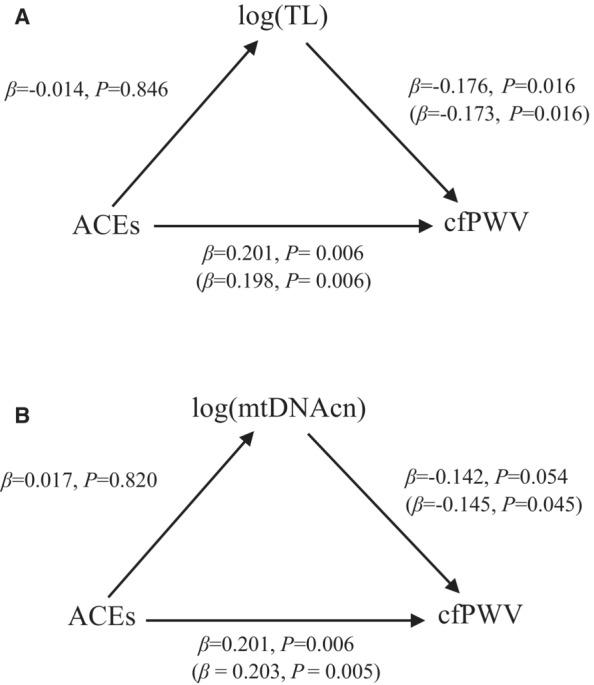
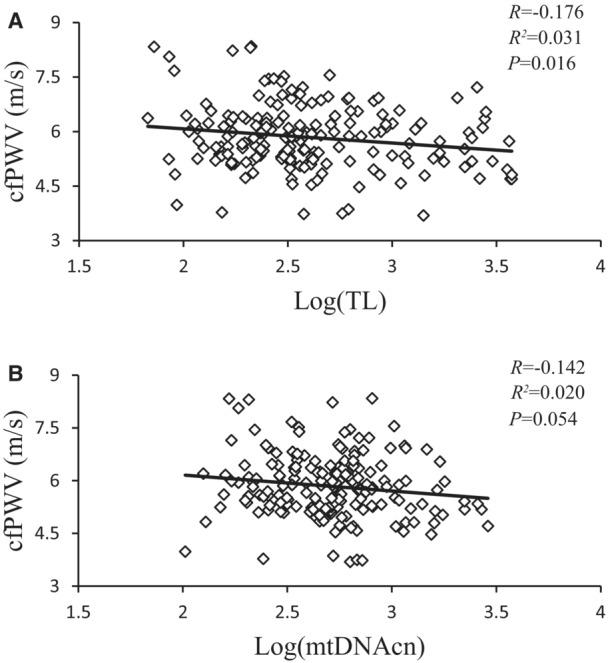
Background Adverse childhood experiences (ACEs) have been linked to increased cardiovascular disease (CVD) risk. Previous reports have suggested that accelerated biological aging-indexed by telomere length (TL) and mitochondrial DNA copy number (mtDNAcn)-may contribute to associations between ACEs and cardiovascular health outcomes. Here, we examine the potential mediating effects of TL and mtDNAcn on the association between ACEs and central arterial stiffness-an intermediate cardiovascular health outcome-as a novel pathway linking ACEs to CVD risk among young adults. Methods and Results One hundred and eighty-five (n=102 women; mean age, 22.5±1.5 years) individuals provided information on ACEs. TL (kb per diploid cell) and mtDNAcn (copies per diploid cell) were quantified using quantitative polymerase chain reaction techniques. Central arterial stiffness was measured as carotid-femoral pulse wave velocity (cfPWV; m/s). Multiple linear regression analyses were used to examine the associations between ACEs, TL, mtDNAcn, and cfPWV. ACEs were positively associated with cfPWV (=0.147, =0.035). TL (=-0.170, =0.011) and mtDNAcn (=-0.159, =0.019) were inversely associated with cfPWV. Neither TL (=-0.027, =0.726) nor mtDNAcn (=0.038, =0.620) was associated with ACEs. Neither marker mediated the association between ACEs and cfPWV. Conclusions An increasing number of ACEs were associated with a faster cfPWV and thus, a greater degree of central arterial stiffness. ACEs were not associated with either TL or mtDNAcn, suggesting that these markers do not represent a mediating pathway linking ACEs to central arterial stiffness.
背景
不良的童年经历(ACEs)与增加心血管疾病(CVD)风险有关。先前的报告表明,端粒长度(TL)和线粒体 DNA 拷贝数(mtDNAcn)所指示的生物衰老加速可能会导致 ACEs 与心血管健康结果之间的关联。在这里,我们研究了 TL 和 mtDNAcn 在 ACEs 与中心动脉僵硬(一种中间心血管健康结果)之间的关联中的潜在中介作用,作为将 ACEs 与 CVD 风险联系起来的新途径。
方法和结果
185 名(n=102 名女性;平均年龄 22.5±1.5 岁)个体提供了 ACEs 信息。使用定量聚合酶链反应技术定量 TL(每个二倍体细胞的 kb)和 mtDNAcn(每个二倍体细胞的拷贝数)。使用颈动脉-股动脉脉搏波速度(cfPWV;m/s)测量中心动脉僵硬。多元线性回归分析用于研究 ACEs、TL、mtDNAcn 和 cfPWV 之间的关联。ACEs 与 cfPWV 呈正相关(=0.147,=0.035)。TL(=-0.170,=0.011)和 mtDNAcn(=-0.159,=0.019)与 cfPWV 呈负相关。TL 与 ACEs 无相关性(=-0.027,=0.726),mtDNAcn 与 ACEs 也无相关性(=0.038,=0.620)。两种标志物均不能介导 ACEs 与 cfPWV 之间的关联。
结论
ACEs 数量的增加与 cfPWV 更快相关,因此与中央动脉僵硬程度更大相关。ACEs 与 TL 或 mtDNAcn 均无相关性,这表明这些标志物不能代表将 ACEs 与中央动脉僵硬联系起来的中介途径。

 Zotero 插件