
基于抗菌肽的抗生素开发的工程方法
Engineering Approaches for the Development of Antimicrobial Peptide-Based Antibiotics.
作者信息
Kang Su-Jin, Nam So Hee, Lee Bong-Jin
机构信息
College of Pharmacy, Dongduk Women's University, Seoul 02748, Korea.
Research Institute of Pharmaceutical Sciences, College of Pharmacy, Seoul National University, Seoul 08826, Korea.
出版信息
Antibiotics (Basel). 2022 Sep 30;11(10):1338. doi: 10.3390/antibiotics11101338.
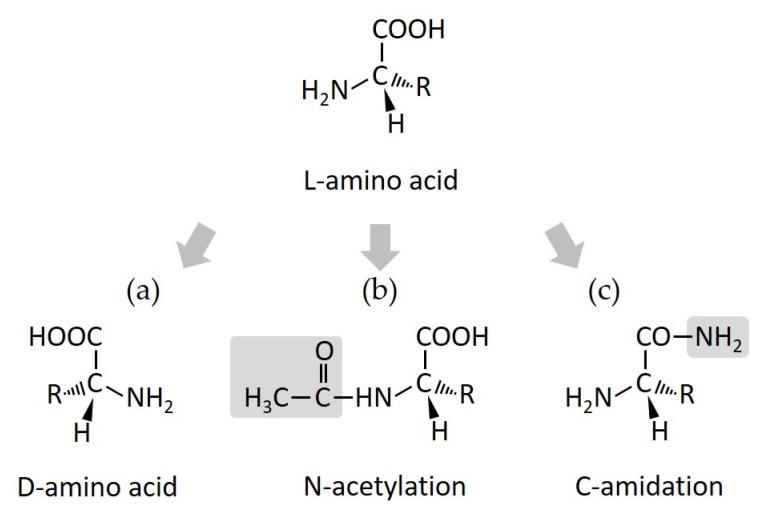
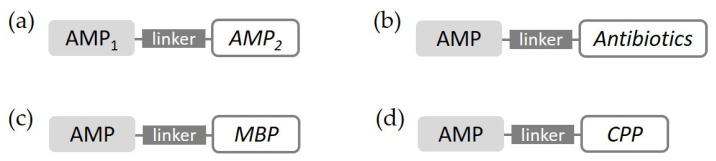
Antimicrobial peptides (AMPs) have received increasing attention as potential alternatives for future antibiotics because of the rise of multidrug-resistant (MDR) bacteria. AMPs are small cationic peptides with broad-spectrum antibiotic activities and different action mechanisms to those of traditional antibiotics. Despite the desirable advantages of developing peptide-based antimicrobial agents, the clinical applications of AMPs are still limited because of their enzymatic degradation, toxicity, and selectivity. In this review, structural modifications, such as amino acid substitution, stapling, cyclization of peptides, and hybrid AMPs with conventional antibiotics or other peptides, will be presented. Additionally, nanodelivery systems using metals or lipids to deliver AMPs will be discussed based on the structural properties and action mechanisms of AMPs.
由于多重耐药(MDR)细菌的出现,抗菌肽(AMPs)作为未来抗生素的潜在替代品受到了越来越多的关注。AMPs是具有广谱抗菌活性的小阳离子肽,其作用机制与传统抗生素不同。尽管开发基于肽的抗菌剂具有诸多优点,但由于其酶促降解、毒性和选择性,AMPs的临床应用仍然有限。在这篇综述中,将介绍结构修饰,如氨基酸取代、肽的环化、肽的钉扎以及将AMPs与传统抗生素或其他肽进行杂交。此外,将根据AMPs的结构特性和作用机制讨论使用金属或脂质递送AMPs的纳米递送系统。


 Zotero 插件