
急性主动脉夹层患者抗血栓药物的使用与院内死亡率
Use of Anti-Thrombotic Drugs and In-Hospital Mortality in Acute Aortic Dissection Patients.
作者信息
Hori Kensuke, Morikawa Nagisa, Tayama Eiki, Fukumoto Yoshihiro
机构信息
Division of Cardiovascular Medicine, Department of Internal Medicine, Kurume University School of Medicine, Kurume 830-0011, Japan.
Division of Cardiovascular Surgery, Department of Surgery, Kurume University School of Medicine, Kurume 830-0011, Japan.
出版信息
Diagnostics (Basel). 2022 Sep 26;12(10):2322. doi: 10.3390/diagnostics12102322.
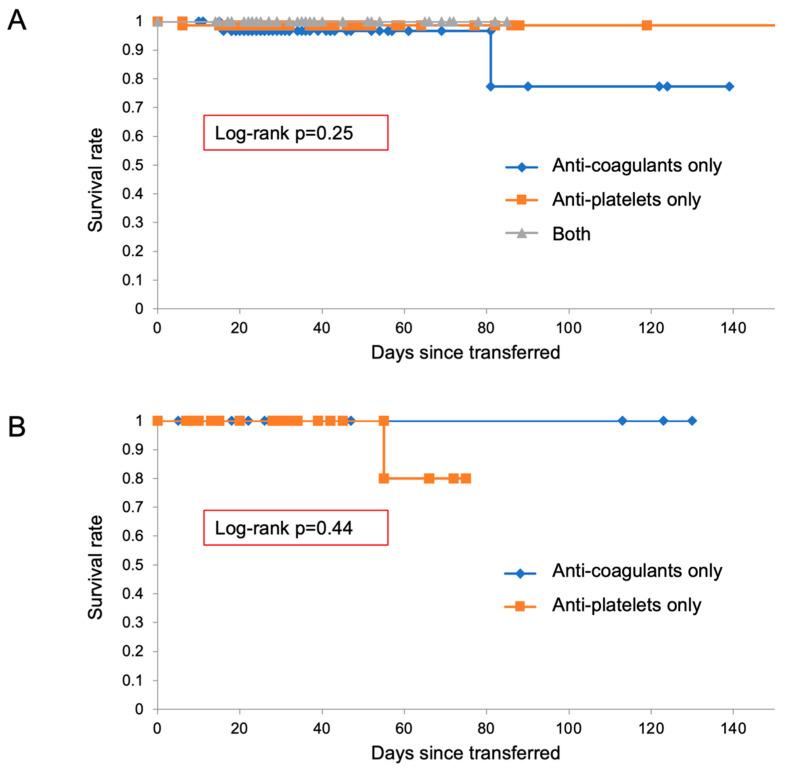
Acute aortic dissection occurs due to a primary tear in the aortic intima, with blood from the aortic lumen entering the adjacent diseased media. In the clinical setting, practitioners often hesitate before the use of anti-thrombotic drugs in the acute phase of aortic dissection. Therefore, we examined the clinical course in patients who had already received antithrombotic therapies at the onset of acute aortic dissection, and who were given anti-thrombotic drugs in the acute phase during hospitalization. We retrospectively enrolled 685 consecutive patients with acute aortic dissection (type A/B: 454/231), who were transferred to Kurume University Hospital from 2004 to 2020. In types A and B, there were no significant differences between in-hospital mortality with or without antithrombotic therapies at the onset (14.3% vs. 16.4%, p = 0.66 in type A, 2.6% vs. 7.3%, p = 0.29 in type B). Patients in type A who survived more than a day and were treated with anti-thrombotic drugs during hospitalization had significantly lower in-hospital mortality compared with those who received no anti-thrombotic drugs in the acute phase (2.2% vs. 16.1%, p < 0.001), while there was no significant difference between in-hospital mortality in the two type-B groups (2.4% vs. 4.9%, p = 0.48). Although there were variations in response among patients with acute aortic dissection, anti-thrombotic drugs did not worsen in-hospital mortality for patients with acute aortic dissection, indicating that medical staff should not hesitate to administer anti-thrombotic drugs if indicated.
急性主动脉夹层是由于主动脉内膜出现原发性撕裂,主动脉腔内的血液进入相邻病变的中膜所致。在临床实践中,医生在急性主动脉夹层急性期使用抗血栓药物时常常犹豫不决。因此,我们研究了在急性主动脉夹层发病时已经接受抗血栓治疗且在住院急性期接受抗血栓药物治疗的患者的临床病程。我们回顾性纳入了2004年至2020年期间连续转诊至久留米大学医院的685例急性主动脉夹层患者(A型/ B型:454/231)。在A型和B型中,发病时接受或未接受抗血栓治疗的患者住院死亡率无显著差异(A型:14.3% 对16.4%,p = 0.66;B型:2.6% 对7.3%,p = 0.29)。A型中存活超过一天且在住院期间接受抗血栓药物治疗的患者与急性期未接受抗血栓药物治疗的患者相比,住院死亡率显著降低(2.2% 对16.1%,p < 0.001),而B型两组的住院死亡率无显著差异(2.4% 对4.9%,p = 0.48)。尽管急性主动脉夹层患者的反应存在差异,但抗血栓药物并未增加急性主动脉夹层患者的住院死亡率,这表明医务人员在有指征时不应犹豫给予抗血栓药物。


 Zotero 插件