
荷叶生物碱、荷叶碱和去甲乌药碱对四氧嘧啶诱导的糖尿病白化大鼠的抗阿尔茨海默病及抗氧化作用
Anti-Alzheimer and Antioxidant Effects of L. Alkaloids, Nuciferine and Norcoclaurine in Alloxan-Induced Diabetic Albino Rats.
作者信息
Khan Shahnaz, Khan Hidayat Ullah, Khan Farman Ali, Shah Afzal, Wadood Abdul, Ahmad Shujaat, Almehmadi Mazen, Alsaiari Ahad Amer, Shah Farid Ullah, Kamran Naveed
机构信息
Department of Chemistry, University of Science and Technology, Bannu 28100, Khyber Pakhtunkhwa, Pakistan.
Department of Chemistry, Shaheed Benazir Bhutto University, Sheringal, Dir Upper 18000, Khyber Pakhtunkhwa, Pakistan.
出版信息
Pharmaceuticals (Basel). 2022 Sep 28;15(10):1205. doi: 10.3390/ph15101205.
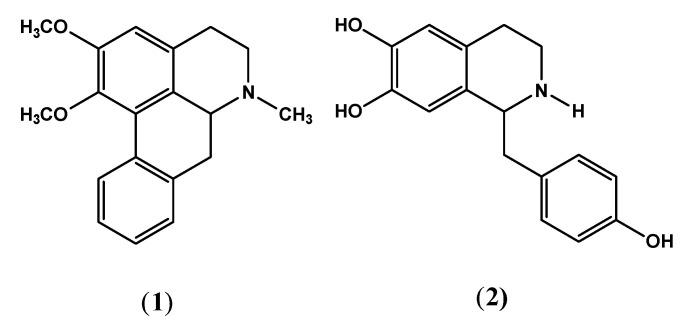
The present study is aimed to determine the efficacy and dose response of the nuciferine (1), norcoclaurine (2) and crude extract of Nelumbo nucifera in managements of diabetes, Alzheimer disease and related allergies. Experimentally, alloxan (100 mg/kg body weight (b.w.))-induced diabetic rats (200−250 g) were divided into seven groups (n = 6). Group I: normal control, Group II: diabetic control, Group III: standard treated with glibenclamide and Group lV-VII: treated with methanolic crude extracts (100, 200 mg/kg), nuciferine and norcoclaurine (10 mg/kg b.w.) for 15 days. Different tests were performed, including blood glucose, body weights and antioxidant enzyme assays, i.e., superoxide dismutase (SOD), catalase test (CAT), lipid peroxidation assay (TBARS), glutathione assay (GSH) and acetylcholinesterase (AChE) assay. Nuciferine and norcoclaurine significantly reduced blood glucose (p < 0.05) and restored body weight in diabetic rats. Moreover, nuciferine and norcoclaurine (10 mg/kg) significantly recovered the antioxidant enzymes (SOD, CAT, GPx and GSH) which decreased during induced diabetes. Significant increase in TBARS was also observed in the diabetic group and nuciferine as well as norcoclaurine (10 mg/kg) inhibited the increase in TBARS in diabetic animals (p < 0.05), as compared to glibenclamide. AChE activity was significantly recovered by nuciferine and norcoclaurine (10 mg/kg) both in the blood and brain of the diabetic group (p < 0.05). Nuciferine and norcoclaurine showed potent inhibitory effects against α-glucosidase and α-amylase with IC50, 19.06 ± 0.03, 15.03 ± 0.09 μM and 24.07 ± 0.05, 18.04 ± 0.021 μM, as confirmed by molecular docking studies. This study concludes that nuciferine and norcoclaurine significantly improve memory and could be considered as an effective phytomedicine for diabetes, Alzheimer’s disease (AD) and oxidative stress.
本研究旨在确定荷叶碱(1)、去甲乌药碱(2)和莲属植物粗提取物在糖尿病、阿尔茨海默病及相关过敏症治疗中的疗效和剂量反应。实验中,将用四氧嘧啶(100mg/kg体重)诱导的糖尿病大鼠(200-250g)分为七组(n = 6)。第一组:正常对照组;第二组:糖尿病对照组;第三组:用格列本脲标准治疗组;第四至七组:分别用甲醇粗提取物(100、200mg/kg)、荷叶碱和去甲乌药碱(10mg/kg体重)治疗15天。进行了不同的测试,包括血糖、体重和抗氧化酶测定,即超氧化物歧化酶(SOD)、过氧化氢酶测试(CAT)、脂质过氧化测定(TBARS)、谷胱甘肽测定(GSH)和乙酰胆碱酯酶(AChE)测定。荷叶碱和去甲乌药碱显著降低糖尿病大鼠的血糖(p < 0.05)并恢复体重。此外,荷叶碱和去甲乌药碱(10mg/kg)显著恢复了在诱导糖尿病期间降低的抗氧化酶(SOD、CAT、谷胱甘肽过氧化物酶和GSH)。糖尿病组中还观察到TBARS显著增加,与格列本脲相比,荷叶碱和去甲乌药碱(10mg/kg)抑制了糖尿病动物中TBARS的增加(p < 0.05)。荷叶碱和去甲乌药碱(10mg/kg)在糖尿病组的血液和大脑中均显著恢复了AChE活性(p < 0.05)。分子对接研究证实,荷叶碱和去甲乌药碱对α-葡萄糖苷酶和α-淀粉酶具有强效抑制作用,IC50分别为19.06±0.03、15.03±0.09μM和24.07±0.05、18.04±0.021μM。本研究得出结论,荷叶碱和去甲乌药碱可显著改善记忆力,可被视为治疗糖尿病、阿尔茨海默病(AD)和氧化应激的有效植物药。


 Zotero 插件