
在牙髓细菌感染体外模型中具有活性的抗菌肽可调节人心脏成纤维细胞中的炎症反应。
Antimicrobial Peptides Active in In Vitro Models of Endodontic Bacterial Infections Modulate Inflammation in Human Cardiac Fibroblasts.
作者信息
Marianantoni Giulia, Meogrossi Giada, Tollapi Eva, Rencinai Alessandro, Brunetti Jlenia, Marruganti Crystal, Gaeta Carlo, Pini Alessandro, Bracci Luisa, Ferrari Marco, Grandini Simone, Falciani Chiara
机构信息
Department of Medical Biotechnologies, University of Siena, 53100 Siena, Italy.
School of Dental Medicine, University of Siena, 53100 Siena, Italy.
出版信息
Pharmaceutics. 2022 Sep 29;14(10):2081. doi: 10.3390/pharmaceutics14102081.
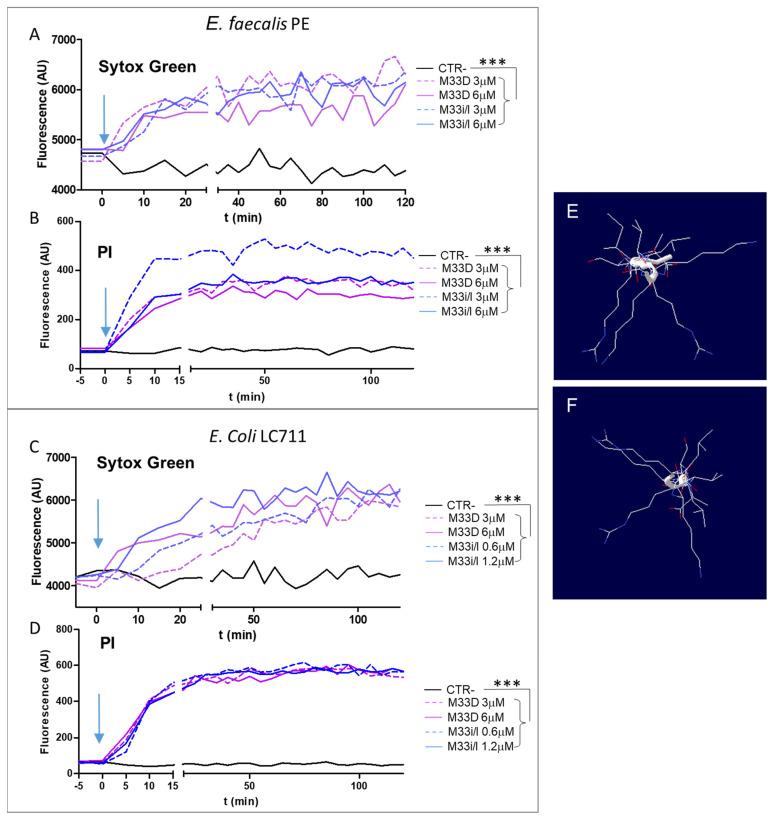
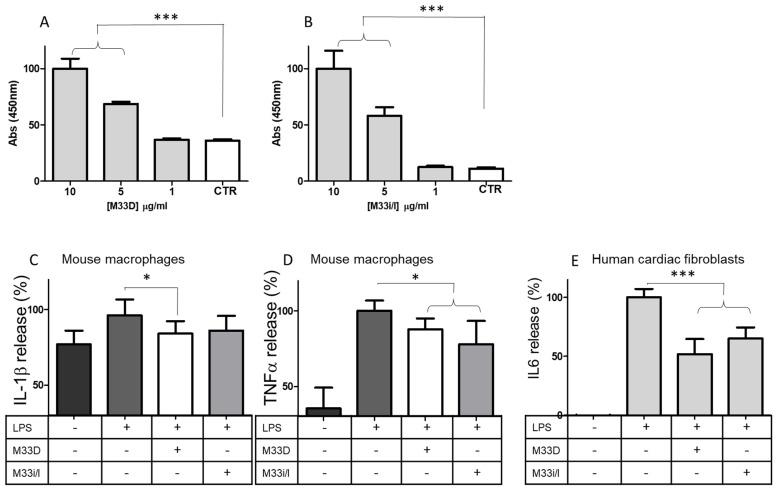
Endodontic and periodontal disease are conditions of infectious origin that can lead to tooth loss or develop into systemic hyperinflammation, which may be associated with a wide variety of diseases, including cardiovascular. Endodontic and periodontal treatment often relies on antibiotics. Since new antimicrobial resistances are a major threat, the use of standard antibiotics is not recommended when the infection is only local. Antimicrobial peptides were recently demonstrated to be valid alternatives for dental treatments. The antimicrobial peptide M33D is a tetrabranched peptide active against Gram-negative and Gram-positive bacteria. It has a long life, unusual for peptides, because its branched form provides resistance to proteases. Here the efficacy of M33D and of its analog M33i/l as antibiotics for local use in dentistry was evaluated. M33D and M33i/l were active against reference strains and multidrug-resistant clinical isolates of Gram-negative and Gram-positive species. Their minimum inhibitory concentration against different strains of dental interest was between 0.4 and 6.0 μM. Both peptides acted rapidly on bacteria, impairing membrane function. They also disrupted biofilm effectively. Disinfection of the root canal is crucial for endodontic treatments. M33D and M33i/l reduced colonies to one-twentieth in a dentin slices model reproducing root canal irrigation. They both captured and neutralized lipopolysaccharide (LPS), a bacterial toxin responsible for inflammation. The release of IL-1β and TNFα by LPS-stimulated murine macrophages was reduced by both peptides. Human cardiac fibroblasts respond to different insults with the release of proinflammatory cytokines, and consequently, they are considered directly involved in atherogenic cardiovascular processes, including those triggered by infections. The presence of M33D and M33i/l at MIC concentration reduced IL6 release from LPS- stimulated human cardiac fibroblasts, hence proving to be promising in preventing bacteria-induced atherogenesis. The two peptides showed low toxicity to mammalian cells, with an EC50 one order of magnitude higher than the average MIC and low hemolytic activity. The development of antimicrobial peptides for dental irrigations and medication is a very promising new field of research that will provide tools to fight dental infections and their severe consequences, while at the same time protecting standard antibiotics from new outbreaks of antimicrobial resistance.
牙髓病和牙周病是起源于感染的病症,可导致牙齿脱落或发展为全身性炎症反应增强,这可能与包括心血管疾病在内的多种疾病相关。牙髓病和牙周病的治疗通常依赖抗生素。由于新出现的抗菌耐药性是一个重大威胁,因此当感染仅为局部感染时,不建议使用标准抗生素。抗菌肽最近被证明是牙科治疗的有效替代物。抗菌肽M33D是一种对革兰氏阴性菌和革兰氏阳性菌均有活性的四分支肽。它具有较长的寿命,这对肽来说并不常见,因为其分支形式使其对蛋白酶具有抗性。在此,评估了M33D及其类似物M33i/l作为牙科局部用抗生素的疗效。M33D和M33i/l对革兰氏阴性菌和革兰氏阳性菌的参考菌株及多重耐药临床分离株均有活性。它们对不同牙科相关菌株的最低抑菌浓度在0.4至6.0 μM之间。两种肽对细菌作用迅速,损害膜功能。它们还能有效破坏生物膜。根管消毒对牙髓病治疗至关重要。在模拟根管冲洗的牙本质切片模型中,M33D和M33i/l将菌落数量减少至二十分之一。它们都能捕获并中和脂多糖(LPS),一种导致炎症的细菌毒素。两种肽都能减少LPS刺激的小鼠巨噬细胞释放IL-1β和TNFα。人心脏成纤维细胞会因不同刺激而释放促炎细胞因子,因此被认为直接参与致动脉粥样硬化的心血管过程,包括由感染引发的过程。在MIC浓度下,M33D和M33i/l的存在可减少LPS刺激的人心脏成纤维细胞释放IL6,因此在预防细菌诱导的动脉粥样硬化方面显示出前景。这两种肽对哺乳动物细胞显示出低毒性,其半数有效浓度(EC50)比平均最低抑菌浓度高一个数量级,且溶血活性低。开发用于牙科冲洗和给药的抗菌肽是一个非常有前景的新研究领域,这将为对抗牙科感染及其严重后果提供工具,同时保护标准抗生素免受新出现的抗菌耐药性爆发的影响。



 Zotero 插件