
匹配滤波器对 CNN 分类器的解释及其在 HAR 中的应用。
Matched Filter Interpretation of CNN Classifiers with Application to HAR.
机构信息
Electrical Engineering Department, College of Engineering, King Faisal University, Al-Ahsa 31982, Saudi Arabia.
Electrical Engineering Department, Faculty of Engineering, Alexandria University, Alexandria 5424041, Egypt.
出版信息
Sensors (Basel). 2022 Oct 21;22(20):8060. doi: 10.3390/s22208060.
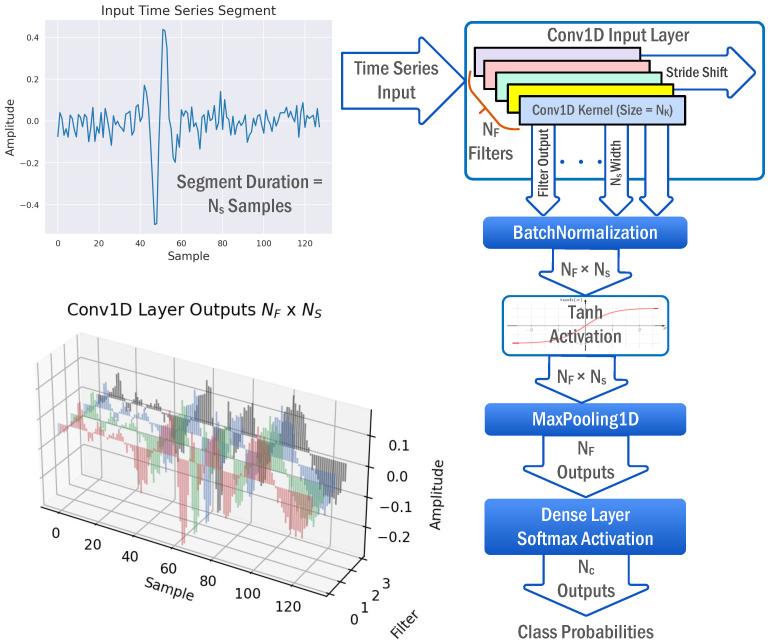
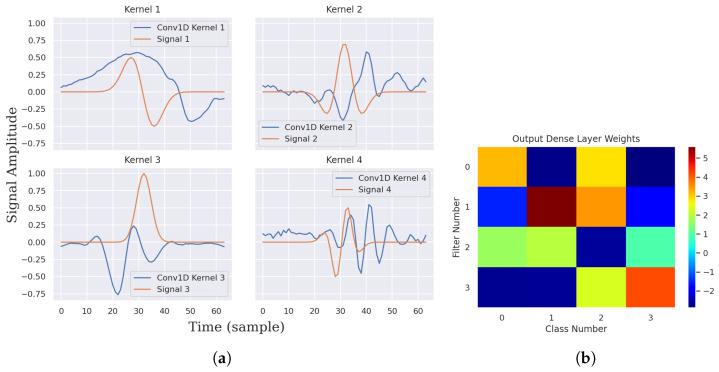
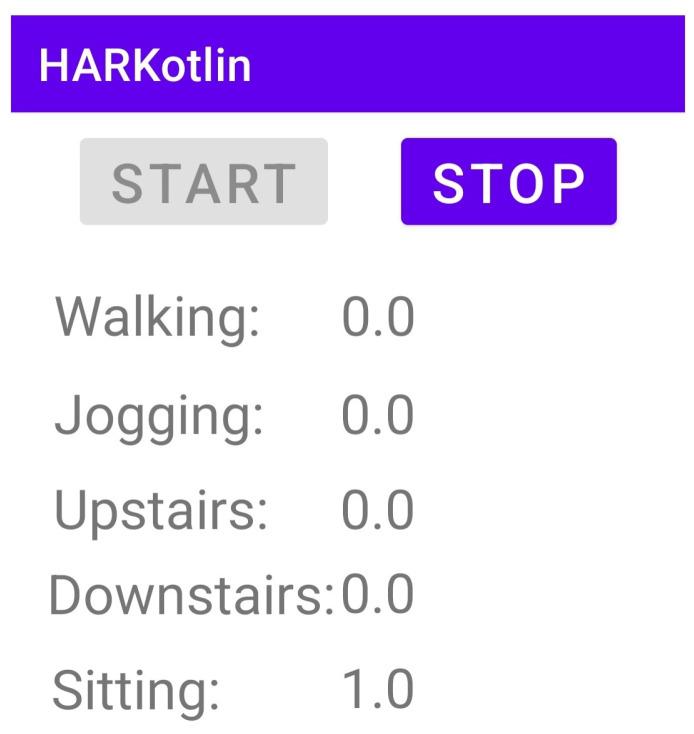
Time series classification is an active research topic due to its wide range of applications and the proliferation of sensory data. Convolutional neural networks (CNNs) are ubiquitous in modern machine learning (ML) models. In this work, we present a matched filter (MF) interpretation of CNN classifiers accompanied by an experimental proof of concept using a carefully developed synthetic dataset. We exploit this interpretation to develop an MF CNN model for time series classification comprising a stack of a Conv1D layer followed by a GlobalMaxPooling layer acting as a typical MF for automated feature extraction and a fully connected layer with softmax activation for computing class probabilities. The presented interpretation enables developing superlight highly accurate classifier models that meet the tight requirements of edge inference. Edge inference is emerging research that addresses the latency, availability, privacy, and connectivity concerns of the commonly deployed cloud inference. The MF-based CNN model has been applied to the sensor-based human activity recognition (HAR) problem due to its significant importance in a broad range of applications. The UCI-HAR, WISDM-AR, and MotionSense datasets are used for model training and testing. The proposed classifier is tested and benchmarked on an android smartphone with average accuracy and F1 scores of 98% and 97%, respectively, which outperforms state-of-the-art HAR methods in terms of classification accuracy and run-time performance. The proposed model size is less than 150 KB, and the average inference time is less than 1 ms. The presented interpretation helps develop a better understanding of CNN operation and decision mechanisms. The proposed model is distinguished from related work by jointly featuring interpretability, high accuracy, and low computational cost, enabling its ready deployment on a wide set of mobile devices for a broad range of applications.
时间序列分类是一个活跃的研究课题,因为它具有广泛的应用和大量的传感器数据。卷积神经网络 (CNN) 在现代机器学习 (ML) 模型中无处不在。在这项工作中,我们提出了一种卷积神经网络分类器的匹配滤波器 (MF) 解释,并通过使用精心开发的合成数据集进行实验证明了这一解释。我们利用这种解释来开发一种用于时间序列分类的 MF CNN 模型,该模型由一个 Conv1D 层堆栈组成,后面跟着一个 GlobalMaxPooling 层,作为自动特征提取的典型 MF,以及一个具有 softmax 激活的全连接层,用于计算类概率。所提出的解释能够开发出超轻量级、高精度的分类器模型,满足边缘推理的严格要求。边缘推理是一项新兴的研究,旨在解决通常部署的云推理的延迟、可用性、隐私和连接性问题。基于 MF 的 CNN 模型已经应用于基于传感器的人体活动识别 (HAR) 问题,因为它在广泛的应用中具有重要意义。UCI-HAR、WISDM-AR 和 MotionSense 数据集用于模型训练和测试。所提出的分类器在具有平均准确率和 F1 分数分别为 98%和 97%的安卓智能手机上进行了测试和基准测试,在分类准确率和运行时性能方面优于最先进的 HAR 方法。所提出的模型大小小于 150KB,平均推理时间小于 1ms。所提出的解释有助于更好地理解 CNN 的操作和决策机制。所提出的模型通过具有可解释性、高精度和低计算成本的特点,与相关工作区分开来,使其能够在广泛的移动设备上进行部署,用于广泛的应用。





 Zotero 插件