
成纤维细胞性肝细胞癌对融合激酶 DNAJB1-PRKACA 的致癌性成瘾。
Oncogenic Addiction of Fibrolamellar Hepatocellular Carcinoma to the Fusion Kinase DNAJB1-PRKACA.
机构信息
Laboratory of Cellular Biophysics, The Rockefeller University, New York, New York.
Hospital Biostatistics, The Rockefeller University, New York, New York.
出版信息
Clin Cancer Res. 2023 Jan 4;29(1):271-278. doi: 10.1158/1078-0432.CCR-22-1851.
PURPOSE
Gene fusions are drivers of many pediatric tumors. In fibrolamellar hepatocellular carcinoma (FLC), a fusion of DNAJB1 and PRKACA is the dominant recurrent mutation. Expression of the DNAJB1-PRKACA fusion gene in mice results in a tumor that recapitulates FLC. However, it is not known whether transient expression of DNAJB1-PRKACA is sufficient only to trigger tumor formation or whether ongoing expression is necessary for maintenance and progression.
EXPERIMENTAL DESIGN
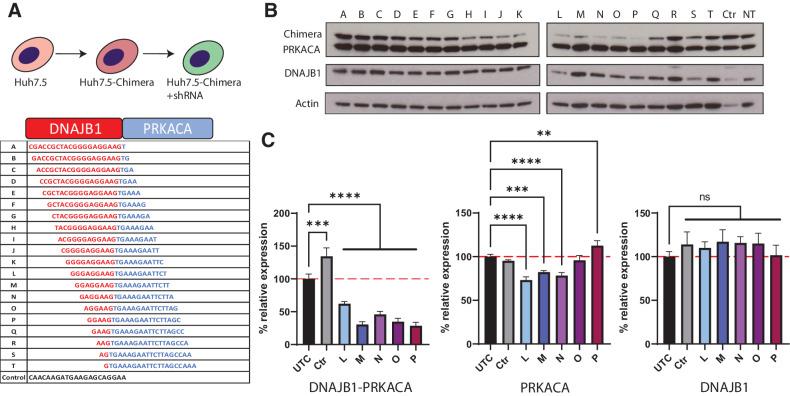
We screened short hairpin RNAs (shRNA) tiled over the fusion junction and identified several potent and specific candidates in vitro and two independent FLC patient-derived xenografts (PDX).
RESULTS
We show that continued DNAJB1-PRKACA expression is not only required for continued tumor growth, but additionally its inhibition results in cell death. Inhibition of DNAJB1-PRKACA by an inducible shRNA in cells of PDX of FLC resulted in cell death in vitro. Induction of the shRNA inhibits FLC tumors growing in mice with no effect on xenografts from a hepatocellular carcinoma cell line engineered to express DNAJB1-PRKACA.
CONCLUSIONS
Our results validate DNAJB1-PRKACA as the oncogene in FLC and demonstrate both a continued requirement for the oncogene for tumor growth as well as an oncogenic addiction that can be exploited for targeted therapies. We anticipate our approach will be useful for investigations of other fusion genes in pediatric cancers and spur development of precision therapies.
目的
基因融合是许多儿科肿瘤的驱动因素。在纤维板层肝细胞癌(FLC)中,DNAJB1 和 PRKACA 的融合是主要的复发性突变。在小鼠中表达 DNAJB1-PRKACA 融合基因可导致重现 FLC 的肿瘤。然而,尚不清楚瞬时表达 DNAJB1-PRKACA 是否足以触发肿瘤形成,还是持续表达对于维持和进展是必要的。
实验设计
我们筛选了融合连接处的短发夹 RNA(shRNA)并在体外和两个独立的 FLC 患者来源的异种移植(PDX)中鉴定了几个有效且特异的候选物。
结果
我们表明,持续的 DNAJB1-PRKACA 表达不仅是持续肿瘤生长所必需的,而且其抑制还会导致细胞死亡。在 FLC 的 PDX 细胞中,通过诱导型 shRNA 抑制 DNAJB1-PRKACA 会导致体外细胞死亡。诱导 shRNA 抑制在小鼠中生长的 FLC 肿瘤,但对表达 DNAJB1-PRKACA 的肝细胞癌细胞系工程化的异种移植物没有影响。
结论
我们的结果验证了 DNAJB1-PRKACA 是 FLC 中的致癌基因,并证明了该致癌基因对于肿瘤生长的持续需求以及可以被利用进行靶向治疗的致癌成瘾。我们预计我们的方法将对儿科癌症中其他融合基因的研究有用,并促进精准治疗的发展。



 Zotero 插件