
生物信息学与元宇宙:我们准备好了吗?
Bioinformatics and the Metaverse: Are We Ready?
作者信息
Taylor Stephen, Soneji Shamit
机构信息
Analysis, Visualization and Informatics Group, MRC Weatherall Institute of Computational Biology, MRC Weatherall Institute of Molecular Medicine, Oxford, United Kingdom.
Division of Molecular Hematology, Department of Laboratory Medicine, Faculty of Medicine, BMC, Lund University, Lund, Sweden.
出版信息
Front Bioinform. 2022 May 12;2:863676. doi: 10.3389/fbinf.2022.863676. eCollection 2022.
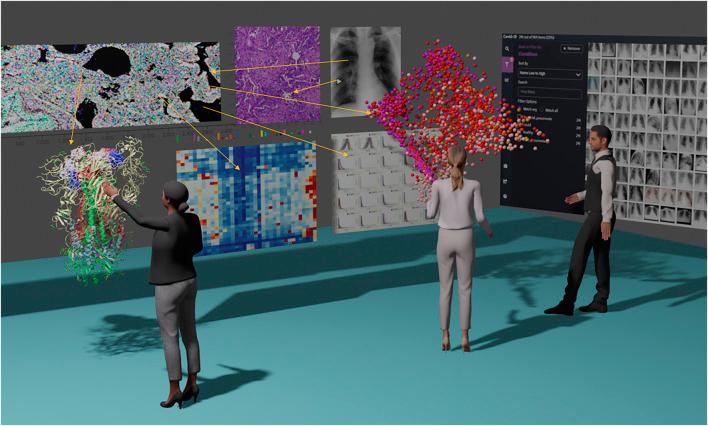
COVID-19 forced humanity to think about new ways of working globally without physically being present with other people, and eXtended Reality (XR) systems (defined as Virtual Reality, Augmented Reality and Mixed Reality) offer a potentially elegant solution. Previously seen as mainly for gaming, commercial and research institutions are investigating XR solutions to solve real world problems from training, simulation, mental health, data analysis, and studying disease progression. More recently large corporations such as Microsoft and Meta have announced they are developing the Metaverse as a new paradigm to interact with the digital world. This article will look at how visualization can leverage the Metaverse in bioinformatics research, the pros and cons of this technology, and what the future may hold.
新冠疫情迫使人类思考在无法与他人实际共处的情况下进行全球协作的新方式,而扩展现实(XR)系统(定义为虚拟现实、增强现实和混合现实)提供了一个可能精妙的解决方案。XR系统此前主要被视为用于游戏,如今商业和研究机构正在研究利用XR系统来解决现实世界中的问题,涵盖培训、模拟、心理健康、数据分析以及研究疾病进展等领域。最近,微软和Meta等大公司宣布,它们正在将元宇宙开发为一种与数字世界交互的新范式。本文将探讨可视化如何在生物信息学研究中利用元宇宙,这项技术的优缺点,以及未来可能的发展。
 Zotero 插件