
山奈酚与黏菌素联合应用对耐黏菌素革兰氏阴性菌的抗菌活性。
The Antibacterial Activity of Kaempferol Combined with Colistin against Colistin-Resistant Gram-Negative Bacteria.
机构信息
Department of Clinical Laboratory, Key Laboratory of Clinical Laboratory Diagnosis and Translational Research of Zhejiang Province, The First Affiliated Hospital of Wenzhou Medical Universitygrid.268099.c, Wenzhou, China.
Department of Medical Laboratory Science, School of Laboratory Medicine and Life Science, Wenzhou Medical Universitygrid.268099.c, Wenzhou, Zhejiang Province, People's Republic of China.
出版信息
Microbiol Spectr. 2022 Dec 21;10(6):e0226522. doi: 10.1128/spectrum.02265-22. Epub 2022 Oct 31.
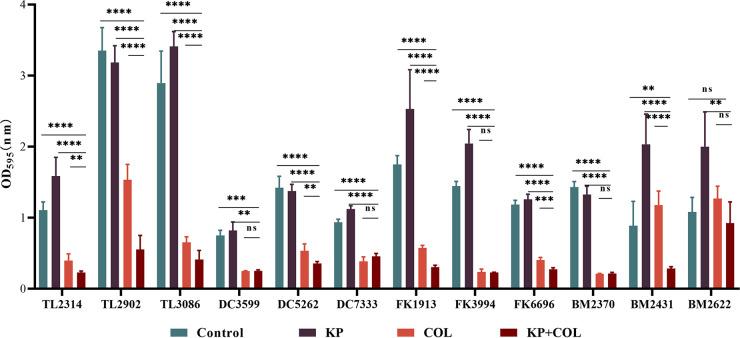
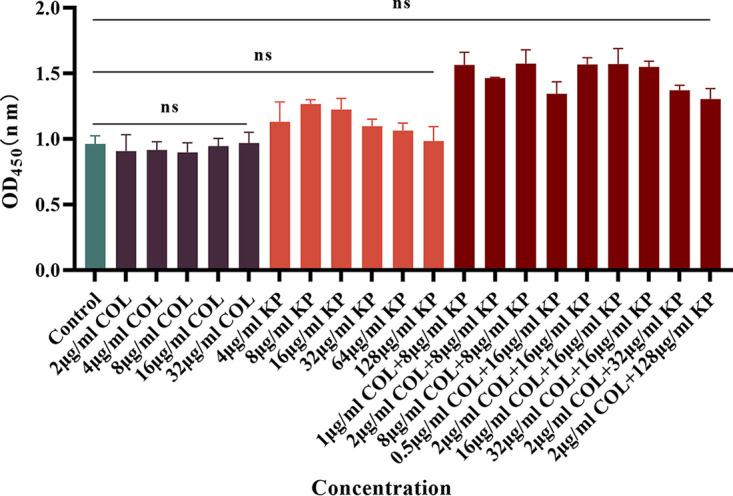
Social hygiene is seriously threatened by the rise in colistin (COL) resistance against Gram-negative bacteria (GNB). With resistance to last-line antibiotics such as COL becoming more common, it is imperative to identify alternative treatment options. In our work, we sought to determine if COL plus kaempferol (KP) present synergistic effects on the antibacterial and antibiofilm activities against colistin-resistant (Col-R) GNB and . Twenty-four Col-R GNB were collected as the experimental strains. The synergistic activity of COL and KP was evaluated by checkerboard method, time-killing assays, and the Galleria mellonella experiment. The antibiofilm effectiveness of the COL/KP combination against Col-R GNB was assessed using biofilm inhibition and eradication assays and scanning electron microscopy (SEM). Cytotoxicity tests were performed to detect the toxicity of KP monotherapy or combination therapy. There is synergistic antibacterial activity of COL and KP combination . KP combined with COL could inhibit the formation of bacterial biofilms. The amalgamation of COL and KP considerably reduced the amount of bacteria in the biofilm, according to the SEM findings. The COL/KP combination improved the survivorship of infected larvae in the G. mellonella infection model. In addition, the combination of KP and COL showed no cytotoxicity at synergistic combined concentrations according to cytotoxicity assays. This represents the first account of the antibacterial and antibiofilm activities of KP in combination with COL against Col-R GNB. Therefore, our results may provide an effective alternative route to combat Col-R GNB infections. COL is one of the few antibiotics effective against clinical isolates of GNB. However, in recent years, GNB resistance to colistin has been increasing. As a result, the combined application of colistin in conjunction with nonantibacterial medications has garnered considerable interest. In this work, the KP/COL combination showed effective antibacterial and antibiofilm activities and . The synergistic effect of combined application may be attributed to membrane permeability. Due to the low cytotoxicity of the combined concentration, the combination exhibits a promising future for use in clinical anti-infection treatments. This finding might broaden the potential applications for COL.
社会卫生正受到革兰氏阴性菌(GNB)中多粘菌素耐药性上升的严重威胁。随着对多粘菌素等最后一线抗生素的耐药性变得越来越普遍,必须确定替代治疗方案。在我们的工作中,我们试图确定多粘菌素加山奈酚(KP)对耐多粘菌素(Col-R)GNB 的抗菌和抗生物膜活性是否具有协同作用。收集了 24 株 Col-R GNB 作为实验菌株。通过棋盘法、时间杀伤试验和大蜡螟实验评估 COL 和 KP 的协同活性。采用生物膜抑制和清除试验及扫描电子显微镜(SEM)评估 COL/KP 联合用药对 Col-R GNB 的抗生物膜效果。进行细胞毒性试验以检测 KP 单药或联合用药的毒性。COL 和 KP 联合用药具有协同抗菌活性。KP 联合 COL 可抑制细菌生物膜的形成。根据 SEM 结果,COL 和 KP 的联合使用大大减少了生物膜中的细菌数量。COL/KP 联合用药可提高大蜡螟感染模型中感染幼虫的存活率。此外,根据细胞毒性试验,协同联合浓度下的 KP 和 COL 联合用药无细胞毒性。这代表了首次报道 KP 与 COL 联合对 Col-R GNB 的抗菌和抗生物膜活性。因此,我们的研究结果可能为治疗 Col-R GNB 感染提供一种有效的替代途径。多粘菌素是少数几种对 GNB 临床分离株有效的抗生素之一。然而,近年来,GNB 对多粘菌素的耐药性不断增加。因此,联合应用多粘菌素与非抗菌药物引起了广泛关注。在这项工作中,KP/COL 联合用药表现出有效的抗菌和抗生物膜活性。联合应用的协同效应可能归因于膜通透性。由于联合浓度的细胞毒性低,该联合具有在临床抗感染治疗中应用的广阔前景。这一发现可能拓宽了 COL 的潜在应用。



 Zotero 插件