
姜黄素/壳聚糖包覆绿色银纳米粒子的抗肝纤维化活性。
Anti-liver fibrosis activity of curcumin/chitosan-coated green silver nanoparticles.
机构信息
Zoology Department, Faculty of Science, Damietta University, New Damietta, Egypt.
Faculty of Science, Damietta University, New Damietta, 34517, Egypt.
出版信息
Sci Rep. 2022 Nov 1;12(1):18403. doi: 10.1038/s41598-022-23276-9.
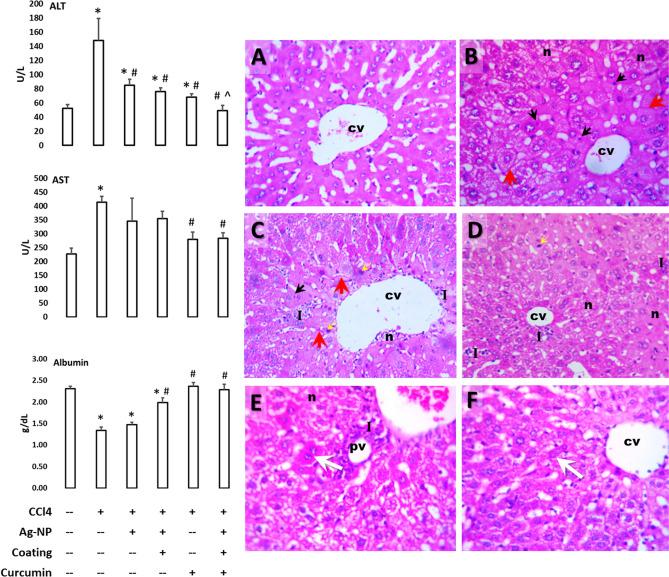
Liver fibrosis results from the hepatic accumulation of the extracellular matrix accompanied by a failure of the mechanisms responsible for matrix dissolution. Pathogenesis of liver fibrosis is associated with many proteins from different cell types. In the present study, in silico molecular docking analysis revealed that curcumin may inhibit the fibrosis-mediating proteins PDGF, PDGFRB, TIMP-1, and TLR-9 by direct binding. Nano-formulation can overcome curcumin problems, increasing the efficacy of curcumin as a drug by maximizing its solubility and bioavailability, enhancing its membrane permeability, and improving its pharmacokinetics, pharmacodynamics and biodistribution. Therefore, green silver nanoparticles (AgNPs) were synthesized in the presence of sunlight by means of the metabolite of Streptomyces malachiticus, and coated with curcumin-chitosan mixture to serve as a drug delivery tool for curcumin to target CCl-induced liver fibrosis mouse model. Fibrosis induction significantly increased hepatic gene expression of COL1A1, α-SMA, PDGFRB, and TIMP1, elevated hepatic enzymes, increased histopathological findings, and increased collagen deposition as determined by Mason's trichrome staining. Treatment with naked AgNPs tended to increase these inflammatory effects, while their coating with chitosan, similar to treatment with curcumin only, did not prevent the fibrogenic effect of CCl. The induction of liver fibrosis was reversed by concurrent treatment with curcumin/chitosan-coated AgNPs. In this nano form, curcumin was found to be efficient as anti-liver fibrosis drug, maintaining the hepatic architecture and function during fibrosis development. This efficacy can be attributed to its inhibitory role through a direct binding to fibrosis-mediating proteins such as PDGFRB, TIMP-1, TLR-9 and TGF-β.
肝纤维化是由于细胞外基质在肝脏中的积累,同时负责基质溶解的机制失效导致的。肝纤维化的发病机制与许多不同细胞类型的蛋白质有关。在本研究中,通过计算机分子对接分析表明姜黄素可能通过直接结合抑制纤维化介导的蛋白质 PDGF、PDGFRB、TIMP-1 和 TLR-9。纳米制剂可以克服姜黄素的问题,通过最大限度地提高其溶解度和生物利用度、增强其膜通透性以及改善其药代动力学、药效学和生物分布来增强姜黄素作为药物的功效。因此,在阳光的存在下,通过 Streptomyces malachiticus 的代谢物合成了绿色的银纳米颗粒(AgNPs),并用姜黄素-壳聚糖混合物进行涂层,作为姜黄素靶向 CCl 诱导的肝纤维化小鼠模型的药物递送工具。纤维化诱导显著增加了 COL1A1、α-SMA、PDGFRB 和 TIMP1 的肝基因表达,升高了肝酶,增加了组织病理学发现,并通过 Mason 三色染色确定增加了胶原沉积。裸 AgNPs 的治疗有增加这些炎症作用的趋势,而用壳聚糖对其进行涂层,与仅用姜黄素治疗一样,不能阻止 CCl 的纤维形成作用。同时用姜黄素/壳聚糖包被的 AgNPs 治疗可逆转肝纤维化的诱导。在这种纳米形式下,姜黄素作为抗肝纤维化药物是有效的,在纤维化发展过程中维持肝脏结构和功能。这种功效可以归因于其通过直接结合纤维化介导的蛋白质如 PDGFRB、TIMP-1、TLR-9 和 TGF-β 发挥抑制作用。



 Zotero 插件