
冠状病毒 2 型 ORF7a 的泛素化通过募集 BclXL 激活内质网应激来防止细胞死亡。
Ubiquitination of SARS-CoV-2 ORF7a Prevents Cell Death Induced by Recruiting BclXL To Activate ER Stress.
机构信息
Department of Infectious Diseases, Renmin Hospital, School of Basic Medical Sciences, Hubei University of Medicine, Shiyan, China.
Institute of Virology, Hubei University of Medicine, Shiyan, China.
出版信息
Microbiol Spectr. 2022 Dec 21;10(6):e0150922. doi: 10.1128/spectrum.01509-22. Epub 2022 Nov 3.
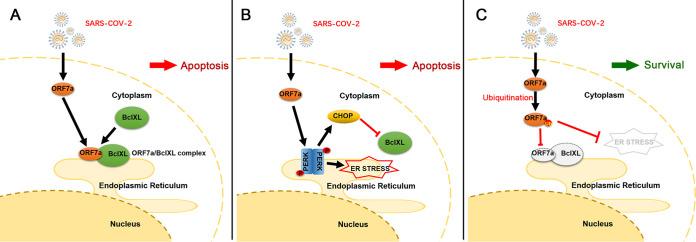
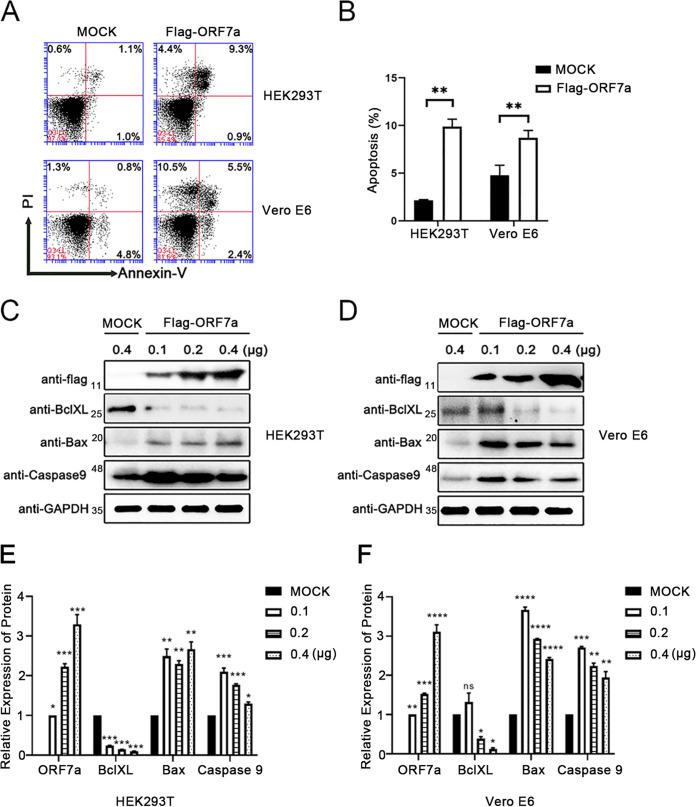
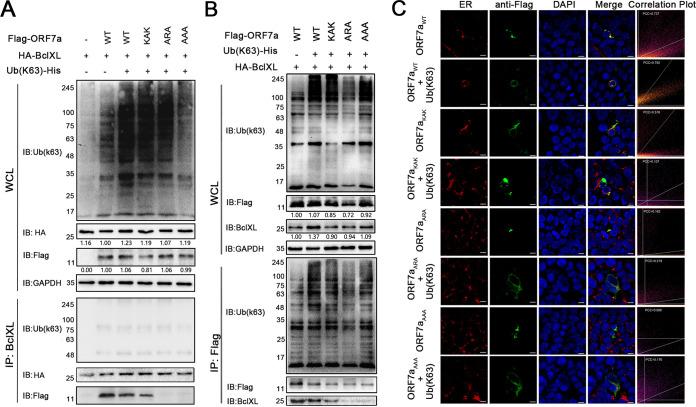
Severe acute respiratory syndrome coronavirus 2 (SARS-CoV-2) is the causative agent of coronavirus disease 2019 (COVID-19), which has emerged in the last 2 years. The accessory protein ORF7a has been proposed as an immunomodulating factor that can cause dramatic inflammatory responses, but it is unknown how ORF7a interacts with host cells. We show that ORF7a induces cell apoptosis by recruiting the prosurvival factor BclXL to the endoplasmic reticulum (ER) via the exposed C-terminal residues Lys117 and Lys119. Simultaneously, ORF7a activates ER stress via the PERK-elF2α-CHOP pathway and inhibits the expression of endogenous BclXL, resulting in enhanced cell apoptosis. Ubiquitination of ORF7a interrupts the interaction with BclXL in the ER and weakens the activation of ER stress, which to some extent rescues the cells. Our work demonstrates that SARS-CoV-2 ORF7a hires antiapoptosis protein and aggregates on the ER, resulting in ER stress and apoptosis initiation. On the other hand, ORF7a utilizes the ubiquitin system to impede and escape host elimination, providing a promising potential target for developing strategies for minimizing the COVID-19 pandemic. Viruses struggle to reproduce after infecting cells, and the host eliminates infected cells through apoptosis to prevent virus spread. Cells adopt a special ubiquitination code to protect against viral infection, while ORF7a manipulates and exploits the ubiquitin system to eliminate host cells' effect on apoptosis and redirect cellular pathways in favor of virus survival. Our results revealed that SARS-CoV-2-encoded accessory protein ORF7a recruits prosurvival factor BclXL to the ER and activates the cellular ER stress response resulting in the initiation of programmed death to remove virus-infected cells. Ubiquitination of ORF7a blocked the recruitment of BclXL and suppressed the ER stress response, which helps to counteract cell apoptosis and rescue cell fate. These findings help us understand the mechanism of SARS-CoV-2 invasion and contribute to a theoretical foundation for the clinical prevention of COVID-19.
严重急性呼吸综合征冠状病毒 2(SARS-CoV-2)是导致 2019 年冠状病毒病(COVID-19)的病原体,它在过去 2 年中出现。ORF7a 辅助蛋白被提议为一种免疫调节因子,可引起剧烈的炎症反应,但 ORF7a 如何与宿主细胞相互作用尚不清楚。我们表明,ORF7a 通过暴露的 C 末端残基 Lys117 和 Lys119 将生存因子 BclXL 募集到内质网(ER),从而诱导细胞凋亡。同时,ORF7a 通过 PERK-elF2α-CHOP 途径激活 ER 应激,并抑制内源性 BclXL 的表达,导致细胞凋亡增强。ORF7a 的泛素化中断了与 ER 中 BclXL 的相互作用,并减弱了 ER 应激的激活,从而在某种程度上挽救了细胞。我们的工作表明,SARS-CoV-2 ORF7a 雇用抗凋亡蛋白并在内质网上聚集,导致 ER 应激和凋亡起始。另一方面,ORF7a 利用泛素系统来阻碍和逃避宿主消除,为开发最大限度减少 COVID-19 大流行的策略提供了有前途的潜在目标。病毒感染细胞后很难繁殖,宿主通过凋亡消除感染细胞以防止病毒传播。细胞采用特殊的泛素化密码来防止病毒感染,而 ORF7a 操纵和利用泛素系统来消除宿主细胞对凋亡的影响,并将细胞途径重定向以有利于病毒存活。我们的结果表明,SARS-CoV-2 编码的辅助蛋白 ORF7a 将生存因子 BclXL 募集到内质网并激活细胞内质网应激反应,从而启动程序性死亡以去除病毒感染的细胞。ORF7a 的泛素化阻断了 BclXL 的募集并抑制了 ER 应激反应,有助于对抗细胞凋亡并挽救细胞命运。这些发现有助于我们理解 SARS-CoV-2 入侵的机制,并为 COVID-19 的临床预防提供理论基础。



 Zotero 插件