
CXD101 联合纳武利尤单抗治疗转移性微卫星稳定结直肠癌患者(CAROSELL):一项多中心、开放标签、单臂、Ⅱ期临床试验。
CXD101 and nivolumab in patients with metastatic microsatellite-stable colorectal cancer (CAROSELL): a multicentre, open-label, single-arm, phase II trial.
机构信息
The Christie NHS Foundation Trust, Manchester, UK.
The Beatson West of Scotland Cancer Centre, Glasgow, UK.
出版信息
ESMO Open. 2022 Dec;7(6):100594. doi: 10.1016/j.esmoop.2022.100594. Epub 2022 Oct 27.
BACKGROUND
Patients with microsatellite stable (MSS) colorectal carcinoma (CRC) do not respond to immune checkpoint inhibitors. Preclinical models suggested synergistic anti-tumour activity combining CXD101 and anti-programmed cell death protein 1 treatment; therefore, we assessed the clinical combination of CXD101 and nivolumab in heavily pre-treated patients with MSS metastatic CRC (mCRC).
PATIENTS AND METHODS
This single-arm, open-label study enrolled patients aged 18 years or older with biopsy-confirmed MSS CRC; at least two lines of systemic anticancer therapies (including oxaliplatin and irinotecan); at least one measurable lesion; Eastern Cooperative Oncology Group performance status of 0, 1 or 2; predicted life expectancy above 3 months; and adequate organ and bone marrow function. Nine patients were enrolled in a safety run-in study to define a tolerable combination schedule of CXD101 and nivolumab, followed by 46 patients in the efficacy assessment phase. Patients in the efficacy assessment cohort were treated orally with 20 mg CXD101 twice daily for 5 consecutive days every 3 weeks, and intravenously with 240 mg nivolumab every 2 weeks. The primary endpoint was immune disease control rate (iDCR).
RESULTS
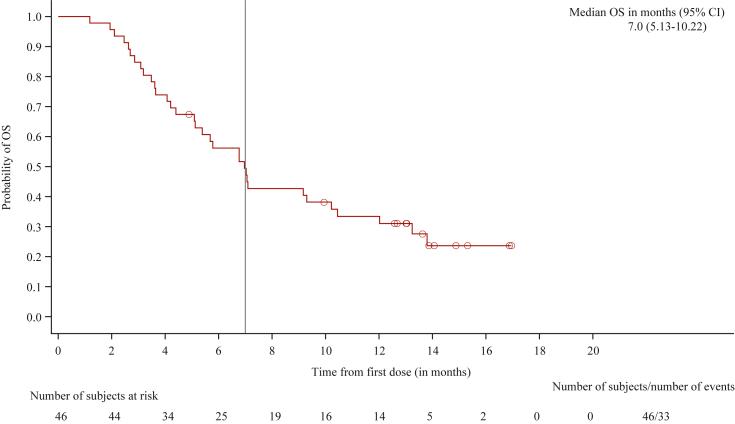
Between 2018 and 2020, 55 patients were treated with CXD101 and nivolumab. The combination therapy was well tolerated with the most frequent grade 3 or 4 adverse events being neutropenia (18%) and anaemia (7%). Immune-related adverse reactions commonly ascribed to checkpoint inhibitors were surprisingly rare although we did see single cases of pneumonitis, hypothyroidism and hypopituitarism. There were no treatment-related deaths. Of 46 patients assessable for efficacy, 4 (9%) achieved partial response and 18 (39%) achieved stable disease, translating to an immune disease control rate of 48%. The median overall survival (OS) was 7.0 months (95% confidence interval 5.13-10.22 months).
CONCLUSIONS
The primary endpoint was met in this phase II study, which showed that the combination of CXD101 and nivolumab, at full individual doses in the treatment of advanced or metastatic MSS CRC, was both well tolerated and efficacious.
背景
微卫星稳定(MSS)结直肠癌(CRC)患者对免疫检查点抑制剂无反应。临床前模型表明,联合使用 CXD101 和抗程序性细胞死亡蛋白 1 治疗具有协同抗肿瘤活性;因此,我们评估了 CXD101 联合纳武利尤单抗在 MSS 转移性 CRC(mCRC)中大量预处理患者中的临床联合应用。
患者和方法
这项单臂、开放标签研究纳入了年龄在 18 岁及以上、经活检证实的 MSS CRC 患者;至少接受过两线系统抗癌治疗(包括奥沙利铂和伊立替康);至少有一个可测量的病变;东部肿瘤协作组体能状态为 0、1 或 2 级;预计生存期超过 3 个月;且器官和骨髓功能充足。9 例患者入组安全性入组研究以确定 CXD101 和纳武利尤单抗的可耐受联合方案,随后 46 例患者进入疗效评估阶段。疗效评估队列中的患者接受口服 20mg CXD101 每日两次,连续 5 天,每 3 周一次,静脉注射 240mg 纳武利尤单抗,每 2 周一次。主要终点是免疫疾病控制率(iDCR)。
结果
2018 年至 2020 年,55 例患者接受了 CXD101 和纳武利尤单抗治疗。联合治疗耐受性良好,最常见的 3 级或 4 级不良事件为中性粒细胞减少症(18%)和贫血症(7%)。常见归因于检查点抑制剂的免疫相关不良反应非常罕见,尽管我们确实观察到了一例肺炎、甲状腺功能减退和垂体功能减退。无治疗相关死亡。46 例可评估疗效的患者中,4 例(9%)患者部分缓解,18 例(39%)患者病情稳定,免疫疾病控制率为 48%。中位总生存期(OS)为 7.0 个月(95%置信区间 5.13-10.22 个月)。
结论
在这项 II 期研究中达到了主要终点,表明在治疗晚期或转移性 MSS CRC 时,以全个人剂量联合使用 CXD101 和纳武利尤单抗,既耐受良好又有效。

 Zotero 插件