
恩格列净在慢性肾脏病患者中的应用。
Empagliflozin in Patients with Chronic Kidney Disease.
机构信息
The affiliations of the members of the writing committee are as follows: the Clinical Trial Service Unit and Epidemiological Studies Unit, Nuffield Department of Population Health (W.G.H., N.S., J.R.E., D.P., P.J., K.J.M., S.Y.A.N., E.S., D.Z., M.H., W.S., K.W., M.J.L., C.B., R.H.), and the Medical Research Council Population Health Research Unit (W.G.H., N.S., J.R.E., D.P., M.H., M.J.L., C.B., R.H.), University of Oxford, Oxford; University Clinic Würzburg, Würzburg (C.W., S.B.), Boehringer Ingelheim International (S.J.H., D.S., J.E., M.B.) and Boehringer Ingelheim Pharmaceuticals (M.P.), Ingelheim am Rhein, Elderbrook Solutions, Bietigheim-Bissingen (D.M.), the Fifth Department of Medicine, University Medical Center Mannheim (S.J.H.) and the First Department of Medicine, Faculty of Medicine Mannheim (M.B.), University of Heidelberg, Mannheim, and the Department of Nephrology, Hospital Rechts der Isar, Technical University of Munich, Munich (D.S.) - all in Germany; Duke Clinical Research Institute, Durham, NC (J.B.G.); University of Utah, Salt Lake City (A.K.C.); National Clinical Research Center of Kidney Diseases, Jinling Hospital, Nanjing University School of Medicine, Nanjing (Z.-H.L.), and Fuwai Hospital, Chinese Academy of Medical Sciences, National Center for Cardiovascular Diseases, Beijing (J.L.) - both in China; Hospital Sultanah Aminah, Johor Bahru, Malaysia (L.S.H., W.L.); the University of Tokyo School of Medicine, Toranomon Hospital (T.K.), and the University of Tokyo School of Medicine (M.N.), Tokyo, Tokai University School of Medicine, Isehara (S.G.) - both in Japan; University of British Columbia, Vancouver (A.L.), and University of Toronto, Toronto (D.C.) - both in Canada; Università degli Studi and IRCCS Ospedale Policlinico San Martino di Genova, Genoa (R.P.), and Associazione Nazionale Medici Cardiologi Ospedalieri Research Center, Florence (A.P.M.) - both in Italy; University of Pennsylvania Perelman School of Medicine, Philadelphia (R.D.); Providence Health, Renton, and University of Washington, Seattle (K.R.T.) - both in Washington; and Hospital Universitari Son Espases, Health Research Institute of the Balearic Islands, University of the Balearic Islands, Palma de Mallorca, Spain (X.R.).
出版信息
N Engl J Med. 2023 Jan 12;388(2):117-127. doi: 10.1056/NEJMoa2204233. Epub 2022 Nov 4.
BACKGROUND
The effects of empagliflozin in patients with chronic kidney disease who are at risk for disease progression are not well understood. The EMPA-KIDNEY trial was designed to assess the effects of treatment with empagliflozin in a broad range of such patients.
METHODS
We enrolled patients with chronic kidney disease who had an estimated glomerular filtration rate (eGFR) of at least 20 but less than 45 ml per minute per 1.73 m of body-surface area, or who had an eGFR of at least 45 but less than 90 ml per minute per 1.73 m with a urinary albumin-to-creatinine ratio (with albumin measured in milligrams and creatinine measured in grams) of at least 200. Patients were randomly assigned to receive empagliflozin (10 mg once daily) or matching placebo. The primary outcome was a composite of progression of kidney disease (defined as end-stage kidney disease, a sustained decrease in eGFR to <10 ml per minute per 1.73 m, a sustained decrease in eGFR of ≥40% from baseline, or death from renal causes) or death from cardiovascular causes.
RESULTS
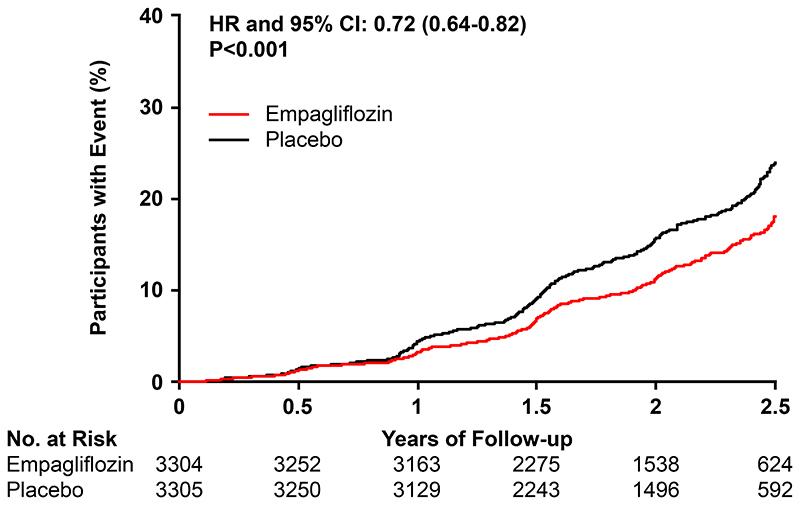
A total of 6609 patients underwent randomization. During a median of 2.0 years of follow-up, progression of kidney disease or death from cardiovascular causes occurred in 432 of 3304 patients (13.1%) in the empagliflozin group and in 558 of 3305 patients (16.9%) in the placebo group (hazard ratio, 0.72; 95% confidence interval [CI], 0.64 to 0.82; P<0.001). Results were consistent among patients with or without diabetes and across subgroups defined according to eGFR ranges. The rate of hospitalization from any cause was lower in the empagliflozin group than in the placebo group (hazard ratio, 0.86; 95% CI, 0.78 to 0.95; P = 0.003), but there were no significant between-group differences with respect to the composite outcome of hospitalization for heart failure or death from cardiovascular causes (which occurred in 4.0% in the empagliflozin group and 4.6% in the placebo group) or death from any cause (in 4.5% and 5.1%, respectively). The rates of serious adverse events were similar in the two groups.
CONCLUSIONS
Among a wide range of patients with chronic kidney disease who were at risk for disease progression, empagliflozin therapy led to a lower risk of progression of kidney disease or death from cardiovascular causes than placebo. (Funded by Boehringer Ingelheim and others; EMPA-KIDNEY ClinicalTrials.gov number, NCT03594110; EudraCT number, 2017-002971-24.).
背景
对于有疾病进展风险的慢性肾脏病患者,恩格列净的作用尚不清楚。EMPA-KIDNEY 试验旨在评估在广泛的此类患者中使用恩格列净治疗的效果。
方法
我们招募了慢性肾脏病患者,肾小球滤过率(eGFR)估计值至少为 20 但小于 45 ml/分钟/1.73 m 体表面积,或 eGFR 至少为 45 但小于 90 ml/分钟/1.73 m,尿白蛋白与肌酐比值(以毫克计白蛋白和以克计肌酐)至少为 200。患者被随机分配接受恩格列净(每日 10 毫克)或匹配的安慰剂。主要结局是肾脏疾病进展(定义为终末期肾病、eGFR 持续下降至<10 ml/分钟/1.73 m、eGFR 从基线持续下降≥40%或因肾脏原因死亡)或心血管原因死亡的复合结局。
结果
共有 6609 名患者接受了随机分组。在中位数为 2.0 年的随访期间,恩格列净组 3304 名患者中有 432 名(13.1%)发生肾脏疾病进展或心血管原因死亡,安慰剂组 3305 名患者中有 558 名(16.9%)(风险比,0.72;95%置信区间[CI],0.64 至 0.82;P<0.001)。在有或没有糖尿病的患者以及根据 eGFR 范围定义的亚组中,结果均一致。与安慰剂组相比,恩格列净组因任何原因住院的发生率较低(风险比,0.86;95%CI,0.78 至 0.95;P=0.003),但心力衰竭住院的复合结局或心血管原因死亡(恩格列净组为 4.0%,安慰剂组为 4.6%)或任何原因死亡(分别为 4.5%和 5.1%)无显著组间差异。两组严重不良事件发生率相似。
结论
在广泛的有疾病进展风险的慢性肾脏病患者中,与安慰剂相比,恩格列净治疗可降低肾脏疾病进展或心血管原因死亡的风险。(由勃林格殷格翰等资助;EMPA-KIDNEY ClinicalTrials.gov 编号,NCT03594110;EudraCT 编号,2017-002971-24。)

 Zotero 插件