
长期伴侣关系——伴侣咨询中的压力、问题及应对过程:基于五对长期伴侣的五个案例研究的见解
Long-term couple relationships - stress, problems and coping processes in couple counseling: Insights based on five case studies with five long-term couples.
作者信息
Kieslich Ute, Steins Gisela
机构信息
Faculty of Educational Sciences, University of Duisburg-Essen, Duisburg, Germany.
Institute of Psychology, University of Duisburg-Essen, Duisburg, Germany.
出版信息
Front Psychol. 2022 Oct 20;13:866580. doi: 10.3389/fpsyg.2022.866580. eCollection 2022.
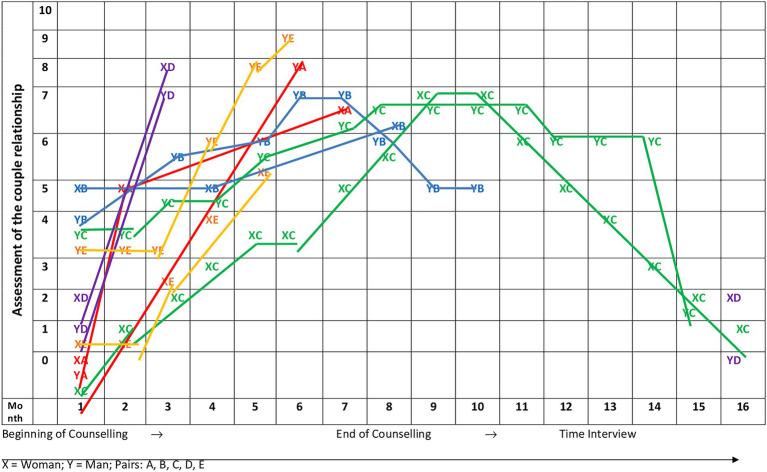
In the course of demographic change, the proportion of older people in many countries is rising continuously and more and more people are experiencing a long time together as a couple. In old age, subjective wellbeing and health aspects are associated with partners' satisfaction with couple relationship. The need for couple counseling in old age is growing in parallel with demographic developments. However, empirical studies on couple therapy with older people in long-term couple relationships exist to date only to a limited extent. The present contribution deals with this knowledge gap. In an explanative two phases design, research has been conducted with long-term couples in couple counseling of which we would like to present here the central qualitative study. The aim is to be able to describe details of these factors. Older couples who have lived in long-term couple relationships were interviewed after using standardized questionnaires concerning the individual and couple-related stress factors and problems at the beginning ( = 62) and the end ( = 36) of their couple counseling process. Five couples from this study were the interviewees for the following study. The couples were interviewed separately. In this interview study and central part of this contribution, the stress factors, problem areas and coping processes of the older couples were examined. The results serve as a suggestion for further research and can only be interpreted with caution due to the small sample of five case studies: The central results of the study are summarized in a circular process model and are discussed in the light of relevant theoretical approaches. The culmination of massive chronic and acute strains and losses associated with feelings of excessive demands and desperation gave rise to emotional alienation of the partners. In the course of couple therapy, the partners mutually opened their thoughts and emotions and modified their previous dysfunctional pattern of interaction. Thus, emotional and physical rapprochement of the partners was fostered with the effect that subjective load of the partners and dissatisfaction of the couple relationship decreased, and subjective emotional wellbeing increased. To prevent negative emotions and destructive conflicts with their spouse, some of the interviewed partners actively used avoidance strategies in couple interactions. Upon completion of couple therapy changes in the couple relationships appeared instable as soon as overcharging stress factors occurred again. The results suggest that an approach to couple therapy for older people in long-term couple relationships should prioritize emotional safeness and attachment in couple relationship to facilitate constructive conflict management. The couple therapy process should emphasize emotion regulation strategies based on age-related strengths and consider age-related vulnerabilities. Moreover, long-term couples may benefit from catamnestic consultation appointments to consolidate the developed changes.
在人口结构变化的过程中,许多国家老年人的比例持续上升,越来越多的人以夫妻身份共同生活很长时间。在老年阶段,主观幸福感和健康状况与伴侣对夫妻关系的满意度相关。随着人口结构的发展,老年夫妻咨询的需求也在同步增长。然而,迄今为止,关于长期夫妻关系中老年人夫妻治疗的实证研究还很有限。本文旨在填补这一知识空白。在一个解释性的两阶段设计中,对长期夫妻进行了研究,我们将在此展示其中央定性研究。目的是能够描述这些因素的细节。在长期夫妻关系中生活的老年夫妻在夫妻咨询开始时(=62)和结束时(=36)使用了关于个人和夫妻相关压力因素及问题的标准化问卷后接受了访谈。本研究中的五对夫妻是后续研究的受访者。夫妻双方分别接受了访谈。在这项访谈研究以及本文的核心部分,研究了老年夫妻的压力因素、问题领域和应对过程。由于五个案例研究的样本量较小,这些结果仅供进一步研究参考,且只能谨慎解读:研究的核心结果总结在一个循环过程模型中,并根据相关理论方法进行了讨论。与过度需求感和绝望感相关的大量慢性和急性压力及损失的累积导致了伴侣之间的情感疏离。在夫妻治疗过程中,伴侣们相互敞开心扉和情感,改变了他们以前功能失调的互动模式。因此,促进了伴侣之间的情感和身体亲近,结果是伴侣的主观负担和夫妻关系的不满减少,主观情感幸福感增加。为了避免与配偶产生负面情绪和破坏性冲突,一些受访伴侣在夫妻互动中积极采用回避策略。夫妻治疗结束后,一旦再次出现过度压力因素,夫妻关系的变化似乎就不稳定了。结果表明,针对长期夫妻关系中老年人的夫妻治疗方法应优先考虑夫妻关系中的情感安全感和依恋感,以促进建设性的冲突管理。夫妻治疗过程应强调基于年龄相关优势的情绪调节策略,并考虑与年龄相关的脆弱性。此外,长期夫妻可能会从定期回访咨询预约中受益,以巩固已发生的变化。

 Zotero 插件