
2型糖尿病相关慢性肾脏病患者的慢性肾脏病进展及经济负担
CKD Progression and Economic Burden in Individuals With CKD Associated With Type 2 Diabetes.
作者信息
Mullins C Daniel, Pantalone Kevin M, Betts Keith A, Song Jinlin, Wu Aozhou, Chen Yan, Kong Sheldon X, Singh Rakesh
机构信息
University of Maryland Baltimore, Baltimore, MD.
Department of Endocrinology and Metabolism, Cleveland Clinic, Cleveland, OH.
出版信息
Kidney Med. 2022 Aug 11;4(11):100532. doi: 10.1016/j.xkme.2022.100532. eCollection 2022 Nov.
RATIONALE & OBJECTIVE: To evaluate progression patterns and associated economic outcomes, using estimated glomerular filtration rate (eGFR) and urine albumin-creatinine ratio (UACR) based on the Kidney Disease: Improving Global Outcomes (KDIGO) risk categories, among patients with type 2 diabetes (T2D) and chronic kidney disease (CKD).
STUDY DESIGN
Patients with T2D and moderate- or high-risk CKD were selected from the Optum electronic health records database (January 2007-December 2019). Progression patterns and post-progression economic outcomes were assessed.
SETTING & PARTICIPANTS: Adults with T2D and CKD in clinical settings.
PREDICTOR
Baseline KDIGO risk categories.
OUTCOMES
Progression to a more severe KDIGO risk category; healthcare resource utilization and medical costs.
ANALYTICAL APPROACH
Progression probability was estimated using cumulative incidence. Healthcare resource utilization and costs were compared across progression groups.
RESULTS
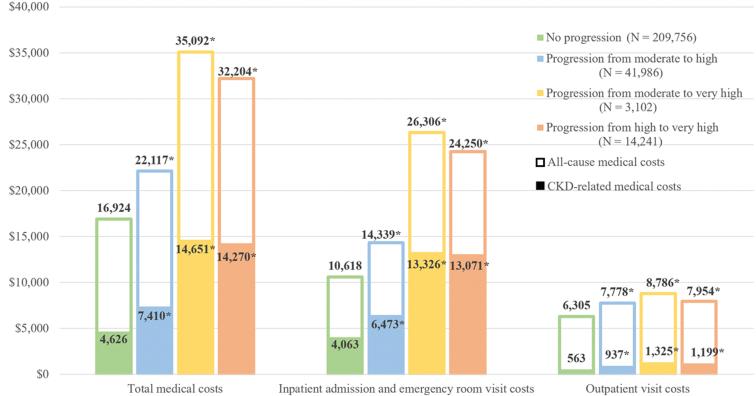
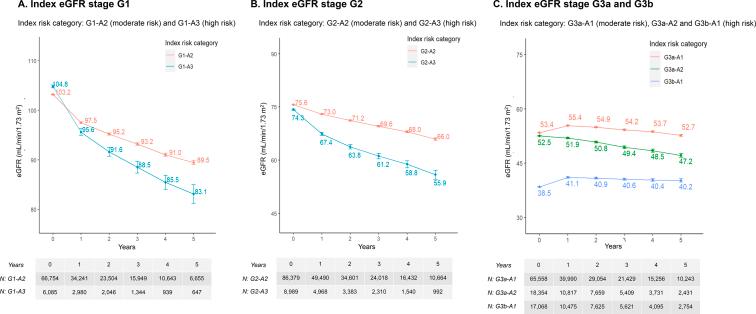
Of 269,187 patients (mean age 65.6 years) with T2D and CKD of moderate or high baseline risk, 18.9% progressed to the very high-risk category within 5 years. Among moderate-risk patients, 17.8% of CKD stage G1-A2, 44.0% of stage G2-A2, and 61.3% of stage G3a-A1 patients progressed to a higher KDIGO risk category. Among high-risk patients, 63.9% of stage G3b-A1/G3a-A2 and 56.0% of stage G2-A3 patients progressed to very high risk. Within the same eGFR stage, a higher UACR stage was associated with 4- to 7-times higher risk of progressing to very high risk and faster eGFR decline. Nonprogressors had lower annual medical costs ($16,924) than patients who progressed from moderate risk to high risk ($22,117, < 0.05), from high risk to very high risk ($32,204, < 0.05), and from moderate risk to very high risk ($35,092, < 0.05).
LIMITATIONS
Infrequent lab testing might have caused lags in identifying progression; medical costs were calculated using unit costs.
CONCLUSIONS
Patients with T2D and CKD of moderate or high risk per KDIGO risk categories had high probabilities of progression, incurring a substantial economic burden. The results highlight the value of UACR in CKD management.
原理与目的
基于改善全球肾脏病预后(KDIGO)风险分类,使用估计肾小球滤过率(eGFR)和尿白蛋白肌酐比值(UACR)来评估2型糖尿病(T2D)和慢性肾脏病(CKD)患者的病情进展模式及相关经济结局。
研究设计
从Optum电子健康记录数据库(2007年1月至2019年12月)中选取T2D和中高危CKD患者。评估病情进展模式和进展后的经济结局。
设置与参与者
临床环境中的成年T2D和CKD患者。
预测因素
基线KDIGO风险分类。
结局
进展至更严重的KDIGO风险分类;医疗资源利用和医疗费用。
分析方法
使用累积发病率估计进展概率。比较各进展组的医疗资源利用和费用。
结果
在269,187例基线风险为中或高的T2D和CKD患者(平均年龄65.6岁)中,18.9%在5年内进展至极高风险类别。在中风险患者中,CKD G1-A2期患者的17.8%、G2-A2期患者的44.0%以及G3a-A1期患者的61.3%进展至更高的KDIGO风险类别。在高风险患者中,G3b-A1/G3a-A2期患者的63.9%和G2-A3期患者的56.0%进展至极高风险。在相同的eGFR阶段,较高的UACR阶段与进展至极高风险的风险高4至7倍以及eGFR下降更快相关。未进展者的年度医疗费用(16,924美元)低于从中风险进展至高风险的患者(22,117美元,<0.05)、从高风险进展至极高风险的患者(32,204美元,<0.05)以及从中风险进展至极高风险的患者(35,092美元,<0.05)。
局限性
实验室检查不频繁可能导致在识别病情进展方面存在滞后;医疗费用是使用单位成本计算的。
结论
根据KDIGO风险分类为中或高风险的T2D和CKD患者有很高的进展概率,会带来巨大的经济负担。结果突出了UACR在CKD管理中的价值。


 Zotero 插件