
一项荟萃分析表明,趋化因子受体对细胞迁移的调节是一种非固有功能,它独立于定向感应进行调控。
A meta-analysis indicates that the regulation of cell motility is a non-intrinsic function of chemoattractant receptors that is governed independently of directional sensing.
机构信息
Centro de Investigaciones Biológicas Margarita Salas, Consejo Superior de Investigaciones Científicas, Madrid, Spain.
出版信息
Front Immunol. 2022 Oct 20;13:1001086. doi: 10.3389/fimmu.2022.1001086. eCollection 2022.
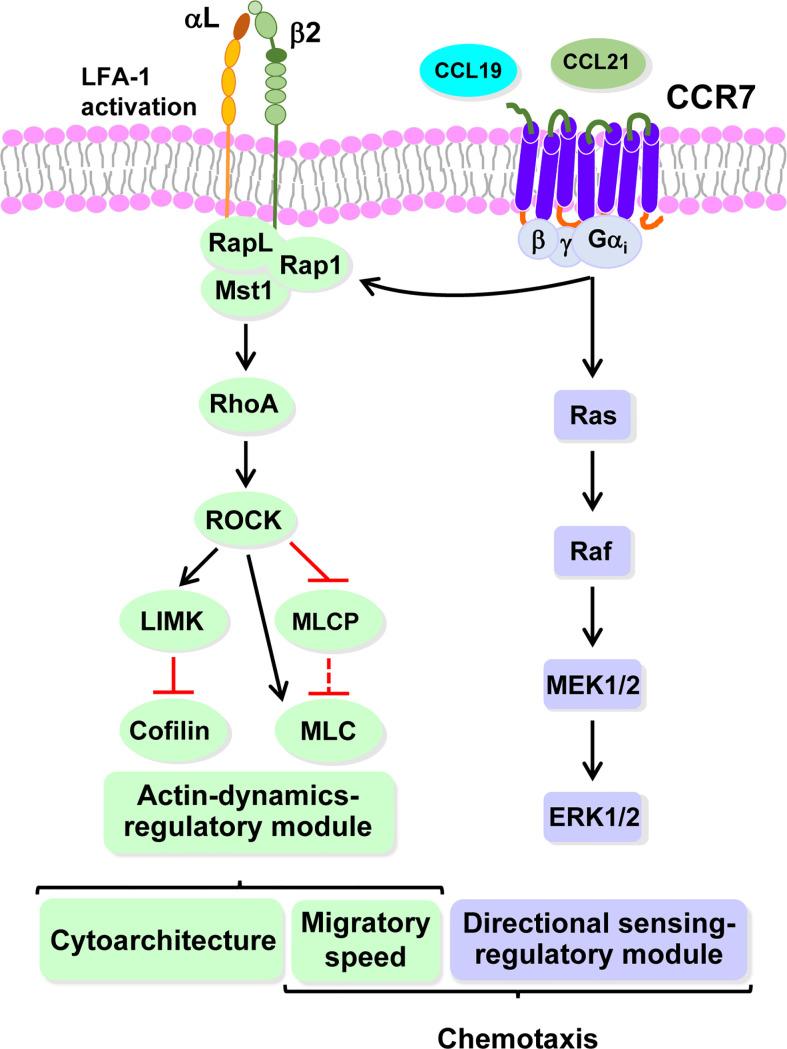
Chemoattraction, defined as the migration of a cell toward a source of a chemical gradient, is controlled by chemoattractant receptors. Chemoattraction involves two basic activities, namely, directional sensing, a molecular mechanism that detects the direction of a source of chemoattractant, and actin-based motility, which allows the migration of a cell towards it. Current models assume first, that chemoattractant receptors govern both directional sensing and motility (most commonly inducing an increase in the migratory speed of the cells, i.e. chemokinesis), and, second, that the signaling pathways controlling both activities are intertwined. We performed a meta-analysis to reassess these two points. From this study emerge two main findings. First, although many chemoattractant receptors govern directional sensing, there are also receptors that do not regulate cell motility, suggesting that is the ability to control directional sensing, not motility, that best defines a chemoattractant receptor. Second, multiple experimental data suggest that receptor-controlled directional sensing and motility can be controlled independently. We hypothesize that this independence may be based on the existence of separated signalling modules that selectively govern directional sensing and motility in chemotactic cells. Together, the information gathered can be useful to update current models representing the signalling from chemoattractant receptors. The new models may facilitate the development of strategies for a more effective pharmacological modulation of chemoattractant receptor-controlled chemoattraction in health and disease.
趋化性是指细胞向化学梯度源的迁移,它由趋化因子受体控制。趋化性涉及两个基本活动,即定向感应,这是一种检测趋化因子源方向的分子机制,以及肌动蛋白为基础的运动,它允许细胞向其迁移。目前的模型假设,趋化因子受体既控制定向感应又控制运动(最常见的是增加细胞的迁移速度,即趋化运动),并且控制这两种活动的信号通路交织在一起。我们进行了一项荟萃分析来重新评估这两点。从这项研究中出现了两个主要发现。首先,尽管许多趋化因子受体控制定向感应,但也有不调节细胞运动的受体,这表明能够控制定向感应,而不是运动,是定义趋化因子受体的最佳特征。其次,许多实验数据表明,受体控制的定向感应和运动可以独立控制。我们假设这种独立性可能基于存在分离的信号模块,这些模块选择性地控制趋化细胞中的定向感应和运动。总之,收集到的信息可以用来更新代表趋化因子受体信号的现有模型。新模型可能有助于制定更有效的药理学策略,以在健康和疾病中更有效地调节趋化因子受体控制的趋化性。


 Zotero 插件