
基于光动力免疫疗法的肿瘤治疗前景洞察。
Insight into the Prospects for Tumor Therapy Based on Photodynamic Immunotherapy.
作者信息
Cheng Xiaoxia, Wei Yiqu, Jiang Xiaomei, Wang Chunli, Liu Mengyu, Yan Jiaxin, Zhang Lei, Zhou Yaqi
机构信息
School of Basic Medical Sciences, Henan University, Kaifeng 475004, China.
School of Clinical Medicine, Henan University, Kaifeng 475004, China.
出版信息
Pharmaceuticals (Basel). 2022 Nov 4;15(11):1359. doi: 10.3390/ph15111359.
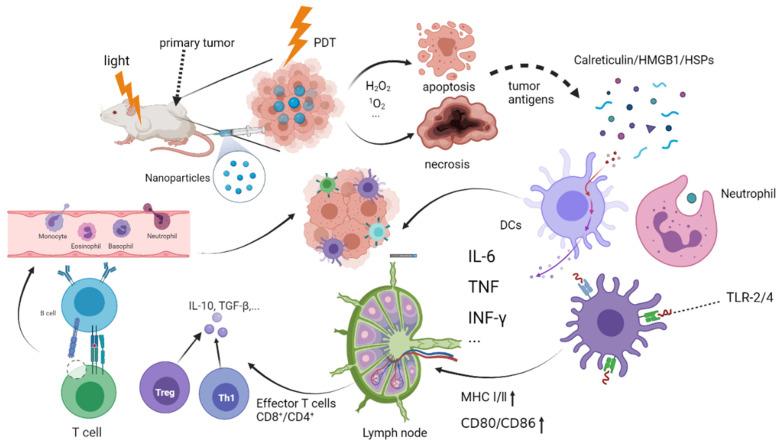
Malignancy is one of the common diseases with high mortality worldwide and the most important obstacle to improving the overall life expectancy of the population in the 21st century. Currently, single or combined treatments, including surgery, chemotherapy, and radiotherapy, are still the mainstream regimens for tumor treatment, but they all present significant side effects on normal tissues and organs, such as organ hypofunction, energy metabolism disorders, and various concurrent diseases. Based on this, theranostic measures for the highly selective killing of tumor cells have always been a hot area in cancer-related fields, among which photodynamic therapy (PDT) is expected to be an ideal candidate for practical clinical application due to its precise targeting and excellent safety performance, so-called PDT refers to a therapeutic method mainly composed of photosensitizers (PSs), laser light, and reactive oxygen species (ROS). Photoimmunotherapy (PIT), a combination of PDT and immunotherapy, can induce systemic antitumor immune responses and inhibit continuing growth and distant metastasis of residual tumor cells, demonstrating a promising application prospect. This article reviews the types of immune responses that occur in the host after PDT treatment, including innate and adaptive immunity. To further help PIT-related drugs improve their pharmacokinetic properties and bioavailability, we highlight the potential improvement of photodynamic immunotherapy from three aspects: immunostimulatory agents, tumor-associated antigens (TAAs) as well as different immune cells. Finally, we focus on recent advances in various strategies and shed light on their corresponding mechanisms of immune activation and possible clinical applications such as cancer vaccines. Having discovered the inherent potential of PDT and the mechanisms that PDT triggers host immune responses, a variety of immunotherapeutic strategies have been investigated in parallel with approaches to improve PDT efficiency. However, it remains to be further elucidated under what conditions the immune effect induced by PDT can achieve tumor immunosuppression and to what extent PDT-induced antitumor immunity will lead to complete tumor rejection. Currently, PIT presents several outstanding intractable challenges, such as the aggregation ability of PSs locally in tumors, deep tissue penetration ability of laser light, immune escape, and biological toxicity, and it is hoped that these issues raised will help to point out the direction of preclinical research on PIT and accelerate its transition to clinical practice.
恶性肿瘤是全球范围内常见的高死亡率疾病之一,也是21世纪提高人群总体预期寿命的最重要障碍。目前,包括手术、化疗和放疗在内的单一或联合治疗仍然是肿瘤治疗的主流方案,但它们都会对正常组织和器官产生显著副作用,如器官功能减退、能量代谢紊乱和各种并发疾病。基于此,高度选择性杀伤肿瘤细胞的诊疗措施一直是癌症相关领域的热点,其中光动力疗法(PDT)因其精确的靶向性和出色的安全性能,有望成为实际临床应用的理想选择,所谓的PDT是指一种主要由光敏剂(PSs)、激光和活性氧(ROS)组成的治疗方法。光免疫疗法(PIT)是PDT与免疫疗法的结合,可诱导全身抗肿瘤免疫反应,抑制残留肿瘤细胞的持续生长和远处转移,展现出广阔的应用前景。本文综述了PDT治疗后宿主发生的免疫反应类型,包括固有免疫和适应性免疫。为进一步帮助PIT相关药物改善其药代动力学性质和生物利用度,我们从免疫刺激剂、肿瘤相关抗原(TAAs)以及不同免疫细胞三个方面强调了光动力免疫疗法的潜在改进。最后,我们聚焦于各种策略的最新进展,并阐明其相应的免疫激活机制以及癌症疫苗等可能的临床应用。在发现PDT的内在潜力以及PDT触发宿主免疫反应的机制后,人们并行研究了多种免疫治疗策略以及提高PDT效率的方法。然而,仍有待进一步阐明在何种条件下PDT诱导的免疫效应可实现肿瘤免疫抑制,以及PDT诱导的抗肿瘤免疫将在多大程度上导致肿瘤完全消退。目前,PIT面临着几个突出的棘手挑战,如PSs在肿瘤局部的聚集能力、激光的深部组织穿透能力、免疫逃逸和生物毒性,希望所提出的这些问题有助于为PIT的临床前研究指明方向,并加速其向临床实践的转化。


 Zotero 插件