
新冠肺炎感染后抑郁症状不能用感染期间的报告症状来解释新冠肺炎幸存者对死亡的恐惧。
Fear of Death during COVID-19 Does Not Explain Post-Infection Depression Symptoms beyond Reported Symptoms during the Infection in COVID-19 Survivors.
机构信息
Clinic for Psychosomatic Medicine and Psychotherapy, University of Duisburg-Essen, LVR-University Hospital, 45147 Essen, Germany.
Center for Translational Neuro- and Behavioral Sciences (C-TNBS), University of Duisburg-Essen, 45147 Essen, Germany.
出版信息
Int J Environ Res Public Health. 2022 Oct 23;19(21):13773. doi: 10.3390/ijerph192113773.
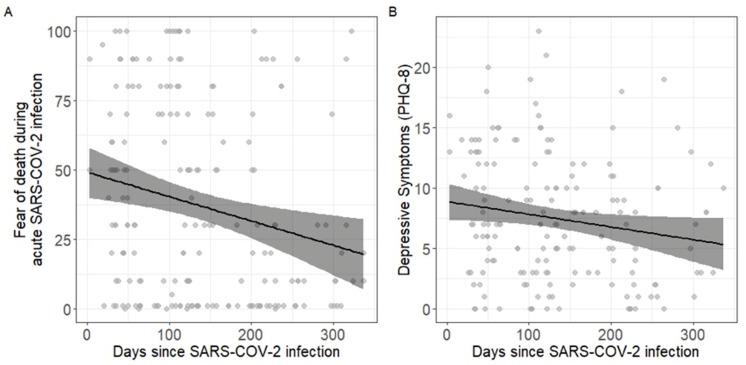
The COVID-19 pandemic poses an unprecedented global burden to the general population and, in particular, to individuals who have been infected with SARS-CoV-2. In the context of the discussion about "post COVID-19", the aim of the study was to advance research on mental health and long-term consequences after COVID-19. In total, 214 COVID-19 survivors (female: 54.2%; hospitalized: 36.7%) participated in the repeated cross-sectional assessment. In addition to demographic data, mental and somatic symptoms, fear of death at the time of infection, and depressive (PHQ-8) and generalized anxiety symptoms (GAD-7) were assessed. Results showed an increased prevalence of depressive symptoms and symptoms of generalized anxiety compared to observations in the general population prior to the COVID-19 pandemic. Psychological symptoms of depression and reported levels of fear of death during the SARS-CoV-2 infection showed a negative association with the time interval since COVID-19 diagnosis. Furthermore, although fear of death during the acute COVID-19 was related to depression and generalized anxiety, this association was predominantly explained by the presence of mental and somatic symptoms. In conclusion, initial fear of death does not impact mental health beyond the overall symptom burden. Furthermore, depressive symptoms appear to vanish across time since infection.
COVID-19 大流行给普通人群带来了前所未有的全球负担,特别是对那些感染了 SARS-CoV-2 的人。在关于“后 COVID-19”的讨论中,本研究的目的是推进 COVID-19 后心理健康和长期后果的研究。共有 214 名 COVID-19 幸存者(女性:54.2%;住院:36.7%)参与了重复的横断面评估。除了人口统计学数据外,还评估了心理和躯体症状、感染时对死亡的恐惧以及抑郁(PHQ-8)和广泛性焦虑症状(GAD-7)。结果显示,与 COVID-19 大流行前观察到的一般人群相比,抑郁症状和广泛性焦虑症状的患病率有所增加。抑郁和报告的 SARS-CoV-2 感染期间对死亡的恐惧程度与 COVID-19 诊断后时间间隔呈负相关。此外,尽管急性 COVID-19 期间的死亡恐惧与抑郁和广泛性焦虑有关,但这种关联主要是由精神和躯体症状的存在所解释的。总之,最初的死亡恐惧并不会对心理健康产生超出整体症状负担的影响。此外,抑郁症状似乎随着感染后的时间推移而消失。
 Zotero 插件