
使用外源性褪黑素、谷胱甘肽、脯氨酸和甜菜碱处理来应对作物的非生物胁迫。
Using Exogenous Melatonin, Glutathione, Proline, and Glycine Betaine Treatments to Combat Abiotic Stresses in Crops.
机构信息
Centre for Agricultural Biochemistry and Biotechnology (CABB), University of Agriculture Faisalabad, Faisalabad 38000, Pakistan.
Center for Soybean Research of the Partner State Key Laboratory of Agrobiotechnology and School of Life Sciences, The Chinese University of Hong Kong, Shatin, Hong Kong.
出版信息
Int J Mol Sci. 2022 Oct 26;23(21):12913. doi: 10.3390/ijms232112913.
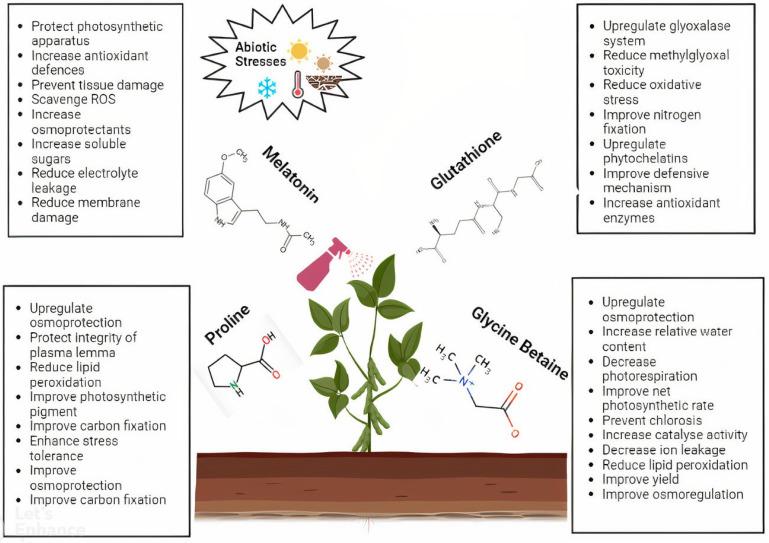
Abiotic stresses, such as drought, salinity, heat, cold, and heavy metals, are associated with global climate change and hamper plant growth and development, affecting crop yields and quality. However, the negative effects of abiotic stresses can be mitigated through exogenous treatments using small biomolecules. For example, the foliar application of melatonin provides the following: it protects the photosynthetic apparatus; it increases the antioxidant defenses, osmoprotectant, and soluble sugar levels; it prevents tissue damage and reduces electrolyte leakage; it improves reactive oxygen species (ROS) scavenging; and it increases biomass, maintains the redox and ion homeostasis, and improves gaseous exchange. Glutathione spray upregulates the glyoxalase system, reduces methylglyoxal (MG) toxicity and oxidative stress, decreases hydrogen peroxide and malondialdehyde accumulation, improves the defense mechanisms, tissue repairs, and nitrogen fixation, and upregulates the phytochelatins. The exogenous application of proline enhances growth and other physiological characteristics, upregulates osmoprotection, protects the integrity of the plasma lemma, reduces lipid peroxidation, increases photosynthetic pigments, phenolic acids, flavonoids, and amino acids, and enhances stress tolerance, carbon fixation, and leaf nitrogen content. The foliar application of glycine betaine improves growth, upregulates osmoprotection and osmoregulation, increases relative water content, net photosynthetic rate, and catalase activity, decreases photorespiration, ion leakage, and lipid peroxidation, protects the oxygen-evolving complex, and prevents chlorosis. Chemical priming has various important advantages over transgenic technology as it is typically more affordable for farmers and safe for plants, people, and animals, while being considered environmentally acceptable. Chemical priming helps to improve the quality and quantity of the yield. This review summarizes and discusses how exogenous melatonin, glutathione, proline, and glycine betaine can help crops combat abiotic stresses.
非生物胁迫,如干旱、盐度、热、冷和重金属,与全球气候变化有关,阻碍植物的生长和发育,影响作物的产量和质量。然而,通过使用小分子的外源处理可以减轻非生物胁迫的负面影响。例如,褪黑素的叶面喷施具有以下作用:它可以保护光合作用器官;增加抗氧化防御、渗透调节物质和可溶性糖水平;防止组织损伤和减少电解质渗漏;改善活性氧(ROS)的清除;增加生物量,维持氧化还原和离子平衡,改善气体交换。谷胱甘肽喷雾上调了醛糖还原酶系统,降低了甲基乙二醛(MG)毒性和氧化应激,减少了过氧化氢和丙二醛的积累,改善了防御机制、组织修复和固氮作用,并上调了植物螯合肽。脯氨酸的外源施用可以增强生长和其他生理特性,上调渗透保护,保护质膜的完整性,减少脂质过氧化,增加光合色素、酚酸、类黄酮和氨基酸,增强了对胁迫的耐受性、碳固定和叶片氮含量。甘氨酸甜菜碱的叶面喷施可以改善生长,上调渗透保护和渗透调节,增加相对含水量、净光合速率和过氧化氢酶活性,降低光呼吸、离子渗漏和脂质过氧化,保护放氧复合物,防止黄化。化学引发相对于转基因技术具有许多重要的优势,因为它通常对农民来说更实惠,对植物、人和动物来说是安全的,并且被认为是环境可接受的。化学引发有助于提高产量的质量和数量。本综述总结和讨论了外源褪黑素、谷胱甘肽、脯氨酸和甘氨酸甜菜碱如何帮助作物抵御非生物胁迫。

 Zotero 插件