
菲律宾南部河口三种可食用双壳贝类的沉积物中的微塑料及摄食率
Microplastic in Sediments and Ingestion Rates in Three Edible Bivalve Mollusc Species in a Southern Philippine Estuary.
作者信息
Bonifacio P S P, Metillo E B, Romano E F
机构信息
Department of Biological Sciences, College of Science and Mathematics, Western Mindanao State University, 7000 Zamboanga City, Philippines.
Department of Marine Science, College of Science and Mathematics, Mindanao State University - Iligan Institute of Technology, 9200 Iligan City, Philippines.
出版信息
Water Air Soil Pollut. 2022;233(11):455. doi: 10.1007/s11270-022-05926-w. Epub 2022 Nov 4.
UNLABELLED
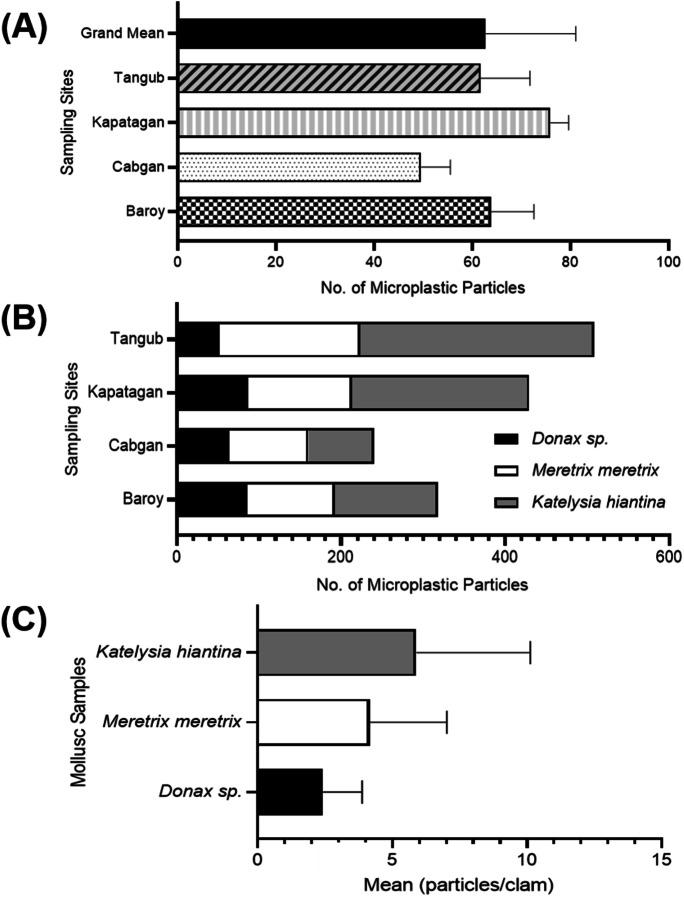
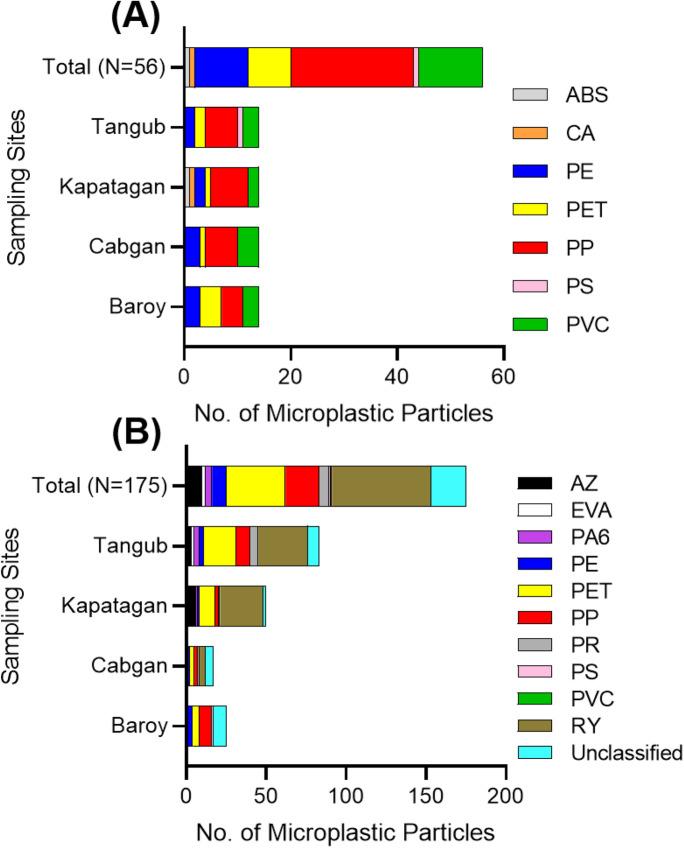
Plastics are now a major environmental concern worldwide with their widespread contamination and accumulation. Microplastic particle (< 5 mm) is an emerging pollution issue as it is being detected worldwide in aquatic and terrestrial ecosystems, but relatively little is known in tropical regions. This study determined the (1) abundance of microplastics in sediment and (2) in situ and laboratory ingestion rates of microplastics in three scarcely studied tropical bivalve mollusc species ( sp., , and ) in Panguil Bay, Southern Philippines. A total of 2258 microplastic particles (62.72 ± 18.31 items/m) were found on the sediment samples. Filament/fiber is the most abundant type of microplastic in terms of morphology, while black and blue are the dominant colors of microplastic particles. There were 1495 microplastic particles (4.15 ± 3.37 particles/clam) present in the clam tissues, of which polypropylene (PP) and rayon (RY) polymers are the most common, whereas (707 particles) showed the highest amount of microplastics. The number of ATR-FTIR-confirmed polymer types in the wild clams is greater than that in the sediments. The study reveals abundant microplastics in sediments and in the three species of bivalve individuals from the wild. All clams ingested low-density polyethylene (LDPE) microplastic particles in the laboratory. The mean number of LDPE microplastic particles ingested by clams is 4.62 ± 2.40 particles/clam/7days, with the highest value observed in . Additionally, sp., , and could ingest high densities of 40-60-μm microplastic particles.
SUPPLEMENTARY INFORMATION
The online version contains supplementary material available at 10.1007/s11270-022-05926-w.
未标注
塑料因其广泛的污染和积累,现已成为全球主要的环境问题。微塑料颗粒(<5毫米)是一个新出现的污染问题,因为在全球水生和陆地生态系统中都能检测到它,但在热带地区相对了解较少。本研究确定了(1)菲律宾南部潘吉尔湾三种鲜为人知的热带双壳贝类软体动物(、和)沉积物中微塑料的丰度,以及(2)其原位和实验室微塑料摄取率。在沉积物样本中总共发现了2258个微塑料颗粒(62.72±18.31个/米)。就形态而言,丝状/纤维状是最丰富的微塑料类型,而黑色和蓝色是微塑料颗粒的主要颜色。蛤组织中有1495个微塑料颗粒(4.15±3.37个/蛤),其中聚丙烯(PP)和人造丝(RY)聚合物最为常见,而显示出的微塑料数量最多(707个颗粒)。野生蛤中经衰减全反射傅里叶变换红外光谱(ATR-FTIR)确认的聚合物类型数量多于沉积物中的。该研究揭示了沉积物以及来自野外的三种双壳贝类个体中存在大量微塑料。所有蛤在实验室中都摄取了低密度聚乙烯(LDPE)微塑料颗粒。蛤摄取LDPE微塑料颗粒的平均数量为4.62±2.40个/蛤/7天,在中观察到的数值最高。此外,、和能够摄取高密度的40 - 60微米微塑料颗粒。
补充信息
在线版本包含可在10.1007/s11..26 - w获取的补充材料。


 Zotero 插件