
诱导多能干细胞衍生的细胞外囊泡在兔和人骨关节炎模型中的治疗作用
Therapeutic effect of induced pluripotent stem cell -derived extracellular vesicles in an and osteoarthritis model.
作者信息
Hsueh Yu-Huan, Buddhakosai Waradee, Le Phung Ngan, Tu Yung-Yi, Huang Hsien-Chang, Lu Huai-En, Chen Wen-Liang, Tu Yuan-Kun
机构信息
College of Biological Science and Technology, National Yang Ming Chiao Tung University, Hsinchu, Taiwan.
Department of Orthopedic Surgery, E-Da Hospitall, I-Shou University, Kaohsiung, Taiwan.
出版信息
J Orthop Translat. 2022 Nov 8;38:141-155. doi: 10.1016/j.jot.2022.10.004. eCollection 2023 Jan.
BACKGROUND/OBJECTIVE: Osteoarthritis (OA) is a multifactorial joint disease associated with the deterioration of chondrocytes and inflammation. Treatment of OA is only aimed at reducing pain and improving joint function. Recently, extracellular vesicles (EVs) secreted from stem cells have emerged as a cell regenerative tool in several degenerative diseases, including OA. We hypothesised that induced pluripotent stem cell (iPSC)-derived EVs would be beneficial for regenerating chondrocytes and OA therapy. Therefore, we aimed to investigate iPSC-EVs' effects on chondrocyte behaviour in an interleukin 1 beta (IL-1β)-induced OA model and anterior cruciate ligament transection (ACLT)-induced OA model of rabbit articular cartilage.
METHODS
The iPSC-EVs were isolated by sequential ultracentrifugation from a 48-h-incubated conditional medium of iPSC. The isolated iPSC-EVs were characterised by transmission electron microscopy, western blot analyses, and dynamic light scatter. The effects of iPSC-EVs on the viability of human primary chondrocytes and cell senescence were analysed. Premature senescence of cells was induced by long-term incubation with low doses of hydrogen peroxide. To investigate the therapeutic effect of iPSC-EVs on OA chondrocytes , IL-1β was used to induce chondrocyte damage. Inflammatory macrophages were activated from THP-1 monocytes to observe the impact of iPSC-EV on macrophage polarisation. The phenotypes of the macrophages exposed to iPSC-EVs were evaluated by ELISA and western blot analyses. The primary chondrocytes were co-cultured with different phenotypes of macrophages to observe the expression of collagen II and catabolic enzymes in chondrocytes. iPSC-EVs were injected intraarticularly into the rabbit with an ACLT-induced OA model. The progression of lesions was assessed through macroscopic and histopathological studies.
RESULTS
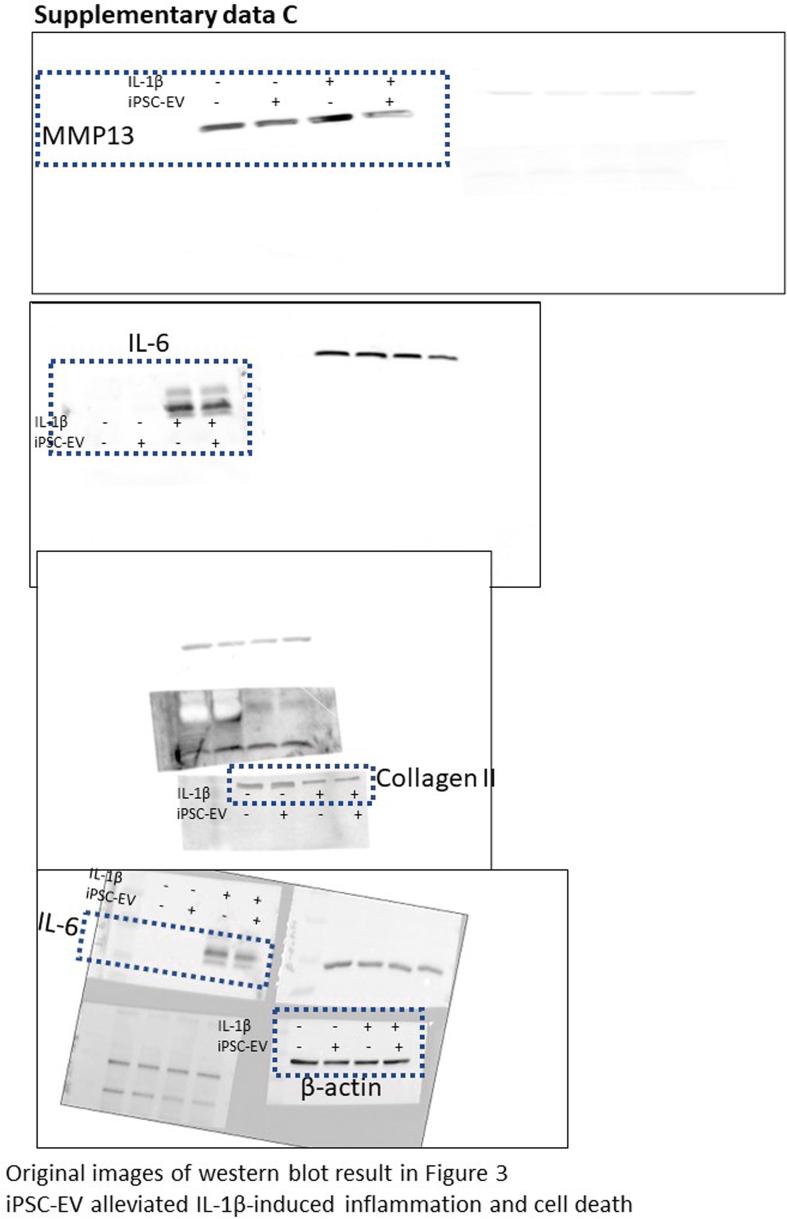
We showed that iPSC-EVs significantly stimulated the proliferation of primary human chondrocytes and suppressed cell senescence by regulating the expression of p21 and collagen II. iPSC-EVs reduced matrix degradation enzymes and IL-6 expression and attenuated IL-1β-mediated cell death of chondrocytes. Furthermore, iPSC-EVs modulated macrophage polarisation, resulting in the rescue of damaged chondrocytes in an inflammatory microenvironment. In the rabbit ACLT model, the OA-like lesions, including inflammation, subchondral bone protrusion, and articular cartilage destruction, were ameliorated by iPSC-EV. A histopathological study consistently revealed that iPSC-EVs attenuated ACLT-mediated alteration of MMP13 and ADAMTS5 and collagen II expression.
CONCLUSION
iPSC-EVs protected chondrocytes by enhancing cell proliferation, suppressing premature senescence, and maintaining homeostasis of collagen II synthesis and matrix degradation enzymes such as matrix metalloproteinases (MMPs) and ADAMTS5. iPSC-EVs also reduced cell death in IL-1β-mediated chondrocyte cell damage. In the rabbit ACLT-induced OA model, iPSC-EV injection reduced cartilage destruction, as indicated by the upregulation of collagen II and down-regulation of MMP13 and ADAMTS5. Overall, our results suggest that iPSC-EVs possess therapeutic potential and may be used as an OA treatment option.
THE TRANSLATIONAL POTENTIAL OF THIS ARTICLE
This study highlights the potential of iPSC-EVs as a therapeutic option for chondrocyte regeneration and OA treatment.
背景/目的:骨关节炎(OA)是一种与软骨细胞退变和炎症相关的多因素关节疾病。OA的治疗仅旨在减轻疼痛和改善关节功能。最近,干细胞分泌的细胞外囊泡(EVs)已成为包括OA在内的几种退行性疾病中的一种细胞再生工具。我们假设诱导多能干细胞(iPSC)衍生的EVs对软骨细胞再生和OA治疗有益。因此,我们旨在研究iPSC-EVs在白细胞介素1β(IL-1β)诱导的OA模型和前交叉韧带横断(ACLT)诱导的兔关节软骨OA模型中对软骨细胞行为的影响。
方法
通过连续超速离心从iPSC的48小时培养条件培养基中分离iPSC-EVs。通过透射电子显微镜、蛋白质印迹分析和动态光散射对分离的iPSC-EVs进行表征。分析了iPSC-EVs对人原代软骨细胞活力和细胞衰老的影响。通过低剂量过氧化氢长期孵育诱导细胞过早衰老。为了研究iPSC-EVs对OA软骨细胞的治疗作用,使用IL-1β诱导软骨细胞损伤。从THP-1单核细胞激活炎性巨噬细胞以观察iPSC-EV对巨噬细胞极化的影响。通过酶联免疫吸附测定和蛋白质印迹分析评估暴露于iPSC-EVs的巨噬细胞的表型。将原代软骨细胞与不同表型的巨噬细胞共培养,以观察软骨细胞中Ⅱ型胶原蛋白和分解代谢酶的表达。将iPSC-EVs关节内注射到ACLT诱导的OA模型兔中。通过宏观和组织病理学研究评估病变的进展。
结果
我们表明,iPSC-EVs通过调节p21和Ⅱ型胶原蛋白的表达,显著刺激人原代软骨细胞的增殖并抑制细胞衰老。iPSC-EVs减少基质降解酶和IL-6的表达,并减轻IL-1β介导的软骨细胞死亡。此外,iPSC-EVs调节巨噬细胞极化,从而在炎性微环境中挽救受损的软骨细胞。在兔ACLT模型中,iPSC-EV改善了OA样病变,包括炎症、软骨下骨突出和关节软骨破坏。组织病理学研究一致显示,iPSC-EVs减轻了ACLT介导的基质金属蛋白酶13(MMP13)、含血小板反应蛋白基序的解聚蛋白样金属蛋白酶5(ADAMTS5)的改变以及Ⅱ型胶原蛋白的表达。
结论
iPSC-EVs通过增强细胞增殖、抑制过早衰老以及维持Ⅱ型胶原蛋白合成和基质降解酶(如基质金属蛋白酶(MMPs)和ADAMTS5)的稳态来保护软骨细胞。iPSC-EVs还减少了IL-1β介导的软骨细胞损伤中的细胞死亡。在兔ACLT诱导的OA模型中,iPSC-EV注射减少了软骨破坏,表现为Ⅱ型胶原蛋白上调以及MMP13和ADAMTS5下调。总体而言,我们的结果表明iPSC-EVs具有治疗潜力,可作为OA的治疗选择。
本文的转化潜力
本研究突出了iPSC-EVs作为软骨细胞再生和OA治疗的治疗选择的潜力。




 Zotero 插件