
支气管肺泡灌洗液宏基因组下一代测序在儿童肺炎中的诊断价值。
Diagnostic value of bronchoalveolar lavage fluid metagenomic next-generation sequencing in pediatric pneumonia.
机构信息
Pediatric Respiratory Department, Maternal and Child Health Hospital of Hubei Province, Wuhan, China.
Department of Scientific Affairs, Vision Medicals Center for Infection Diseases, Guangzhou, China.
出版信息
Front Cell Infect Microbiol. 2022 Oct 27;12:950531. doi: 10.3389/fcimb.2022.950531. eCollection 2022.
OBJECTIVES
The aim of this study was to evaluate the diagnostic value of bronchoalveolar lavage fluid (BALF) metagenomic next-generation sequencing (mNGS) versus conventional microbiological tests (CMTs) for pediatric pneumonia.
METHODS
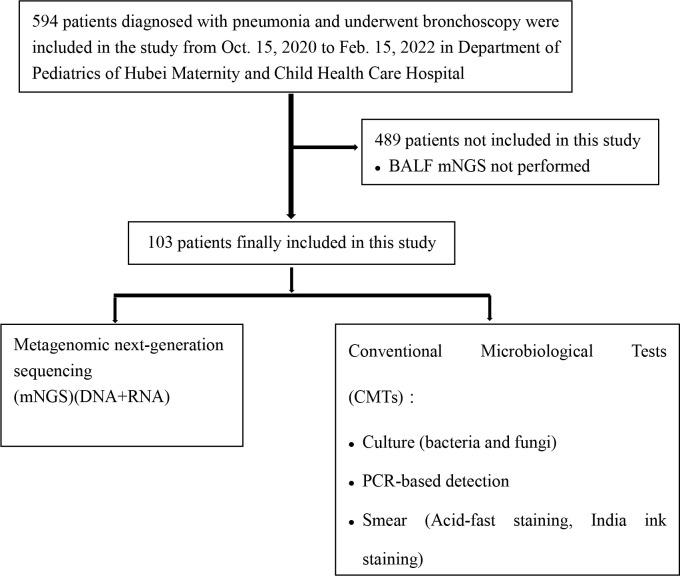
This retrospective observational study enrolled 103 children who were diagnosed with pneumonia and hospitalized at Hubei Maternity and Child Health Care Hospital between 15 October 2020 and 15 February 2022. The pneumonia diagnosis was based on clinical manifestations, lung imaging, and microbiological tests. Pathogens in the lower respiratory tract were detected using CMTs and BALF mNGS (of DNA and RNA). The diagnostic performance of BALF mNGS was compared with that of CMTs.
RESULTS
In 96 patients, pathogens were identified by microbiological tests. The overall pathogen detection rate of mNGS was significantly higher than that of CMTs (91.3% vs. 59.2%, = 0.000). The diagnostic performance of mNGS varied for different pathogens; however, its sensitivity and accuracy for diagnosing bacterial and viral infections were both higher than those of CMTs ( = 0.000). For the diagnosis of fungi, the sensitivity of mNGS (87.5%) was higher than that of CMTs (25%); however, its specificity and accuracy were lower than those of CMTs ( < 0.01). For the diagnosis of , the specificity (98.8%) and accuracy (88.3%) of mNGS were high; however, its sensitivity (42.1%) was significantly lower than that of CMTs (100%) ( = 0.001). In 96 patients with definite pathogens, 52 cases (50.5%) were infected with a single pathogen, while 44 cases (42.7%) had polymicrobial infections. Virus-bacteria and virus-virus co-infections were the most common. , , rhinovirus, cytomegalovirus, parainfluenza virus, and fungi were more likely to be associated with polymicrobial infections.
CONCLUSIONS
BALF mNGS improved the detection rate of pediatric pneumonia, especially in mixed infections. The diagnostic performance of BALF mNGS varies according to pathogen type. mNGS can be used to supplement CMTs. A combination of mNGS and CMTs may be the best diagnostic strategy.
目的
本研究旨在评估支气管肺泡灌洗液(BALF)宏基因组下一代测序(mNGS)与常规微生物学检测(CMTs)在儿科肺炎中的诊断价值。
方法
本回顾性观察性研究纳入了 2020 年 10 月 15 日至 2022 年 2 月 15 日期间在湖北省妇幼保健院住院的 103 名被诊断为肺炎的儿童。肺炎的诊断基于临床表现、肺部影像学和微生物学检查。采用 CMTs 和 BALF mNGS(DNA 和 RNA)检测下呼吸道病原体。比较 BALF mNGS 与 CMTs 的诊断性能。
结果
在 96 名患者中,通过微生物学检测确定了病原体。mNGS 的总体病原体检测率明显高于 CMTs(91.3%比 59.2%, = 0.000)。mNGS 对不同病原体的诊断性能不同;然而,其对细菌和病毒感染的灵敏度和准确性均高于 CMTs( = 0.000)。对于真菌感染,mNGS 的灵敏度(87.5%)高于 CMTs(25%);然而,其特异性和准确性均低于 CMTs( < 0.01)。对于 的诊断,mNGS 的特异性(98.8%)和准确性(88.3%)较高;然而,其灵敏度(42.1%)明显低于 CMTs(100%)( = 0.001)。在 96 名确定病原体的患者中,52 例(50.5%)为单一病原体感染,44 例(42.7%)为混合感染。病毒-细菌和病毒-病毒混合感染最常见。肺炎支原体、嗜肺军团菌、鼻病毒、巨细胞病毒、副流感病毒和真菌更可能与混合感染相关。
结论
BALF mNGS 提高了儿科肺炎的检出率,尤其是在混合感染中。BALF mNGS 的诊断性能因病原体类型而异。mNGS 可用于补充 CMTs。mNGS 与 CMTs 的联合应用可能是最佳的诊断策略。

 Zotero 插件