
综合健康与严格指数在评估印度政府控制新冠疫情传播措施中的效用:生态时间序列研究。
Utility of the Comprehensive Health and Stringency Indexes in Evaluating Government Responses for Containing the Spread of COVID-19 in India: Ecological Time-Series Study.
机构信息
Department of Biostatistics, Post Graduate Institute of Medical Education and Research, Chandigarh, India.
Department of Psychology, Mehr Chand Mahajan DAV College, Chandigarh, India.
出版信息
JMIR Public Health Surveill. 2023 Feb 10;9:e38371. doi: 10.2196/38371.
BACKGROUND
Many nations swiftly designed and executed government policies to contain the rapid rise in COVID-19 cases. Government actions can be broadly segmented as movement and mass gathering restrictions (such as travel restrictions and lockdown), public awareness (such as face covering and hand washing), emergency health care investment, and social welfare provisions (such as poor welfare schemes to distribute food and shelter). The Blavatnik School of Government, University of Oxford, tracked various policy initiatives by governments across the globe and released them as composite indices. We assessed the overall government response using the Oxford Comprehensive Health Index (CHI) and Stringency Index (SI) to combat the COVID-19 pandemic.
OBJECTIVE
This study aims to demonstrate the utility of CHI and SI to gauge and evaluate the government responses for containing the spread of COVID-19. We expect a significant inverse relationship between policy indices (CHI and SI) and COVID-19 severity indices (morbidity and mortality).
METHODS
In this ecological study, we analyzed data from 2 publicly available data sources released between March 2020 and October 2021: the Oxford Covid-19 Government Response Tracker and the World Health Organization. We used autoregressive integrated moving average (ARIMA) and seasonal ARIMA to model the data. The performance of different models was assessed using a combination of evaluation criteria: adjusted R, root mean square error, and Bayesian information criteria.
RESULTS
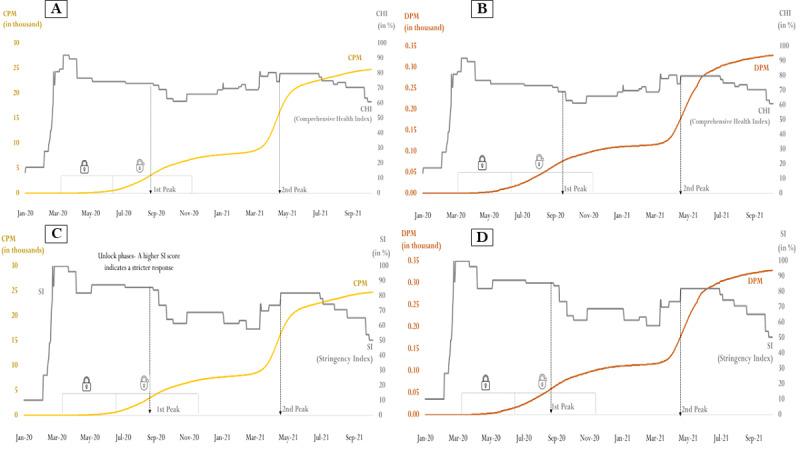
implementation of policies by the government to contain the COVID-19 crises resulted in higher CHI and SI in the beginning. Although the value of CHI and SI gradually fell, they were consistently higher at values of >80% points. During the initial investigation, we found that cases per million (CPM) and deaths per million (DPM) followed the same trend. However, the final CPM and DPM models were seasonal ARIMA (3,2,1)(1,0,1) and ARIMA (1,1,1), respectively. This study does not support the hypothesis that COVID-19 severity (CPM and DPM) is associated with stringent policy measures (CHI and SI).
CONCLUSIONS
Our study concludes that the policy measures (CHI and SI) do not explain the change in epidemiological indicators (CPM and DPM). The study reiterates our understanding that strict policies do not necessarily lead to better compliance but may overwhelm the overstretched physical health systems. Twenty-first-century problems thus demand 21st-century solutions. The digital ecosystem was instrumental in the timely collection, curation, cloud storage, and data communication. Thus, digital epidemiology can and should be successfully integrated into existing surveillance systems for better disease monitoring, management, and evaluation.
背景
许多国家迅速制定并执行政府政策,以遏制 COVID-19 病例的快速上升。政府的行动可以大致分为流动和群众集会限制(如旅行限制和封锁)、公众意识(如戴口罩和洗手)、紧急医疗保健投资和社会福利供应(如分发食物和住所的贫困福利计划)。牛津大学布拉瓦特尼克政府学院跟踪了全球各国政府的各种政策举措,并将其作为综合指数发布。我们使用牛津综合健康指数(CHI)和严格指数(SI)来评估政府应对 COVID-19 大流行的整体情况。
目的
本研究旨在展示 CHI 和 SI 的效用,以衡量和评估遏制 COVID-19 传播的政府反应。我们预计政策指数(CHI 和 SI)与 COVID-19 严重程度指数(发病率和死亡率)之间存在显著的反比关系。
方法
在这项生态研究中,我们分析了 2020 年 3 月至 2021 年 10 月期间发布的 2 个公开可用数据源中的数据:牛津 COVID-19 政府反应追踪器和世界卫生组织。我们使用自回归综合移动平均(ARIMA)和季节性 ARIMA 对数据进行建模。使用评估标准的组合来评估不同模型的性能:调整 R、均方根误差和贝叶斯信息标准。
结果
政府为遏制 COVID-19 危机而实施的政策导致 CHI 和 SI 最初较高。尽管 CHI 和 SI 的值逐渐下降,但它们始终保持在>80%的较高值。在初步调查中,我们发现每百万人(CPM)和每百万人(DPM)的病例数遵循相同的趋势。然而,最终的 CPM 和 DPM 模型分别为季节性 ARIMA(3,2,1)(1,0,1)和 ARIMA(1,1,1)。本研究不支持 COVID-19 严重程度(CPM 和 DPM)与严格政策措施(CHI 和 SI)相关的假设。
结论
我们的研究得出结论,政策措施(CHI 和 SI)并不能解释流行病学指标(CPM 和 DPM)的变化。该研究重申了我们的理解,即严格的政策不一定导致更好的遵守,但可能使过度紧张的卫生系统不堪重负。因此,21 世纪的问题需要 21 世纪的解决方案。数字生态系统在及时收集、策展、云存储和数据通信方面发挥了重要作用。因此,数字流行病学可以而且应该成功地整合到现有的监测系统中,以更好地监测、管理和评估疾病。
 Zotero 插件