
泽布替尼与伊布替尼用于复发/难治性慢性淋巴细胞白血病和小淋巴细胞淋巴瘤:一项随机 III 期试验的中期分析。
Zanubrutinib Versus Ibrutinib in Relapsed/Refractory Chronic Lymphocytic Leukemia and Small Lymphocytic Lymphoma: Interim Analysis of a Randomized Phase III Trial.
机构信息
St James's University Hospital, Leeds, United Kingdom.
Department I of Internal Medicine, Center for Integrated Oncology Aachen, University of Cologne, Bonn, Cologne, Düsseldorf, Germany.
出版信息
J Clin Oncol. 2023 Feb 10;41(5):1035-1045. doi: 10.1200/JCO.22.00510. Epub 2022 Nov 17.
PURPOSE
Zanubrutinib is a potent, irreversible next-generation Bruton tyrosine kinase (BTK) inhibitor designed to maximize BTK occupancy and minimize off-target kinase inhibition. We hypothesized that complete/sustained BTK occupancy may improve efficacy outcomes and increased BTK specificity may minimize off-target inhibition-related toxicities.
PATIENTS AND METHODS
ALPINE (ClinicalTrials.gov identifier: NCT03734016) is a global, randomized, open-label phase III study of zanubrutinib versus ibrutinib in patients with relapsed/refractory chronic lymphocytic leukemia. The primary end point was investigator-assessed overall response rate (ORR). The preplanned interim analysis was scheduled approximately 12 months after the first 415 patients were enrolled.
RESULTS
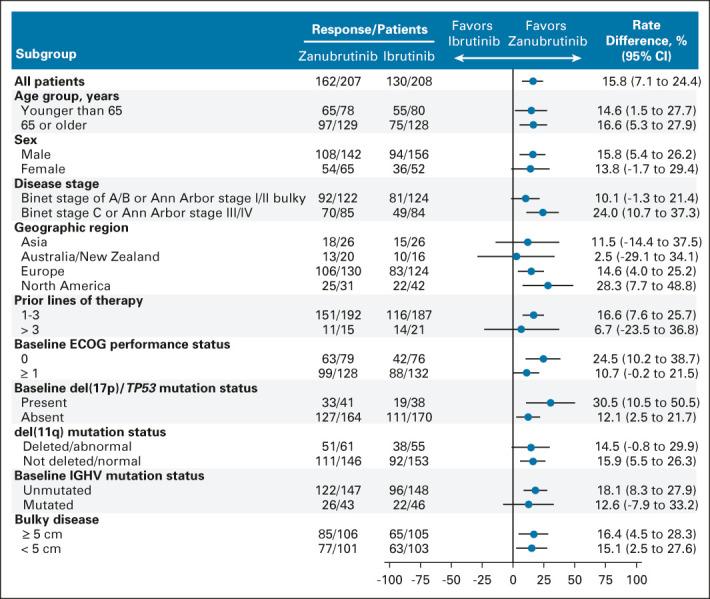
Between November 1, 2018, and December 14, 2020, 652 patients were enrolled. We present the interim analysis of the first 415 enrolled patients randomly assigned to receive zanubrutinib (n = 207) or ibrutinib (n = 208). At 15 months of median follow-up, ORR (partial or complete response) was significantly higher with zanubrutinib (78.3%; 95% CI, 72.0 to 83.7) versus ibrutinib (62.5%; 95% CI, 55.5 to 69.1; two-sided < .001). ORR was higher with zanubrutinib versus ibrutinib in subgroups with del(17p)/ mutations (80.5% 50.0%) and del(11q) (83.6% 69.1%); 12-month progression-free survival in all patients was higher with zanubrutinib (94.9%) versus ibrutinib (84.0%; hazard ratio, 0.40; 95% CI, 0.23 to 0.69). Atrial fibrillation rate was significantly lower with zanubrutinib versus ibrutinib (2.5% 10.1%; two-sided = .001). Rates of cardiac events, major hemorrhages, and adverse events leading to treatment discontinuation/death were lower with zanubrutinib.
CONCLUSION
Zanubrutinib had a significantly higher ORR, lower atrial fibrillation rate, and improved progression-free survival and overall cardiac safety profile versus ibrutinib. These data support improved efficacy/safety outcomes with selective BTK inhibition.
目的
zanubrutinib 是一种强效、不可逆的下一代布鲁顿酪氨酸激酶(BTK)抑制剂,旨在最大限度地提高 BTK 占有率并最小化脱靶激酶抑制。我们假设完全/持续的 BTK 占有率可能会提高疗效,增加 BTK 的特异性可能会最小化与脱靶抑制相关的毒性。
患者和方法
ALPINE(ClinicalTrials.gov 标识符:NCT03734016)是一项全球性、随机、开放标签的 III 期研究,比较 zanubrutinib 与伊布替尼在复发/难治性慢性淋巴细胞白血病患者中的疗效。主要终点是研究者评估的总缓解率(ORR)。该预先计划的中期分析计划在首次入组的 415 例患者后约 12 个月进行。
结果
2018 年 11 月 1 日至 2020 年 12 月 14 日期间,共入组 652 例患者。我们报告了随机分配至 zanubrutinib(n=207)或伊布替尼(n=208)的前 415 例入组患者的中期分析结果。中位随访 15 个月时,zanubrutinib 的 ORR(部分或完全缓解)显著高于伊布替尼(78.3%[95%CI,72.0 至 83.7]与 62.5%[95%CI,55.5 至 69.1%];双侧 <.001)。在伴有 del(17p)/突变(80.5% 50.0%)和 del(11q)(83.6% 69.1%)的亚组中,zanubrutinib 的 ORR 高于伊布替尼;所有患者的 12 个月无进展生存率 zanubrutinib 高于伊布替尼(94.9% 84.0%;风险比,0.40;95%CI,0.23 至 0.69)。与伊布替尼相比,zanubrutinib 的心房颤动发生率显著降低(2.5% 10.1%;双侧 =.001)。与伊布替尼相比,zanubrutinib 的心脏不良事件、大出血和导致治疗中断/死亡的不良事件发生率更低。
结论
与伊布替尼相比,zanubrutinib 的 ORR 更高,心房颤动发生率更低,无进展生存率和整体心脏安全性更好。这些数据支持选择性 BTK 抑制可改善疗效/安全性。



 Zotero 插件