
阿卡替尼与研究者选择方案治疗复发/难治性慢性淋巴细胞白血病:ASCEND试验最终结果
Acalabrutinib Versus Investigator's Choice in Relapsed/Refractory Chronic Lymphocytic Leukemia: Final ASCEND Trial Results.
作者信息
Ghia Paolo, Pluta Andrzej, Wach Małgorzata, Lysak Daniel, Šimkovič Martin, Kriachok Iryna, Illés Árpád, de la Serna Javier, Dolan Sean, Campbell Philip, Musuraca Gerardo, Jacob Abraham, Avery Eric J, Lee Jae Hoon, Usenko Ganna, Wang Min Hui, Yu Ting, Jurczak Wojciech
机构信息
Università Vita-Salute San Raffaele and IRCCS Ospedale San Raffaele, Milano, Italy.
Department of Hematological Oncology, Oncology Specialist Hospital, Brzozow, Poland.
出版信息
Hemasphere. 2022 Nov 14;6(12):e801. doi: 10.1097/HS9.0000000000000801. eCollection 2022 Dec.
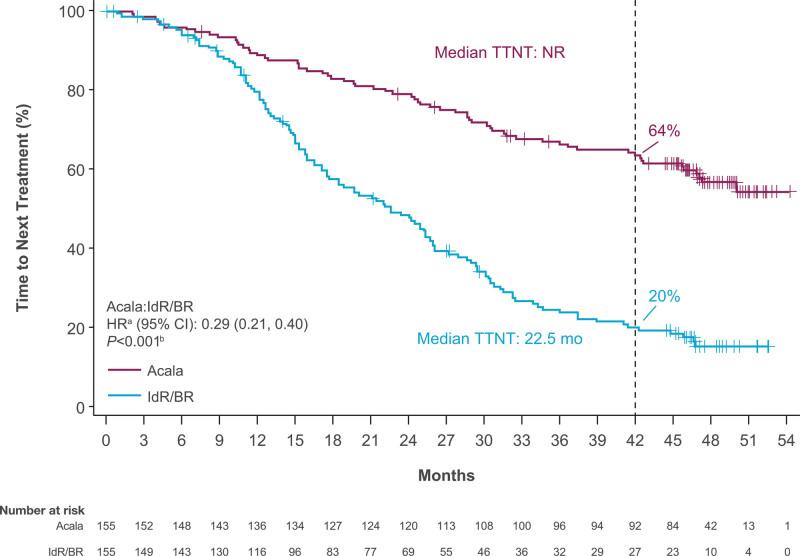
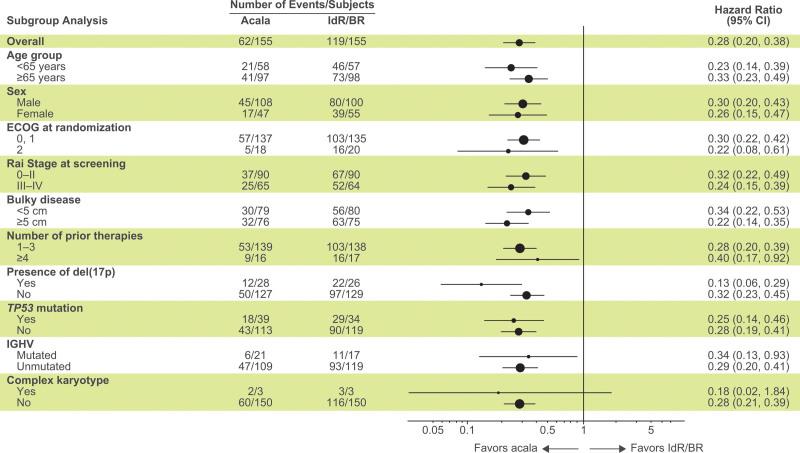
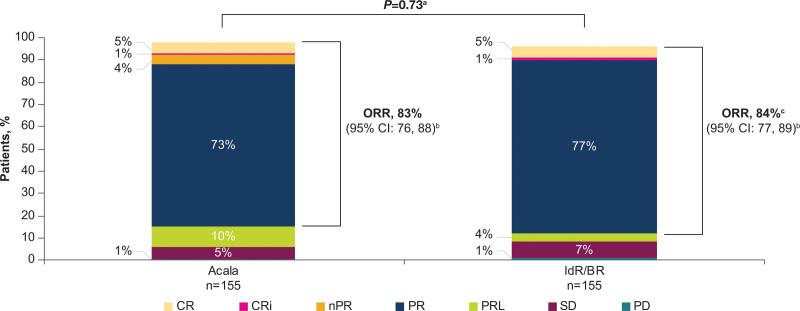
Acalabrutinib is a Bruton tyrosine kinase inhibitor approved for patients with chronic lymphocytic leukemia (CLL). ASCEND is the pivotal phase 3 study of acalabrutinib versus investigator's choice of idelalisib plus rituximab (IdR) or bendamustine plus rituximab (BR) in patients with relapsed/refractory (R/R) CLL. In the primary ASCEND analysis (median 16.1-month follow-up), acalabrutinib showed superior efficacy with an acceptable tolerability profile versus IdR/BR; here, we report final ~4 year follow-up results. Patients with R/R CLL received oral acalabrutinib 100 mg twice daily until progression or unacceptable toxicity, or investigator's choice of IdR or BR. A total of 310 patients (acalabrutinib, n = 155; IdR, n = 119; BR, n = 36) were enrolled. At median follow-up of 46.5 months (acalabrutinib) and 45.3 months (IdR/BR), acalabrutinib significantly prolonged investigator-assessed progression-free survival (PFS) versus IdR/BR (median, not reached [NR] vs 16.8 months; < 0.001); 42-month PFS rates were 62% (acalabrutinib) versus 19% (IdR/BR). Median overall survival (OS) was NR (both arms); 42-month OS rates were 78% (acalabrutinib) versus 65% (IdR/BR). Adverse events led to drug discontinuation in 23%, 67%, and 17% of patients in the acalabrutinib, IdR, and BR arms, respectively. Events of clinical interest (acalabrutinib vs IdR/BR) included all-grade atrial fibrillation/flutter (8% vs 3%), all-grade hypertension (8% vs 5%), all-grade major hemorrhage (3% vs 3%), grade ≥3 infections (29% vs 29%), and second primary malignancies excluding nonmelanoma skin cancer (7% vs 2%). At ~4 years follow-up, acalabrutinib maintained favorable efficacy versus standard-of-care regimens and a consistent tolerability profile in patients with R/R CLL.
阿卡替尼是一种已被批准用于慢性淋巴细胞白血病(CLL)患者的布鲁顿酪氨酸激酶抑制剂。ASCEND是一项关键的3期研究,比较了阿卡替尼与研究者选择的idelalisib加利妥昔单抗(IdR)或苯达莫司汀加利妥昔单抗(BR)用于复发/难治性(R/R)CLL患者的疗效。在ASCEND的主要分析中(中位随访16.1个月),与IdR/BR相比,阿卡替尼显示出更好的疗效且耐受性可接受;在此,我们报告最终约4年的随访结果。R/R CLL患者接受口服阿卡替尼100mg,每日两次,直至疾病进展或出现不可接受的毒性,或接受研究者选择的IdR或BR治疗。总共纳入了310例患者(阿卡替尼组,n = 155;IdR组,n = 119;BR组,n = 36)。在阿卡替尼组中位随访46.5个月、IdR/BR组中位随访45.3个月时,与IdR/BR相比,阿卡替尼显著延长了研究者评估的无进展生存期(PFS)(中位,未达到[NR] vs 16.8个月;P<0.001);42个月的PFS率分别为62%(阿卡替尼组)和19%(IdR/BR组)。中位总生存期(OS)均未达到(两组);42个月的OS率分别为78%(阿卡替尼组)和65%(IdR/BR组)。不良事件导致阿卡替尼组、IdR组和BR组分别有23%、67%和17%的患者停药。具有临床意义的事件(阿卡替尼组与IdR/BR组相比)包括所有级别的心房颤动/扑动(8% vs 3%)、所有级别的高血压(8% vs 5%)、所有级别的大出血(3% vs 3%)、≥3级感染(29% vs 29%)以及除外非黑色素瘤皮肤癌的第二原发性恶性肿瘤(7% vs 2%)。在约4年的随访中,与标准治疗方案相比,阿卡替尼在R/R CLL患者中维持了良好的疗效和一致的耐受性。



 Zotero 插件