
mRNA 或基于载体的 COVID-19 疫苗接种后对 SARS-CoV-2 奥密克戎变异株的中和反应减弱。
Diminished neutralization responses towards SARS-CoV-2 Omicron VoC after mRNA or vector-based COVID-19 vaccinations.
机构信息
Department of Viral Immunology, Helmholtz Centre for Infection Research, Braunschweig, Germany.
Department of Epidemiology, Helmholtz Centre for Infection Research, Braunschweig, Germany.
出版信息
Sci Rep. 2022 Nov 18;12(1):19858. doi: 10.1038/s41598-022-22552-y.
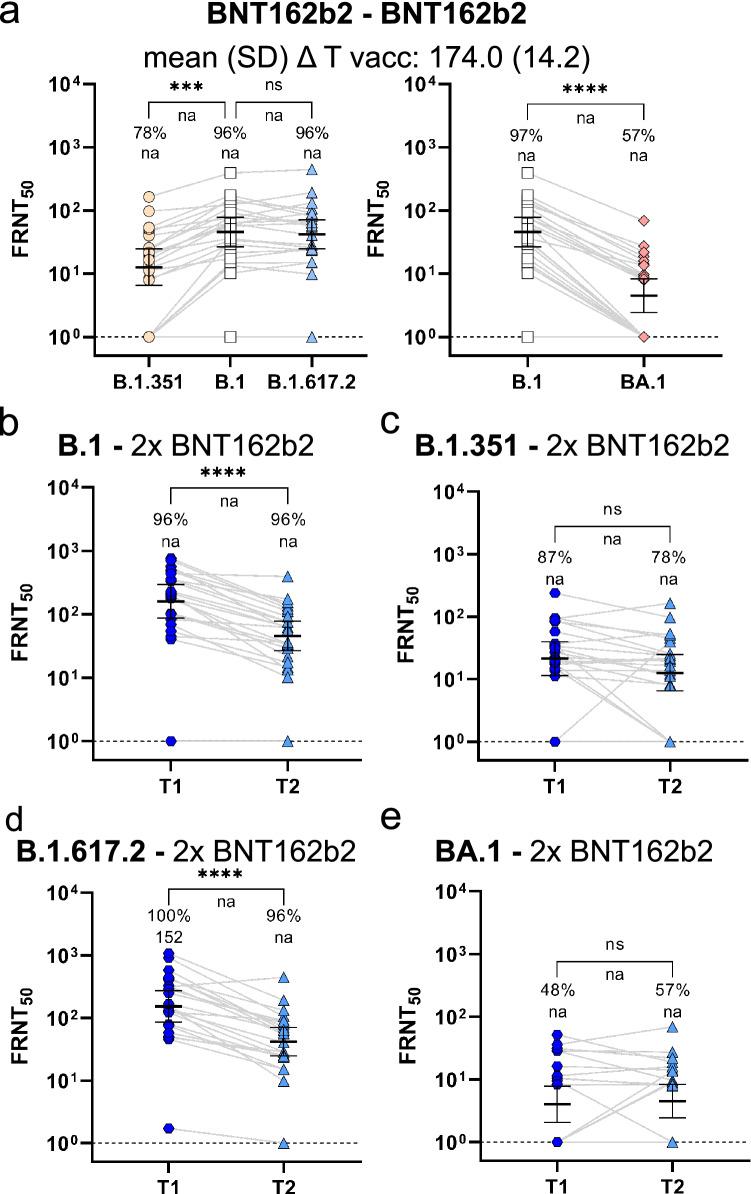
SARS-CoV-2 variants accumulating immune escape mutations provide a significant risk to vaccine-induced protection against infection. The novel variant of concern (VoC) Omicron BA.1 and its sub-lineages have the largest number of amino acid alterations in its Spike protein to date. Thus, they may efficiently escape recognition by neutralizing antibodies, allowing breakthrough infections in convalescent and vaccinated individuals in particular in those who have only received a primary immunization scheme. We analyzed neutralization activity of sera from individuals after vaccination with all mRNA-, vector- or heterologous immunization schemes currently available in Europe by in vitro neutralization assay at peak response towards SARS-CoV-2 B.1, Omicron sub-lineages BA.1, BA.2, BA.2.12.1, BA.3, BA.4/5, Beta and Delta pseudotypes and also provide longitudinal follow-up data from BNT162b2 vaccinees. All vaccines apart from Ad26.CoV2.S showed high levels of responder rates (96-100%) towards the SARS-CoV-2 B.1 isolate, and minor to moderate reductions in neutralizing Beta and Delta VoC pseudotypes. The novel Omicron variant and its sub-lineages had the biggest impact, both in terms of response rates and neutralization titers. Only mRNA-1273 showed a 100% response rate to Omicron BA.1 and induced the highest level of neutralizing antibody titers, followed by heterologous prime-boost approaches. Homologous BNT162b2 vaccination, vector-based AZD1222 and Ad26.CoV2.S performed less well with peak responder rates of 48%, 56% and 9%, respectively. However, Omicron responder rates in BNT162b2 recipients were maintained in our six month longitudinal follow-up indicating that individuals with cross-protection against Omicron maintain it over time. Overall, our data strongly argue for booster doses in individuals who were previously vaccinated with BNT162b2, or a vector-based primary immunization scheme.
SARS-CoV-2 变体积累免疫逃逸突变,对感染疫苗诱导的保护构成重大风险。新型关注变体(VOC)奥密克戎 BA.1 及其亚谱系在其刺突蛋白中具有迄今为止最多的氨基酸改变。因此,它们可能有效地逃避中和抗体的识别,导致在恢复期和接种疫苗的个体中发生突破性感染,特别是在那些仅接受过初级免疫方案的个体中。我们通过体外中和测定分析了目前在欧洲可用的所有 mRNA、载体或异源免疫方案接种个体的血清中和活性,针对 SARS-CoV-2 B.1、奥密克戎亚谱系 BA.1、BA.2、BA.2.12.1、BA.3、BA.4/5、Beta 和 Delta 假型的峰值反应,并提供了 BNT162b2 疫苗接种者的纵向随访数据。除了 Ad26.CoV2.S 之外,所有疫苗对 SARS-CoV-2 B.1 分离株的反应率均达到了很高的水平(96-100%),对 Beta 和 Delta VOC 假型的中和能力略有降低。新型奥密克戎变体及其亚谱系的影响最大,无论是在反应率还是中和滴度方面。只有 mRNA-1273 对奥密克戎 BA.1 的反应率达到 100%,并诱导最高水平的中和抗体滴度,其次是异源初免-加强方案。同源 BNT162b2 疫苗接种、基于载体的 AZD1222 和 Ad26.CoV2.S 的表现较差,峰值反应率分别为 48%、56%和 9%。然而,在我们的六个月纵向随访中,BNT162b2 接种者对奥密克戎的反应率保持不变,表明对奥密克戎具有交叉保护的个体随着时间的推移会持续保持这种保护。总体而言,我们的数据强烈支持对先前接种过 BNT162b2 或基于载体的初级免疫方案的个体进行加强剂量接种。

 Zotero 插件