
FGFR2 扩增的肿瘤克隆在上消化道癌中呈显著异质性分布。
FGFR2-amplified tumor clones are markedly heterogeneously distributed in carcinomas of the upper gastrointestinal tract.
机构信息
Institute of Pathology, University Hospital Cologne, Kerpener Street 62, 50937, Cologne, Germany.
Department of General, Visceral and Cancer Surgery, University Hospital Cologne, Cologne, Germany.
出版信息
J Cancer Res Clin Oncol. 2023 Jul;149(8):5289-5300. doi: 10.1007/s00432-022-04460-w. Epub 2022 Nov 23.
BACKGROUND
FGFR2 is a therapy-relevant target in tumors of the upper gastrointestinal tract (GIT), and clinical trials are currently underway to test the efficacy of FGFR2 inhibitors. Tumor heterogeneity is one of the relevant causes of treatment failure. Almost nothing is known about the heterogeneous distribution of FGFR2-amplified clones in adenocarcinomas of the upper GIT.
PATIENTS AND METHODS
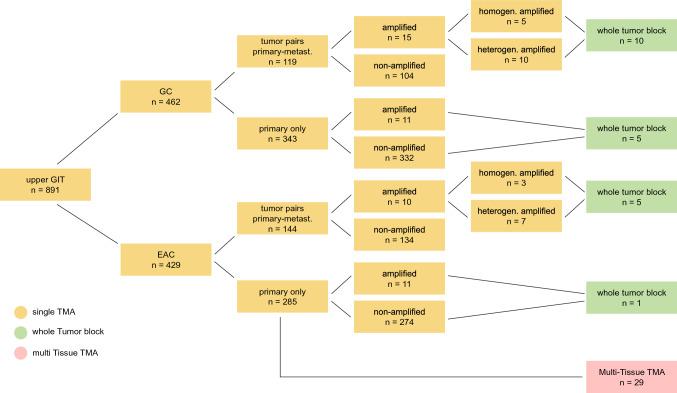
To assess FGFR2 gene copy number alteration and intratumoral heterogeneity of upper GIT adenocarcinomas, we analyzed 893 patient-derived formalin-fixed paraffin-embedded tumor specimens, including primary operated and neoadjuvant-treated tumors (462 gastric carcinomas and 429 esophageal adenocarcinomas) as well as complementary lymph node and distant metastasis by fluorescence in situ hybridization.
RESULTS
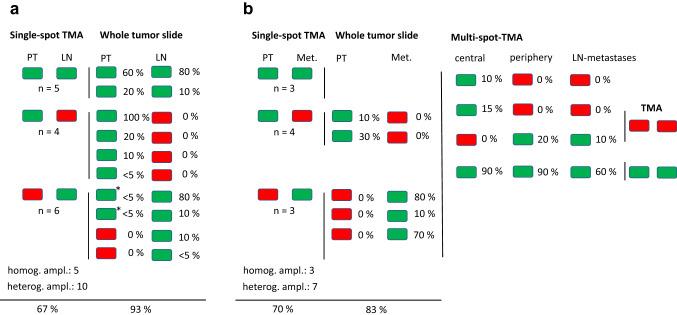
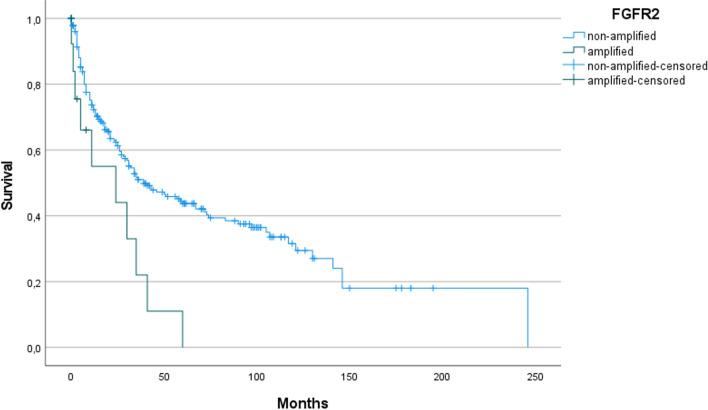
Twenty-six gastric tumors (5.6%) and 21 esophageal adenocarcinomas (4.9%) showed FGFR2 amplification. Overall, 93% of gastric carcinomas and 83% of esophageal carcinomas showed heterogeneous amplification. FGFR2 amplification was found in different histological growth patterns, including intestinal and diffuse type according to the Lauren classification. In the primary gastric carcinoma group, FGFR2 amplification was associated with poor prognosis (p = 0.005).
CONCLUSION
Homogeneous FGFR2 amplification in tumors of the upper GIT is the exception. This has highly relevant implications in the nature of FGFR2 diagnostics (sufficient tumor cell number, determination of amplification at metastasis versus primary tumor, etc.) and on the response probability of appropriate inhibitors. It is relevant that the often poorly treatable and aggressive subtype of diffuse carcinomas (poorly cohesive carcinomas) also shows FGFR2 amplification and that an individualized therapy option with FGFR2 inhibitors could be an option in this group.
背景
FGFR2 是上消化道(GIT)肿瘤的治疗相关靶点,目前正在进行临床试验以测试 FGFR2 抑制剂的疗效。肿瘤异质性是治疗失败的相关原因之一。几乎不知道在上消化道腺癌中 FGFR2 扩增克隆的异质性分布。
患者和方法
为了评估上消化道腺癌中 FGFR2 基因拷贝数改变和肿瘤内异质性,我们通过荧光原位杂交分析了 893 例患者来源的福尔马林固定石蜡包埋肿瘤标本,包括原发性手术和新辅助治疗的肿瘤(462 例胃癌和 429 例食管腺癌)以及补充的淋巴结和远处转移。
结果
26 例胃癌(5.6%)和 21 例食管腺癌(4.9%)显示 FGFR2 扩增。总体而言,93%的胃癌和 83%的食管腺癌表现为异质性扩增。FGFR2 扩增存在于不同的组织学生长模式中,包括根据 Lauren 分类的肠型和弥漫型。在原发性胃癌组中,FGFR2 扩增与预后不良相关(p=0.005)。
结论
上消化道肿瘤中同质 FGFR2 扩增是例外。这在 FGFR2 诊断的性质(足够的肿瘤细胞数量、确定转移与原发性肿瘤的扩增等)以及适当抑制剂的反应概率方面具有重要意义。弥漫型癌(黏附性差的癌)这种通常治疗效果差且侵袭性强的亚型也显示 FGFR2 扩增,并且 FGFR2 抑制剂的个体化治疗选择可能是该组的一个选择。

 Zotero 插件