
根瘤菌属(Azospirillum)Sp245 中的 GGDEF-EAL 蛋白 CdgB 是一种具有潜在极性定位的双功能酶。
The GGDEF-EAL protein CdgB from Azospirillum baldaniorum Sp245, is a dual function enzyme with potential polar localization.
机构信息
Laboratorio de la Interacción bacteria-planta, Centro de Investigaciones en Ciencias Microbiológicas, Benemérita Universidad Autónoma de Puebla, Puebla Pue, México.
Programa de Biología de Sistemas y Biología Sintética, Centro de Ciencias Genómicas, Universidad Nacional Autónoma de México, Cuernavaca, México.
出版信息
PLoS One. 2022 Nov 23;17(11):e0278036. doi: 10.1371/journal.pone.0278036. eCollection 2022.
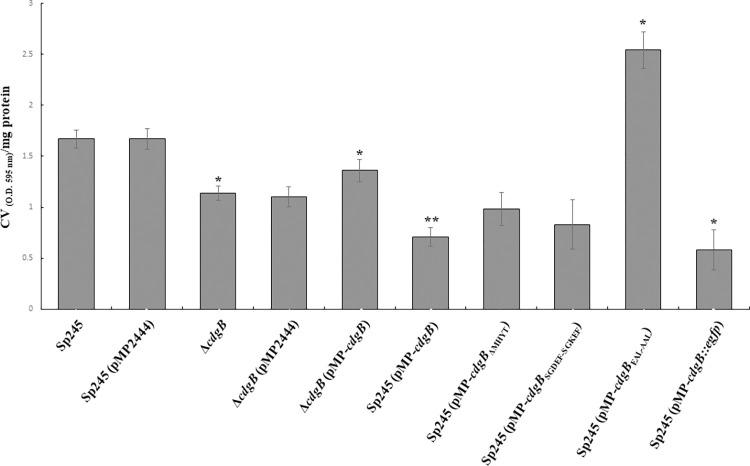
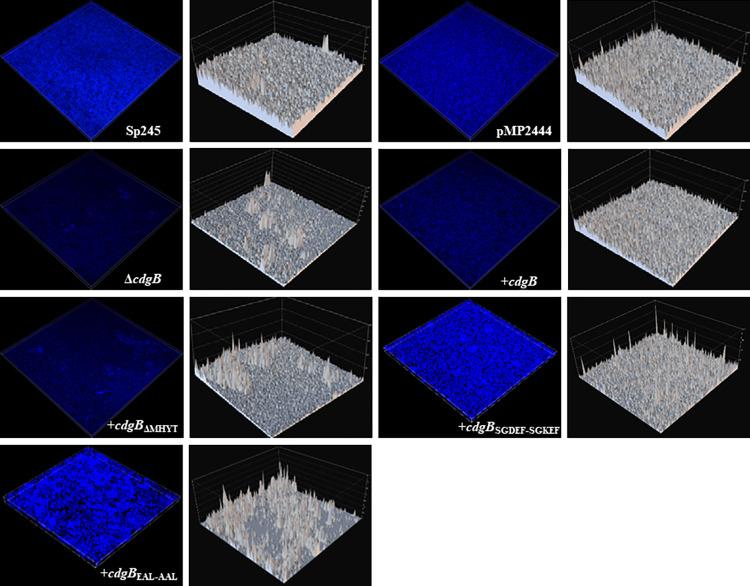
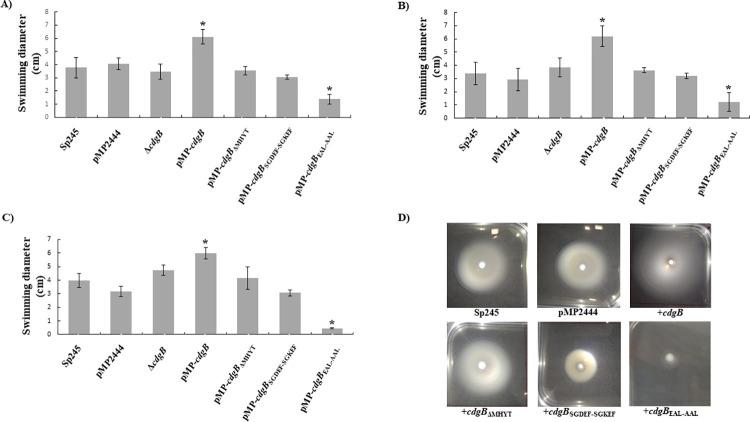
Azospirillum baldaniorum Sp245, a plant growth-promoting rhizobacterium, can form biofilms through a process controlled by the second messenger cyclic diguanylate monophosphate (c-di-GMP). A. baldaniorum has a variety of proteins potentially involved in controlling the turnover of c-di-GMP many of which are coupled to sensory domains that could be involved in establishing a mutualistic relationship with the host. Here, we present in silico analysis and experimental characterization of the function of CdgB (AZOBR_p410089), a predicted MHYT-PAS-GGDEF-EAL multidomain protein from A. baldaniorum Sp245. When overproduced, CdgB behaves predominantly as a c-di-GMP phosphodiesterase (PDE) in A. baldaniorum Sp245. It inhibits biofilm formation and extracellular polymeric substances production and promotes swimming motility. However, a CdgB variant with a degenerate PDE domain behaves as diguanylate cyclase (DGC). This strongly suggest that CdgB is capable of dual activity. Variants with alterations in the DGC domain and the MHYT domain negatively affects extracellular polymeric substances production and induction of swimming motility. Surprisingly, we observed that overproduction of CdgB results in increased c-di-GMP accumulation in the heterologous host Escherichia coli, suggesting under certain conditions, the WT CdgB variant can behave predominantly as a DGC. Furthermore, we also demonstrated that CdgB is anchored to the cell membrane and localizes potentially to the cell poles. This localization is dependent on the presence of the MHYT domain. In summary, our results suggest that CdgB can provide versatility to signaling modules that control motile and sessile lifestyles in response to key environmental signals in A. baldaniorum.
根瘤固氮螺菌 Sp245 是一种能促进植物生长的根瘤菌,它可以通过二信使环二鸟苷酸(c-di-GMP)控制的过程形成生物膜。根瘤固氮螺菌有多种潜在参与控制 c-di-GMP 周转的蛋白,其中许多与感应域相连,这些感应域可能参与与宿主建立共生关系。在这里,我们对根瘤固氮螺菌 Sp245 中一种预测的 MHYT-PAS-GGDEF-EAL 多结构域蛋白 CdgB(AZOBR_p410089)进行了计算机分析和功能表征。当过度表达时,CdgB 在根瘤固氮螺菌 Sp245 中主要表现为 c-di-GMP 磷酸二酯酶(PDE)。它抑制生物膜形成和胞外聚合物的产生,并促进泳动运动。然而,一个具有退化 PDE 结构域的 CdgB 变体表现为双鸟苷酸环化酶(DGC)。这强烈表明 CdgB 具有双重活性。在 DGC 结构域和 MHYT 结构域发生改变的变体中,胞外聚合物的产生和诱导泳动运动的能力受到负面影响。令人惊讶的是,我们观察到 CdgB 的过度表达导致异源宿主大肠杆菌中 c-di-GMP 的积累增加,这表明在某些条件下,WT CdgB 变体可以主要表现为 DGC。此外,我们还证明了 CdgB 被锚定在细胞膜上,并可能定位于细胞的两极。这种定位依赖于 MHYT 结构域的存在。总之,我们的结果表明,CdgB 可以为信号模块提供多功能性,以响应根瘤固氮螺菌中的关键环境信号,控制游动和定殖生活方式。




 Zotero 插件