
神经元表面抗体相关自身免疫性脑炎中 CSF 白蛋白商的评估。
Evaluation of CSF albumin quotient in neuronal surface antibody-associated autoimmune encephalitis.
机构信息
Department of Neurology, Zhejiang Hospital, Hangzhou, 310013, China.
Department of Neurology, Second Affiliated Hospital, School of Medicine, Zhejiang University, Hangzhou, 310009, China.
出版信息
Fluids Barriers CNS. 2022 Nov 23;19(1):93. doi: 10.1186/s12987-022-00392-2.
BACKGROUND AND OBJECTIVES
Disruption of brain barriers is considered to be involved in the pathogenesis of neuronal surface antibody-associated autoimmune encephalitis (NSAE), but few studies have focused on their relationship. We aimed to explore the association between the integrity of brain barriers and clinical and paraclinical characteristics in patients with NSAE.
METHODS
This retrospective study consecutively recruited patients with NSAE. The cerebrospinal fluid (CSF) / serum albumin quotient (Qalb) was used to evaluate the function of brain barriers. The data on demographic information, clinical manifestations, magnetic resonance imaging (MRI), CSF findings and prognosis were collected and analyzed.
RESULTS
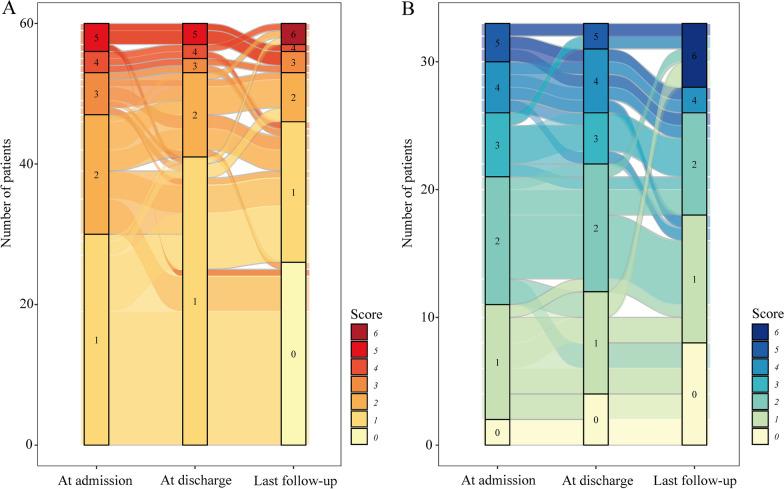
Of the 93 patients included, 33 (35.5%) patients were assigned to the elevated Qalb group and 60 (64.5%) patients to the normal Qalb group. Males and prodromal symptoms were more common in elevated Qalb group (both P < 0.05). The CSF white blood cell, protein, immunoglobulin G and albumin were significantly higher in elevated Qalb group (all P < 0.05). Patients with elevated Qalb were more likely to have brain lesions on MRI (60.6% versus 33.3%, P = 0.011). The modified Rankin Scale (mRS) scores at discharge and at last follow-up were significantly higher in patients with elevated Qalb than those with normal Qalb (both P < 0.05). After univariate and multivariate analyses, Qalb elevation (adjusted odds ratio = 3.96, 95% confidence interval = 1.15-13.59, P = 0.029) was demonstrated as the only independent risk factor for a poor prognosis.
DISCUSSION
Males, prodromal symptoms, brain lesions on MRI, CSF pleocytosis, and elevated CSF protein were more common in NSAE patients with increased Qalb. Qalb elevation was an independent prognostic indicator for a poor prognosis in NSAE.
背景与目的
脑屏障破坏被认为与神经元表面抗体相关自身免疫性脑炎(NSAE)的发病机制有关,但很少有研究关注它们之间的关系。我们旨在探讨 NSAA 患者脑屏障完整性与临床和临床前特征的关系。
方法
本回顾性研究连续纳入 NSAA 患者。采用脑脊液(CSF)/血清白蛋白商(Qalb)评估脑屏障功能。收集并分析患者的人口统计学信息、临床表现、磁共振成像(MRI)、CSF 结果和预后数据。
结果
93 例患者中,33 例(35.5%)患者 Qalb 升高,60 例(64.5%)患者 Qalb 正常。升高组中男性和前驱症状更常见(均 P<0.05)。升高组 CSF 白细胞、蛋白、免疫球蛋白 G 和白蛋白均显著升高(均 P<0.05)。升高组 MRI 脑病变更常见(60.6%比 33.3%,P=0.011)。升高组患者出院时和末次随访时改良 Rankin 量表(mRS)评分显著高于正常组(均 P<0.05)。单因素和多因素分析显示,Qalb 升高(调整比值比=3.96,95%置信区间=1.15-13.59,P=0.029)是预后不良的唯一独立危险因素。
讨论
Qalb 升高的 NSAA 患者中更常见男性、前驱症状、MRI 脑病变、CSF 白细胞增多和 CSF 蛋白升高。Qalb 升高是 NSAA 预后不良的独立预测指标。

 Zotero 插件