
膜与流道发展对油/水乳液过滤性能和能源足迹的综合影响
The Combined Effects of the Membrane and Flow Channel Development on the Performance and Energy Footprint of Oil/Water Emulsion Filtration.
作者信息
Barambu Nafiu Umar, Bilad Muhammad Roil, Shamsuddin Norazanita, Samsuri Shafirah, Nordin Nik Abdul Hadi Md, Arahman Nasrul
机构信息
Chemical Engineering Department, Universiti Teknologi PETRONAS, Bandar Seri Iskandar 32610, Perak, Malaysia.
Faculty of Integrated Technologies, Universiti Brunei Darussalam, Jalan Tungku Link, Gadong BE1410, Brunei.
出版信息
Membranes (Basel). 2022 Nov 16;12(11):1153. doi: 10.3390/membranes12111153.
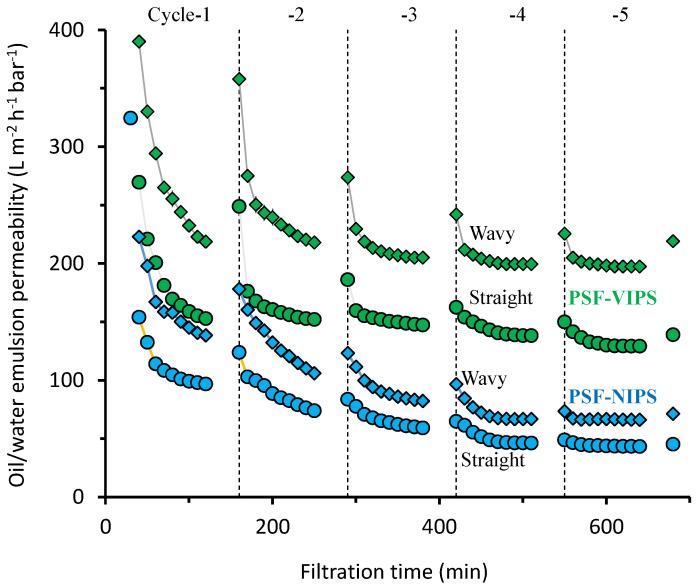
Membrane filtration is a promising technology for oil/water emulsion filtration due to its excellent removal efficiency of microdroplets of oil in water. However, its performance is highly limited due to the fouling-prone nature of oil droplets on hydrophobic membranes. Membrane filtration typically suffers from a low flux and high pumping energy. This study reports a combined approach to tackling the membrane fouling challenge in oil/water emulsion filtration via a membrane and a flow channel development. Two polysulfone (PSF)-based lab-made membranes, namely PSF- PSF-Nonsolvent induced phase separation (NIPS) and PSF-Vapor-induced phase separation (VIPS), were selected, and the flow channel was modified into a wavy path. They were assessed for the filtration of a synthetic oil/water emulsion. The results showed that the combined membrane and flow channel developments enhanced the clean water permeability with a combined increment of 105%, of which 34% was attributed to the increased effective filtration area due to the wavy flow channel. When evaluated for the filtration of an oil/water emulsion, a 355% permeability increment was achieved from 43 for the PSF-NIPS in the straight flow channel to 198 L m h bar for the PSF-VIPS in the wavy flow channel. This remarkable performance increment was achieved thanks to the antifouling attribute of the developed membrane and enhanced local mixing by the wavy flow channel to limit the membrane fouling. The increase in the filtration performance was translated into up to 78.4% (0.00133 vs. 0.00615 kWh m) lower in pumping energy. The overall findings demonstrate a significant improvement by adopting multi-pronged approaches in tackling the challenge of membrane fouling for oil/water emulsion filtration, suggesting the potential of this approach to be applied for other feeds.
膜过滤因其对水中油微滴的出色去除效率,是一种用于油/水乳液过滤的很有前景的技术。然而,由于油滴在疏水膜上容易产生污染,其性能受到很大限制。膜过滤通常存在通量低和泵送能量高的问题。本研究报告了一种通过膜和流道改进来应对油/水乳液过滤中膜污染挑战的组合方法。选择了两种基于聚砜(PSF)的实验室自制膜,即PSF-非溶剂诱导相分离(NIPS)膜和PSF-蒸汽诱导相分离(VIPS)膜,并将流道改造成波浪形路径。对它们进行了合成油/水乳液过滤的评估。结果表明,膜和流道的组合改进提高了清水渗透率,综合增量为105%,其中34%归因于波浪形流道增加了有效过滤面积。在对油/水乳液过滤进行评估时,渗透率从直流通道中PSF-NIPS膜的43 L m h bar提高到波浪形流道中PSF-VIPS膜的198 L m h bar,实现了355%的增量。这种显著的性能提升得益于所开发膜的抗污染特性以及波浪形流道增强的局部混合,从而限制了膜污染。过滤性能的提高转化为泵送能量降低了78.4%(从0.00615 kWh m降至0.00133 kWh m)。总体研究结果表明,采用多管齐下的方法应对油/水乳液过滤中的膜污染挑战有显著改进,表明这种方法有应用于其他进料的潜力。


 Zotero 插件