
采用环保制冷剂 R290-R170 的超低温级联冷冻机的运行性能。
Operation performance of an ultralow-temperature cascade refrigeration freezer with environmentally friendly refrigerants R290-R170.
机构信息
School of Mechanical and Electrical Engineering, University of Electronic Science and Technology of China, Zhongshan Institute, Zhongshan, 528400, China.
Zhongshan Candor Electrical Appliances Company Limited, Zhongshan, 528427, China.
出版信息
Environ Sci Pollut Res Int. 2023 Mar;30(11):29790-29806. doi: 10.1007/s11356-022-24310-z. Epub 2022 Nov 23.
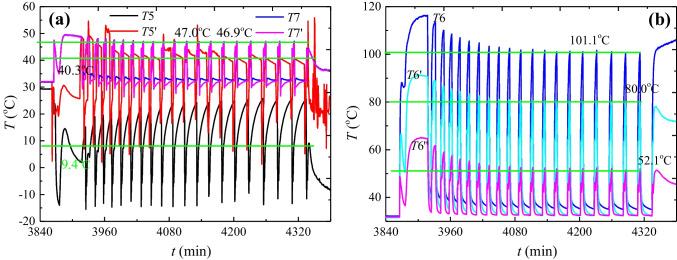
In the present study, the operation performance of an ultralow-temperature cascade refrigeration freezer is experimentally researched. The natural refrigerants R290-R170 are adopted as high-temperature and low-temperature fluids. The experimental test is conducted in a type laboratory with a dry bulb temperature of 32.0 °C and a wet bulb temperature of 26.5 °C. Different state monitors are set to display the system operation performance, and several temperature monitors are arranged to study the pull-down performance and temperature variations in the freezer. Based on the established experimental rig, three freezing temperatures, including - 40 °C, - 80 °C, and - 86 °C, are measured and compared. The results show that it takes about 240 min for the freezer to be pulled down to - 80 °C. During the pull-down period, different monitors all experience rapid temperature drop, and the power consumption reduces from 1461.4 W to 997.5 W. Once the target temperature is achieved, the freezer comes into periodic start-stop operation. With the set temperature ranging from - 40 °C to - 86 °C, the inlet temperature of two compressors gradually decreases, while the discharge temperature has an increase trend. The cooling effect of the pre-cooled condenser reduces with the freezing temperature, while the long connection pipe has opposite variation profile. Moreover, it is observed that for different freezing temperatures, most of the space in the freezer can be cooled down to the target temperature. It is confirmed that the present ultralow-temperature freezer can be used for the storage and transportation of COVID-19 vaccines. However, it is also found that the cascade refrigeration system is not suitable for high freezing temperature, due to high power consumption and extensive start-stop switch of refrigeration system.
在本研究中,对超低温级联制冷冷冻箱的运行性能进行了实验研究。采用 R290-R170 作为高温和低温工质。在干球温度为 32.0°C、湿球温度为 26.5°C 的类型实验室中进行了实验测试。设置了不同的状态监测器来显示系统运行性能,并布置了几个温度监测器来研究冷冻箱的下拉性能和温度变化。基于建立的实验台,测量并比较了三个冷冻温度,分别为-40°C、-80°C 和-86°C。结果表明,冷冻箱需要约 240 分钟才能降至-80°C。在下拉期间,不同的监测器都经历了快速的温度下降,功耗从 1461.4W 降低到 997.5W。一旦达到目标温度,冷冻箱就会进入周期性的启动-停止运行。随着设定温度在-40°C 到-86°C 之间变化,两个压缩机的入口温度逐渐降低,而排放温度呈上升趋势。预冷冷凝器的冷却效果随着冷冻温度的降低而降低,而长连接管则呈现相反的变化趋势。此外,观察到对于不同的冷冻温度,冷冻箱的大部分空间都可以冷却到目标温度。证实了目前的超低温冷冻箱可用于储存和运输 COVID-19 疫苗。然而,也发现级联制冷系统不适合高冷冻温度,因为制冷系统的功耗高且频繁启动和停止。




 Zotero 插件