
在预测的环境浓度下接触纳米塑料会导致种系 Ephrin 信号激活,这与后代毒性形成有关。
Nanoplastic Exposure at Predicted Environmental Concentrations Induces Activation of Germline Ephrin Signal Associated with Toxicity Formation in the Offspring.
作者信息
Zhao Yue, Hua Xin, Bian Qian, Wang Dayong
机构信息
Key Laboratory of Environmental Medicine Engineering in Ministry of Education, Medical School, Southeast University, Nanjing 210009, China.
Institute of Toxicology and Risk Assessment, Jiangsu Provincial Center for Disease Control and Prevention, Nanjing 210009, China.
出版信息
Toxics. 2022 Nov 17;10(11):699. doi: 10.3390/toxics10110699.
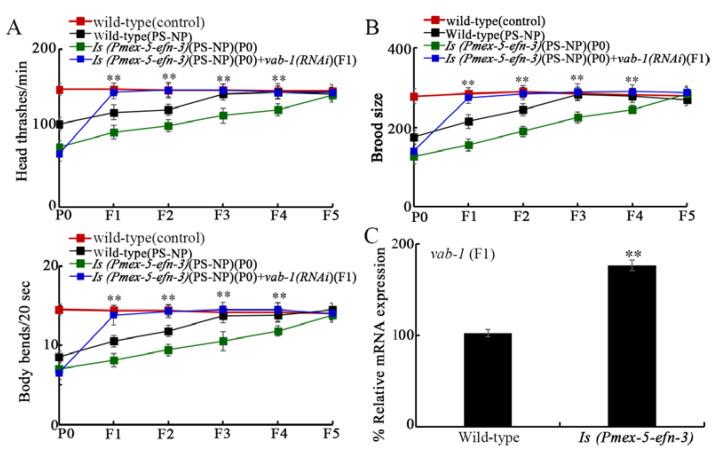
In nematode , exposure to polystyrene nanoparticles (PS-NPs) at predicted environmental concentrations can cause induction of transgenerational toxicity. However, the underlying mechanisms for toxicity formation of PS-NP in the offspring remain largely unknown. In this study, based on high-throughput sequencing, Ephrin ligand EFN-3 was identified as a target of KSR-1/2 (two kinase suppressors of Ras) in the germline during the control of transgenerational PS-NP toxicity. At parental generation (P0-G), exposure to 0.1-10 μg/L PS-NP caused the increase in expression of germline , and this increase in germline expression could be further detected in the offspring, such as F1-G and F2-G. Germline RNAi of caused a resistance to transgenerational PS-NP toxicity, suggesting that the activation of germline EFN-3 at P0-G mediated transgenerational PS-NP toxicity. In the offspring, Ephrin receptor VAB-1 was further activated by the increased EFN-3 caused by PS-NP exposure at P0-G, and RNAi of also resulted in resistance to transgenerational PS-NP toxicity. VAB-1 acted in both the neurons and the germline to control toxicity of PS-NP in the offspring. In the neurons, VAB-1 regulated PS-NP toxicity by suppressing expressions of DBL-1, JNK-1, MPK-1, and GLB-10. In the germline, VAB-1 regulated PS-NP toxicity by increasing NDK-1 and LIN-23 expressions and decreasing EGL-1 expression. Therefore, germline Ephrin ligand EFN-3 and its receptor VAB-1 acted together to mediate the formation of transgenerational PS-NP toxicity. Our data highlight the important role of activation in germline Ephrin signals in mediating transgenerational toxicity of nanoplastics at predicted environmental concentrations in organisms.
在线虫中,暴露于预测环境浓度的聚苯乙烯纳米颗粒(PS-NPs)会导致跨代毒性的诱导。然而,PS-NP在后代中形成毒性的潜在机制在很大程度上仍然未知。在本研究中,基于高通量测序,在跨代PS-NP毒性控制过程中,Ephrin配体EFN-3被鉴定为生殖系中KSR-1/2(Ras的两个激酶抑制因子)的靶点。在亲代(P0-G),暴露于0.1-10μg/L的PS-NP会导致生殖系表达增加,并且这种生殖系表达的增加在后代中,如F1-G和F2-G中也能进一步检测到。对EFN-3进行生殖系RNA干扰导致对跨代PS-NP毒性产生抗性,这表明P0-G时生殖系EFN-3的激活介导了跨代PS-NP毒性。在后代中,P0-G时PS-NP暴露导致的EFN-3增加进一步激活了Ephrin受体VAB-1,对VAB-1进行RNA干扰也导致对跨代PS-NP毒性产生抗性。VAB-1在神经元和生殖系中都发挥作用,以控制后代中PS-NP的毒性。在神经元中,VAB-1通过抑制DBL-1、JNK-1、MPK-1和GLB-10的表达来调节PS-NP毒性。在生殖系中,VAB-1通过增加NDK-1和LIN-23的表达以及降低EGL-1的表达来调节PS-NP毒性。因此,生殖系Ephrin配体EFN-3及其受体VAB-1共同作用介导了跨代PS-NP毒性的形成。我们的数据突出了生殖系Ephrin信号激活在介导生物体中预测环境浓度下纳米塑料跨代毒性方面的重要作用。



 Zotero 插件