
间歇性能量限制与持续能量限制联合高强度间歇训练对超重/肥胖成年人的不同影响:一项随机对照试验。
Differential effects of intermittent energy restriction vs. continuous energy restriction combined high-intensity interval training on overweight/obese adults: A randomized controlled trial.
作者信息
Xu Rui, Cao You-Xiang, Chen Yu-Ting, Jia Yu-Qi
机构信息
School of Sports and Health, Nanjing Sport Institute, Nanjing, China.
Laboratory of Kinesiology, Nanjing Sport Institute, Nanjing, China.
出版信息
Front Nutr. 2022 Nov 8;9:979618. doi: 10.3389/fnut.2022.979618. eCollection 2022.
BACKGROUND
Intermittent energy restriction (IER) and continuous energy restriction (CER) are increasingly popular dietary approaches used for weight loss and overall health. These energy restriction protocols combined with exercise on weight loss and other health outcomes could achieve additional effects in a short-term intervention.
OBJECTIVES
To evaluate the effects of a 4-week IER or CER program on weight, blood lipids, and CRF in overweight/obese adults when combined with high-intensity interval training (HIIT).
METHODS
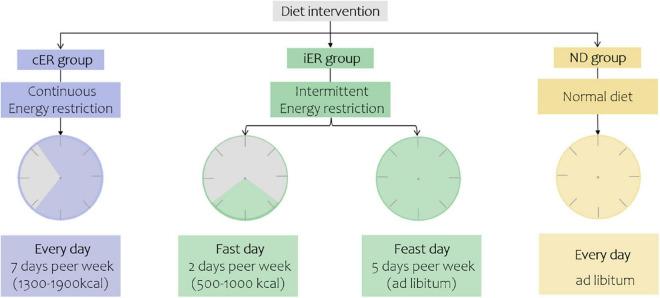
Forty-eight overweight/obese adults [age: 21.3 ± 2.24 years, body mass index (BMI): 25.86 ± 2.64 kg⋅m] were randomly assigned to iER, cER, and normal diet (ND) groups ( = 16 per group), each consisting of a 4-week intervention. All of the groups completed HIIT intervention (3 min at 80% of V̇O followed by 3 min at 50% of V̇O ), 30 min/training sessions, five sessions per week. iER subjects consumed 30% of energy needs on 2 non-consecutive days/week, and 100% of energy needs on another 5 days; cER subjects consumed 70% of energy needs; and ND subjects consumed 100% of energy needs. Body composition, waist circumference (WC) and hip circumference (HC), triglyceride (TG), total cholesterol (TC), low-density lipoprotein-cholesterol (LDL-c), high-density lipoprotein-cholesterol (HDL-c), and cardiorespiratory fitness (CRF) were measured before and after the intervention.
RESULTS
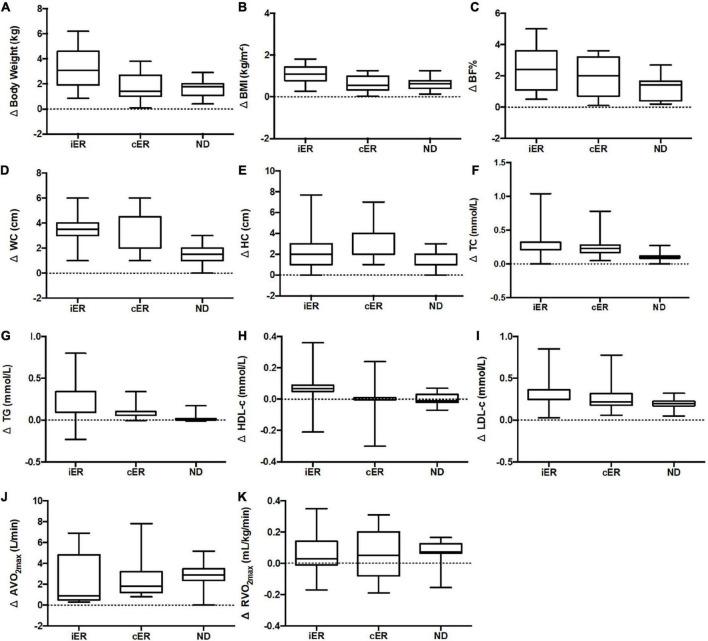
Of the total 57 participants who underwent randomization, 48 (84.2%) completed the 4-week intervention. After intervention body composition and body circumference decreased in three groups, but no significant differences between groups. The iER tends to be superior to cER in the reduction of body composition and body circumference. The mean body weight loss was 4.57 kg (95% confidence interval [CI], 4.1-5.0, < 0.001) in iER and 2.46 kg (95% CI, 4.1-5.0, < 0.001) in iER. The analyses of BMI, BF%, WC, and HC were consistent with the primary outcome results. In addition, TG, TC, HDL-c, and CRF improved after intervention but without significant changes ( > 0.05).
CONCLUSION
Both IER and CER could be effective in weight loss and increased CRF when combined with HIIT. However, iER showed greater benefits for body weight, BF%, WC, and HC compared with cER.
背景
间歇性能量限制(IER)和持续性能量限制(CER)是越来越流行的用于减肥和促进整体健康的饮食方法。这些能量限制方案与运动相结合对体重减轻和其他健康结果的影响,在短期干预中可能会产生额外的效果。
目的
评估为期4周的IER或CER方案与高强度间歇训练(HIIT)相结合时,对超重/肥胖成年人的体重、血脂和心肺功能的影响。
方法
48名超重/肥胖成年人[年龄:21.3±2.24岁,体重指数(BMI):25.86±2.64kg·m²]被随机分为IER组、CER组和正常饮食(ND)组(每组n = 16),每组进行为期4周的干预。所有组均完成HIIT干预(以80%的最大摄氧量运动3分钟,随后以50%的最大摄氧量运动3分钟),每次训练30分钟,每周训练5次。IER组受试者每周2个非连续日摄入30%的能量需求,另外5天摄入100%的能量需求;CER组受试者摄入70%的能量需求;ND组受试者摄入100%的能量需求。在干预前后测量身体成分、腰围(WC)和臀围(HC)、甘油三酯(TG)、总胆固醇(TC)、低密度脂蛋白胆固醇(LDL-c)、高密度脂蛋白胆固醇(HDL-c)和心肺适能(CRF)。
结果
在总共57名接受随机分组的参与者中,48名(84.2%)完成了为期4周的干预。干预后,三组的身体成分和身体周长均下降,但组间无显著差异。IER组在身体成分和身体周长的降低方面往往优于CER组。IER组的平均体重减轻为4.57kg(95%置信区间[CI],4.1 - 5.0,P < 0.001),CER组为2.46kg(95%CI,4.1 - 5.0,P < 0.001)。BMI、体脂百分比、WC和HC的分析结果与主要结局结果一致。此外,干预后TG、TC、HDL-c和CRF有所改善,但无显著变化(P > 0.05)。
结论
IER和CER与HIIT相结合时均可有效减轻体重并提高CRF。然而,与CER相比,IER在体重、体脂百分比、WC和HC方面显示出更大的益处。

 Zotero 插件