
利用叶提取物绿色合成氧化锌纳米颗粒:表征、抗菌、抗氧化及光催化活性
Green synthesis of zinc oxide nanoparticles using leaf extract: characterization, antimicrobial, antioxidant and photocatalytic activity.
作者信息
Rahman Farjana, Majed Patwary Md Abdul, Bakar Siddique Md Abu, Bashar Muhammad Shahriar, Haque Md Aminul, Akter Beauty, Rashid Rimi, Haque Md Anamul, Royhan Uddin A K M
机构信息
Department of Chemistry, Comilla University, Cumilla 3506, Bangladesh.
Institute of National Analytical Research and Service (INARS), Bangladesh Council of Scientific and Industrial Research (BCSIR), Dhanmondi, Dhaka 1205, Bangladesh.
出版信息
R Soc Open Sci. 2022 Nov 23;9(11):220858. doi: 10.1098/rsos.220858. eCollection 2022 Nov.
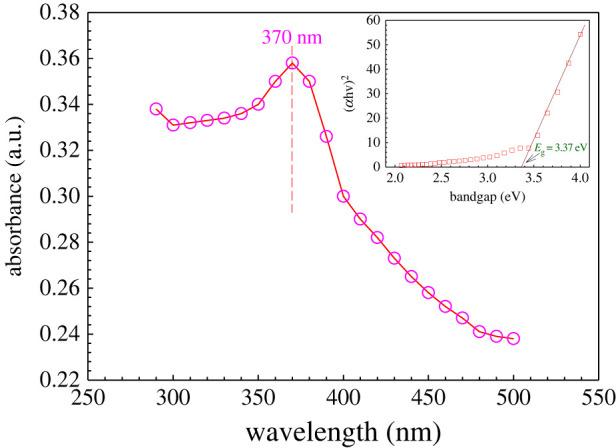
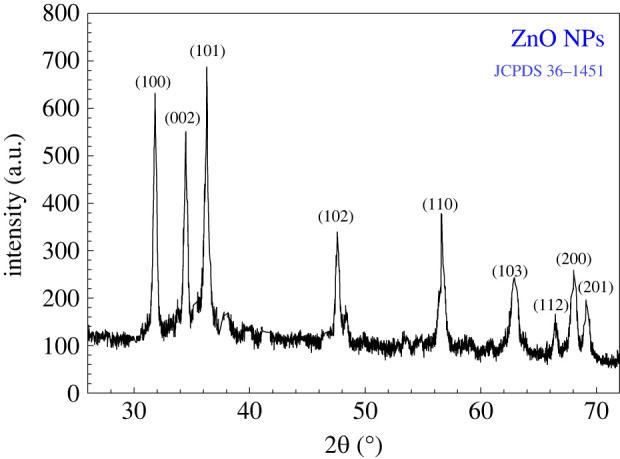
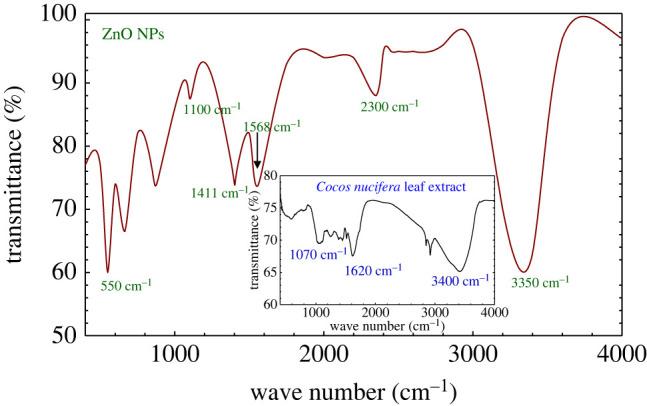
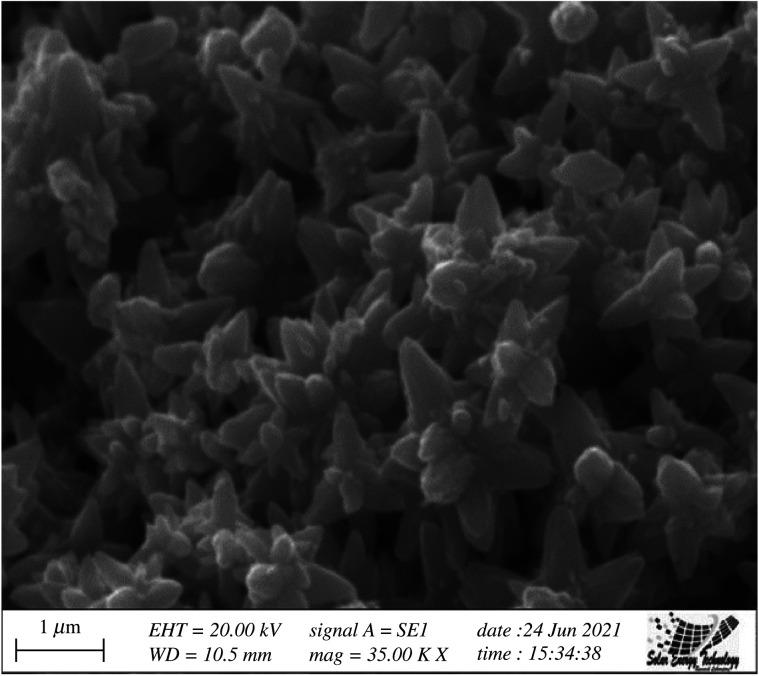
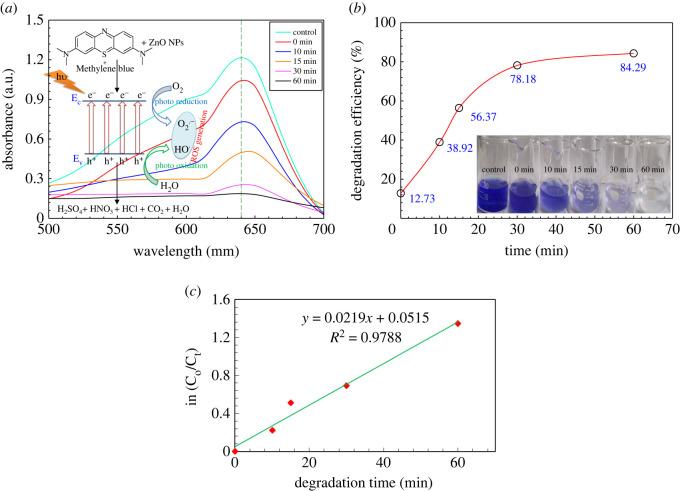
Zinc oxide nanoparticles (ZnO NPs) have been successfully prepared using leaf extract and their antimicrobial, antioxidant and photocatalytic activity investigated. The structural, compositional and morphological properties of the NPs were recorded and studied systematically to confirm the synthesis. The aqueous suspension of NPs showed an ultraviolet-visible (UV-Vis) absorption maxima of 370 nm, indicating primarily its formation. X-ray diffraction analysis identified the NPs with a hexagonal wurtzite structure and an average particle size of 16.6 nm. Fourier transform infrared analysis identified some biomolecules and functional groups in the leaf extract as responsible for the encapsulation and stabilization of ZnO NPs. Energy-dispersive X-ray analysis showed the desired elemental compositions in the material. A flower-shaped morphology of ZnO NPs was observed by scanning electron microscopy, with a grain size of around 15 nm. The optical properties of the NPs were studied by UV-Vis spectroscopy, and the band gap was calculated as 3.37 eV. The prepared ZnO NPs have demonstrated antimicrobial activity against , with a zone of inhibition of 14 and 10 mm, respectively. The photocatalytic behaviour of ZnO NPs showed absorbance degradation at around 640 nm and it discoloured methylene blue dye after 1 h, with a degradation maximum of 84.29%. Thus, the prepared ZnO NPs could potentially be used in antibiotic development and pharmaceutical industries, and as photocatalysts.
已使用叶提取物成功制备了氧化锌纳米颗粒(ZnO NPs),并对其抗菌、抗氧化和光催化活性进行了研究。系统记录并研究了纳米颗粒的结构、组成和形态特性,以确认合成情况。纳米颗粒的水悬浮液在370 nm处显示出紫外可见(UV-Vis)吸收最大值,这主要表明了其形成。X射线衍射分析确定纳米颗粒具有六方纤锌矿结构,平均粒径为16.6 nm。傅里叶变换红外分析确定叶提取物中的一些生物分子和官能团是负责ZnO NPs的包封和稳定化的原因。能量色散X射线分析显示材料中具有所需的元素组成。通过扫描电子显微镜观察到ZnO NPs呈花状形态,晶粒尺寸约为15 nm。通过UV-Vis光谱研究了纳米颗粒的光学性质,计算出带隙为3.37 eV。所制备的ZnO NPs对……表现出抗菌活性,抑菌圈分别为14和10 mm。ZnO NPs的光催化行为在约640 nm处显示吸光度下降,并且在1小时后使亚甲基蓝染料褪色,最大降解率为84.29%。因此,所制备的ZnO NPs有可能用于抗生素开发和制药行业,并用作光催化剂。


 Zotero 插件