
通过反应性熔融加工制备的基于抗冲击聚(3-羟基丁酸酯)/聚(ε-己内酯)的材料,用于压缩成型和3D打印应用。
Impact-Resistant Poly(3-Hydroxybutyrate)/Poly(ε-Caprolactone)-Based Materials, through Reactive Melt Processing, for Compression-Molding and 3D-Printing Applications.
作者信息
Laoutid Fouad, Lenoir Hadrien, Molins Santaeularia Adriana, Toncheva Antoniya, Schouw Tim, Dubois Philippe
机构信息
Polymeric and Composite Materials Unit, Materia Nova Research Center, University of Mons, Nicolas Copernic 3, 7000 Mons, Belgium.
出版信息
Materials (Basel). 2022 Nov 19;15(22):8233. doi: 10.3390/ma15228233.
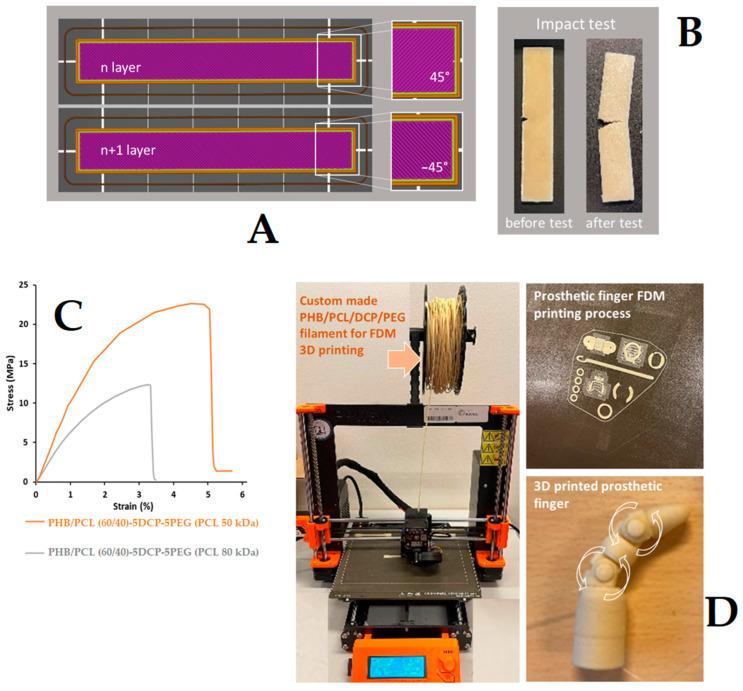
Biobased and biocompatible polymers, such as polyhydroxyalkanoates (PHAs), are of great interest for a large range of applications in the spirit of green chemistry and upcoming reuse and recycling strategies. Polyhydroxybutyrate (PHB), as a promising biocompatible polymer belonging to PHAs, is subject to increased research concern regarding the high degree of crystallinity and brittle behavior of the resulting materials. Therefore, the improvement of PHB's physico-mechanical properties aims to decrease the Young's modulus values and to increase the ductility of samples. Here, we proposed an ambitious approach to develop melt-processed materials, while combining PHB characteristics with the ductile properties of poly(ε-caprolactone) (PCL). In order to compatibilize the poorly miscible PHB/PCL blends, dicumyl peroxide (DCP) was used as a free-radical promotor of polyester interchain reactions via the reaction extrusion process. The resulting PHB/PCL-DCP materials revealed a slight increase in the elongation at break, and significant improvement in the impact resistance (7.2 kJ.m) as compared to PHB. Additional decrease in the Young's modulus values was achieved by incorporating low molecular polyethylene glycol (PEG) as a plasticizer, leading to an important improvement in the impact resistance (15 kJ.m). Successful 3D printing using fused deposition melting (FDM) of the resulting PHB/PCL-based blends for the design of a prosthetic finger demonstrated the great potential of the proposed approach for the development of next-generation biomaterials.
生物基和生物相容性聚合物,如聚羟基脂肪酸酯(PHA),在绿色化学以及即将到来的再利用和回收策略的背景下,在广泛的应用中具有极大的吸引力。聚羟基丁酸酯(PHB)作为一种有前景的属于PHA的生物相容性聚合物,由于所得材料的高结晶度和脆性行为而受到越来越多的研究关注。因此,改善PHB的物理机械性能旨在降低杨氏模量值并提高样品的延展性。在此,我们提出了一种大胆的方法来开发熔融加工材料,将PHB的特性与聚(ε-己内酯)(PCL)的韧性相结合。为了使互溶性较差的PHB/PCL共混物相容,过氧化二异丙苯(DCP)通过反应挤出工艺用作聚酯链间反应的自由基促进剂。与PHB相比,所得的PHB/PCL-DCP材料的断裂伸长率略有增加,抗冲击性有显著改善(7.2 kJ.m)。通过加入低分子聚乙二醇(PEG)作为增塑剂,杨氏模量值进一步降低,从而使抗冲击性有重要改善(15 kJ.m)。使用所得的基于PHB/PCL的共混物通过熔融沉积成型(FDM)成功进行3D打印以设计假手指,证明了所提出的方法在开发下一代生物材料方面的巨大潜力。





 Zotero 插件