
通过键合和空间共轭对小分子芳香族和脂肪族醛亚胺光致发光的影响。
Effects of Through-Bond and Through-Space Conjugations on the Photoluminescence of Small Aromatic and Aliphatic Aldimines.
作者信息
Zhuang Peifeng, Yuan Chang, Bai Yunhao, He Changcheng, Long Jiayu, Tan Hongwei, Wang Huiliang
机构信息
Beijing Key Laboratory of Energy Conversion and Storage Materials, College of Chemistry, Beijing Normal University, Beijing 100875, China.
Key Laboratory of Theoretical and Computational Photochemistry, Ministry of Education, College of Chemistry, Beijing Normal University, Beijing 100875, China.
出版信息
Molecules. 2022 Nov 19;27(22):8046. doi: 10.3390/molecules27228046.
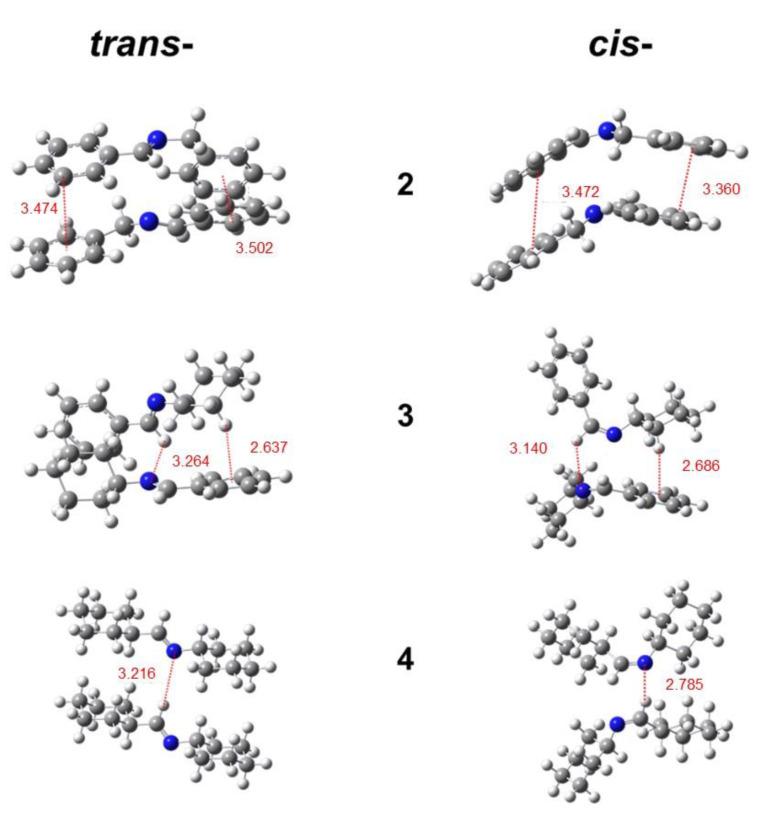
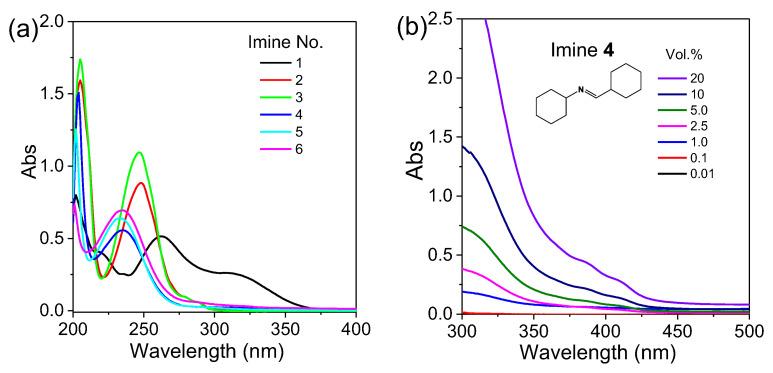
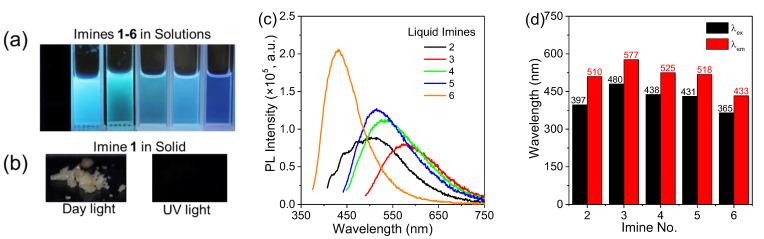
Through-bond conjugation (TBC) and/or through-space conjugation (TSC) determine the photophysical properties of organic luminescent compounds. No systematic studies have been carried out to understand the transition from aromatic TBC to non-aromatic TSC on the photoluminescence of organic luminescent compounds. In this work, a series of small aromatic and aliphatic aldimines were synthesized. For the aromatic imines, surprisingly, ,1-diphenylmethanimine with the highest TBC is non-emissive, while -benzyl-1-phenylmethanimine and -cyclohexyl-1-phenylmethanimine emit bright fluorescence in aggregate states. The aliphatic imines are all emissive, and their maximum emission wavelength decreases while the quantum yield increases with a decrease in steric hindrance. The imines show concentration-dependent and excitation-dependent emissions. Theoretical calculations show that the TBC extents in the aromatic imines are not strong enough to induce photoluminescence in a single molecule state, while the intermolecular TSC becomes dominant for the fluorescence emissions of both aromatic and aliphatic imines in aggregate states, and the configurations and spatial conformations of the molecules in aggregate states play a key role in the formation of effective TSC. This study provides an understanding of how chemical and spatial structures affect the formation of TBC and TSC and their functions on the photoluminescence of organic luminescent materials.
通过化学键共轭(TBC)和/或空间共轭(TSC)决定了有机发光化合物的光物理性质。尚未开展系统研究来了解有机发光化合物的光致发光过程中从芳香族TBC到非芳香族TSC的转变。在这项工作中,合成了一系列小分子芳香族和脂肪族醛亚胺。对于芳香族亚胺,令人惊讶的是,具有最高TBC的1,1-二苯基甲亚胺不发光,而苄基-1-苯基甲亚胺和环己基-1-苯基甲亚胺在聚集态下发出明亮的荧光。脂肪族亚胺均发光,并且随着空间位阻的减小,它们的最大发射波长减小而量子产率增加。这些亚胺表现出浓度依赖性和激发依赖性发射。理论计算表明,芳香族亚胺中的TBC程度不足以在单分子状态下诱导光致发光,而分子间TSC在聚集态下对于芳香族和脂肪族亚胺的荧光发射均占主导地位,并且聚集态下分子的构型和空间构象在有效TSC的形成中起关键作用。这项研究有助于理解化学结构和空间结构如何影响TBC和TSC的形成及其对有机发光材料光致发光的作用。


 Zotero 插件