
2020 年 3 月至 8 月与 2019 年同期相比,COVID-19 大流行对埃塞俄比亚北谢瓦地区基于设施的基本母婴保健服务利用的影响:一项混合方法研究。
Impact of the COVID-19 pandemic on utilisation of facility-based essential maternal and child health services from March to August 2020 compared with pre-pandemic March-August 2019: a mixed-methods study in North Shewa Zone, Ethiopia.
机构信息
HaSET MNCH Research Program, St Paul's Hospital Millennium Medical College, Addis Ababa, Ethiopia.
Department of Obstetrics and Gynecology, St Paul's Hospital Millennium Medical College, Addis Ababa, Ethiopia.
出版信息
BMJ Open. 2022 Jun 3;12(6):e059408. doi: 10.1136/bmjopen-2021-059408.
INTRODUCTION
Health systems are often weakened by public health emergencies that make it harder to access health services. We aimed to assess maternal, newborn and child health (MNCH) service utilisation during the first 6 months of the COVID-19 pandemic compared with prior to the pandemic.
METHODS
We conducted a mixed study design in eight health facilities that are part of the Birhan field site in Amhara, Ethiopia and compared the trend of service utilisation in the first 6 months of COVID-19 with the corresponding time and data points of the preceding year.
RESULT
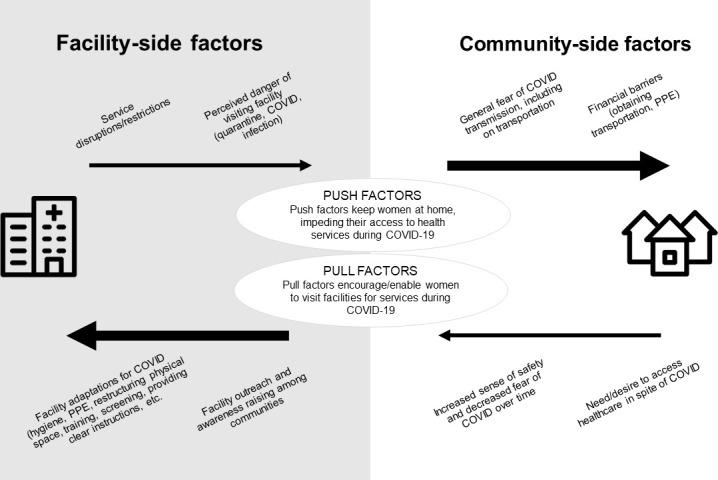
New family planning visits (43.2 to 28.5/month, p=0.014) and sick under 5 child visits (225.0 to 139.8/month, p=0.007) declined over the first 6 months of the pandemic compared with the same period in the preceding year. Antenatal (208.9 to 181.7/month, p=0.433) and postnatal care (26.6 to 19.8/month, p=0.155) visits, facility delivery rates (90.7 to 84.2/month, p=0.776), and family planning visits (313.3 to 273.4/month, p=0.415) declined, although this did not reach statistical significance. Routine immunisation visits (37.0 to 36.8/month, p=0.982) for children were maintained. Interviews with healthcare providers and clients highlighted several barriers to service utilisation during COVID-19, including fear of disease transmission, economic hardship, and transport service disruptions and restrictions. Enablers of service utilisation included communities' decreased fear of COVID-19 and awareness-raising activities.
CONCLUSION
We observed a decline in essential MNCH services particularly in sick children and new family planning visits. To improve the resiliency of fragile health systems, resources are needed to continuously monitor service utilisation and clients' evolving concerns during public health emergencies.
简介
公共卫生紧急事件常常使卫生系统变得脆弱,导致人们更难获得卫生服务。本研究旨在评估 COVID-19 大流行的前 6 个月与大流行前相比,孕产妇、新生儿和儿童健康(MNCH)服务的利用情况。
方法
我们在埃塞俄比亚阿姆哈拉州伯尔汗实地的 8 个卫生机构中开展了一项混合研究设计,并比较了 COVID-19 前 6 个月服务利用趋势与前一年同期的相应时间和数据点。
结果
与前一年同期相比,COVID-19 大流行的前 6 个月新的计划生育访问量(43.2 次/月至 28.5 次/月,p=0.014)和 5 岁以下儿童就诊(225.0 次/月至 139.8 次/月,p=0.007)有所下降。产前(208.9 次/月至 181.7 次/月,p=0.433)和产后护理(26.6 次/月至 19.8 次/月,p=0.155)、分娩率(90.7 次/月至 84.2 次/月,p=0.776)和计划生育访问量(313.3 次/月至 273.4 次/月,p=0.415)有所下降,但没有达到统计学意义。儿童常规免疫接种(37.0 次/月至 36.8 次/月,p=0.982)保持不变。对卫生保健提供者和客户的访谈强调了 COVID-19 期间服务利用的几个障碍,包括对疾病传播的恐惧、经济困难以及交通服务中断和限制。服务利用的促进因素包括社区对 COVID-19 的恐惧减少和提高认识活动。
结论
我们观察到基本的 MNCH 服务,特别是在生病儿童和新计划生育访问方面有所下降。为了提高脆弱卫生系统的弹性,需要资源来持续监测公共卫生紧急情况下的服务利用情况和客户不断变化的关注点。
 Zotero 插件