
基因中的天冬氨酸376被谷氨酸取代以及代谢增强赋予了其对苯磺隆的高抗性。
An Asp376Glu substitution in gene and enhanced metabolism confers high tribenuron-methyl resistance in .
作者信息
Palma-Bautista Candelario, Vázquez-García José G, Osuna Maria D, Garcia-Garcia Blanca, Torra Joel, Portugal Joao, De Prado Rafael
机构信息
Department of Biochemistry and Molecular Biology, University of Cordoba, Cordoba, Spain.
Plant Protection Department, Scientific and Technological Research Centre of Extremadura (CICYTEX), Guadajira, Badajoz, Spain.
出版信息
Front Plant Sci. 2022 Nov 11;13:1011596. doi: 10.3389/fpls.2022.1011596. eCollection 2022.
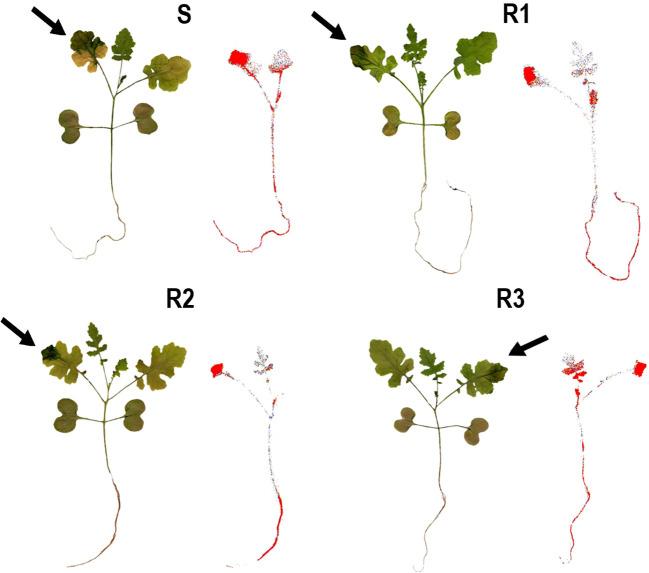
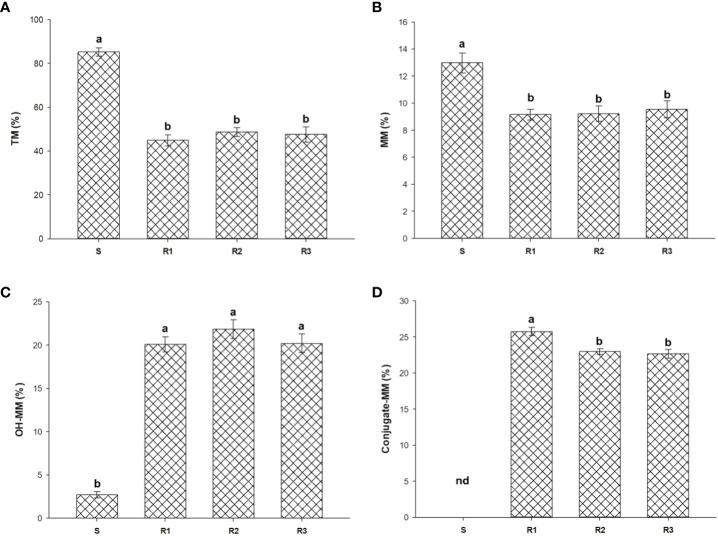
Acetolactate synthase (ALS) inhibiting herbicides (group 2) have been widely applied for the last 20 years to control in cereal crops from southern Spain. In 2008, a tribenuron-methyl (TM) resistant (R) population was first reported in a cereal field in Malaga (southern Spain). In 2018, three suspected R populations (R1, R2 and R3) to TM were collected from three different fields in Granada (southern Spain, 100 km away from Malaga). The present work aims to confirm the putative resistance of these populations to TM and explore their resistance mechanisms. Dose-response assays showed that the R1, R2 and R3 populations ranging between 57.4, 44.4 and 57.1 times more resistance to TM than the susceptible population (S). A mutation in the gene (Asp376Glu) was detected in the Rs populations. C-metabolism studies show that metabolites and TM were changing significantly faster in the R than in the S plants. Alternative chemical control trials showed that 2,4-D and MCPA (auxin mimics), glyphosate (enolpyruvyl shikimate phosphate synthase,EPSPS, inhibitor-group 9), metribuzin (PSII inhibitors/Serine 264 Binders, -group 5) and mesotrione (hydroxyphenyl pyruvate dioxygenase, HPPD, inhibitor-group 27) presented a high control of the four populations of tested, both S and R. Based on these results, it is the first case described where the Asp376Glu mutation and P450-mediated metabolism participates in resistance to TM in . Comparing these results with those found in the population in Malaga in 2008, where the resistance was TSR type (Pro197Ser), we can suggest that despite the geographical proximity (over 100 km), the resistance in these cases was due to different evolutionary events.
乙酰乳酸合成酶(ALS)抑制性除草剂(第2组)在过去20年中已广泛应用于西班牙南部的谷类作物防治。2008年,首次在马拉加(西班牙南部)的一块谷类田地中报道了对甲基苯磺隆(TM)具有抗性(R)的种群。2018年,从格拉纳达(西班牙南部,距马拉加100公里)的三块不同田地中采集了三个疑似对TM具有抗性的种群(R1、R2和R3)。本研究旨在确认这些种群对TM的假定抗性,并探索其抗性机制。剂量反应试验表明,R1、R2和R3种群对TM的抗性比对敏感种群(S)高57.4、44.4和57.1倍。在抗性种群中检测到基因(Asp376Glu)中的一个突变。碳代谢研究表明,抗性植株中代谢物和TM的变化明显快于敏感植株。替代化学防治试验表明,2,4-D和MCPA(生长素类似物)、草甘膦(烯醇丙酮酸莽草酸磷酸合酶,EPSPS,抑制剂-第9组)、嗪草酮(PSII抑制剂/丝氨酸264结合剂,-第5组)和甲基磺草酮(对羟基苯基丙酮酸双加氧酶,HPPD,抑制剂-第27组)对测试的四个种群(S和R)均有较高的防效。基于这些结果,这是首次描述Asp376Glu突变和P450介导的代谢参与对TM抗性的案例。将这些结果与2008年在马拉加的抗性种群中发现的结果(抗性为TSR类型,Pro197Ser)进行比较,我们可以认为,尽管地理距离较近(超过100公里),但这些案例中的抗性是由于不同的进化事件导致的。



 Zotero 插件