
久坐和身体活跃的老年人的限时进食与认知功能:以斋月日间间歇性禁食为模型
Time-restricted feeding and cognitive function in sedentary and physically active elderly individuals: Ramadan diurnal intermittent fasting as a model.
作者信息
Boujelbane Mohamed Ali, Trabelsi Khaled, Jahrami Haitham A, Masmoudi Liwa, Ammar Achraf, Khacharem Aïmen, Boukhris Omar, Puce Luca, Garbarino Sergio, Scoditti Egeria, Khanfir Saber, Msaad Aymen, Msaad Amine, Akrout Soulaimane, Hakim Ahmed, Bragazzi Nicola Luigi, Bryk Kelsey, Glenn Jordan M, Chtourou Hamdi
机构信息
High Institute of Sport and Physical Education, University of Sfax, Sfax, Tunisia.
Research Laboratory: Education, Motricité, Sport et Santé, EM2S, LR19JS01, High Institute of Sport and Physical Education of Sfax, University of Sfax, Sfax, Tunisia.
出版信息
Front Nutr. 2022 Nov 9;9:1041216. doi: 10.3389/fnut.2022.1041216. eCollection 2022.
OBJECTIVES
This study aimed to investigate the effects of Ramadan diurnal intermittent fasting (RDIF) on cognitive performance, sleep quality, daytime sleepiness, and insomnia in physically active and sedentary elderly individuals.
METHODS
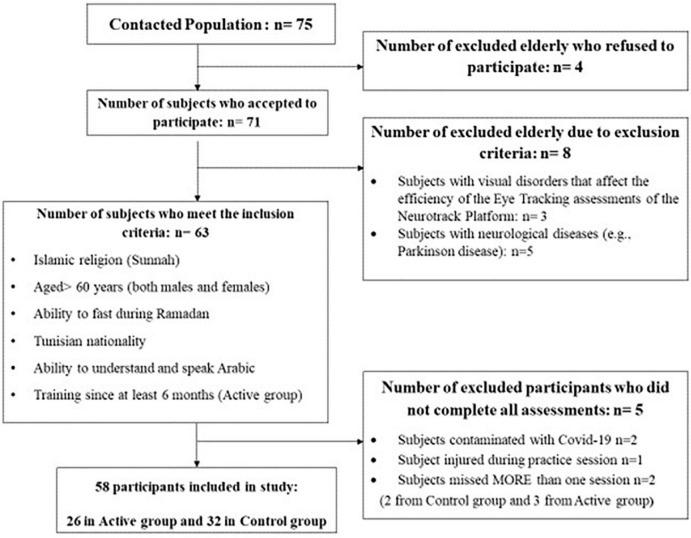
A total of 58 participants (62.93 ± 3.99 years) were assigned to one of the following two groups: a sedentary group (control group) who observed Ramadan ( = 32) and a physically active group ( = 26) who continued to train while observing Ramadan. Participants were assessed 2 weeks before Ramadan and during the fourth week of Ramadan. On each occasion, participants completed a digital assessment of their cognitive performance and responded to the Pittsburgh sleep quality index (PSQI), the insomnia severity index (ISI) and the Epworth sleepiness scale (ESS) questionnaires to assess sleep parameters.
RESULTS
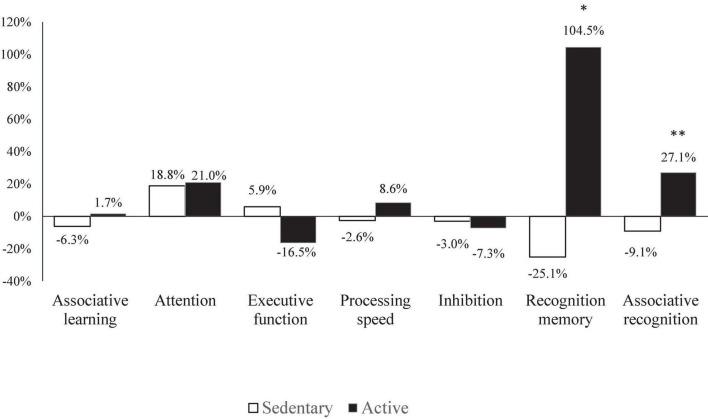
Compared to before Ramadan, performance in executive function ( = 0.035), attention ( = 0.005), inhibition ( = 0.02), associative memory ( = 0.041), and recognition memory ( = 0.025) increased significantly during Ramadan in the physically active group. For the sedentary group, associative learning performance decreased ( = 0.041), whilst performances in the remaining domains remained unchanged during Ramadan. Global PSQI, ISI, and ESS scores indicated both groups suffered from poor sleep quality and excessive daytime sleepiness, with significantly higher negative effects of RDIF observed in the sedentary group.
CONCLUSION
Older adults who continue to train at least three times per week during Ramadan may improve their cognitive performance, despite the impairment of sleep quality. Future studies in older adults during Ramadan including objective measures of sleep (e.g., polysomnography, actigraphy) and brain function (e.g., functional magnetic resonance imaging) are warranted.
目的
本研究旨在调查斋月日间间歇性禁食(RDIF)对身体活跃和久坐不动的老年人认知能力、睡眠质量、日间嗜睡和失眠的影响。
方法
共有58名参与者(62.93±3.99岁)被分为以下两组之一:一组为久坐不动组(对照组),共32人,他们在斋月期间进行斋戒;另一组为身体活跃组,共26人,他们在斋月期间继续进行训练。在斋月前2周和斋月第四周对参与者进行评估。每次评估时,参与者完成认知能力的数字评估,并回答匹兹堡睡眠质量指数(PSQI)、失眠严重程度指数(ISI)和爱泼华嗜睡量表(ESS)问卷,以评估睡眠参数。
结果
与斋月前相比,身体活跃组在斋月期间执行功能(P = 0.035)、注意力(P = 0.005)、抑制能力(P = 0.02)、联想记忆(P = 0.041)和识别记忆(P = 0.025)方面的表现显著提高。对于久坐不动组,联想学习能力下降(P = 0.041),而在斋月期间其余领域的表现保持不变。PSQI、ISI和ESS的总体得分表明两组睡眠质量都较差且日间嗜睡过度,在久坐不动组中观察到RDIF的负面影响显著更高。
结论
在斋月期间每周至少继续训练三次的老年人,尽管睡眠质量受到损害,但可能会改善其认知能力。有必要在斋月期间对老年人进行进一步研究,包括采用客观的睡眠测量方法(如多导睡眠图、活动记录仪)和脑功能测量方法(如功能磁共振成像)。

 Zotero 插件