
中国基于人工智能的互联网医院药学服务:基于案例研究的视角
Artificial intelligence-based internet hospital pharmacy services in China: Perspective based on a case study.
作者信息
Bu Fengjiao, Sun Hong, Li Ling, Tang Fengmin, Zhang Xiuwen, Yan Jingchao, Ye Zhengqiang, Huang Taomin
机构信息
Department of Pharmacy, Eye & ENT Hospital, Fudan University, Shanghai, China.
Information Center, Eye & ENT Hospital, Fudan University, Shanghai, China.
出版信息
Front Pharmacol. 2022 Nov 9;13:1027808. doi: 10.3389/fphar.2022.1027808. eCollection 2022.
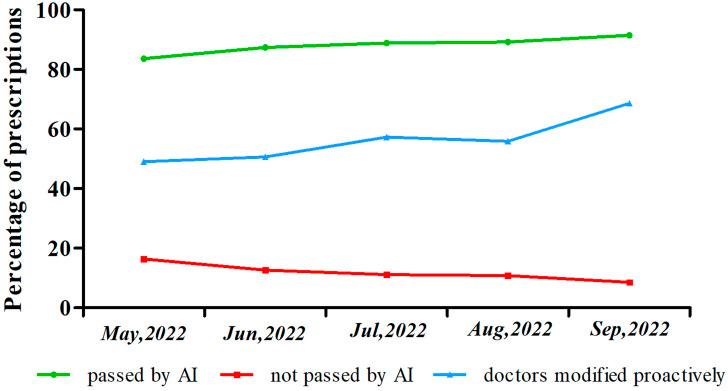
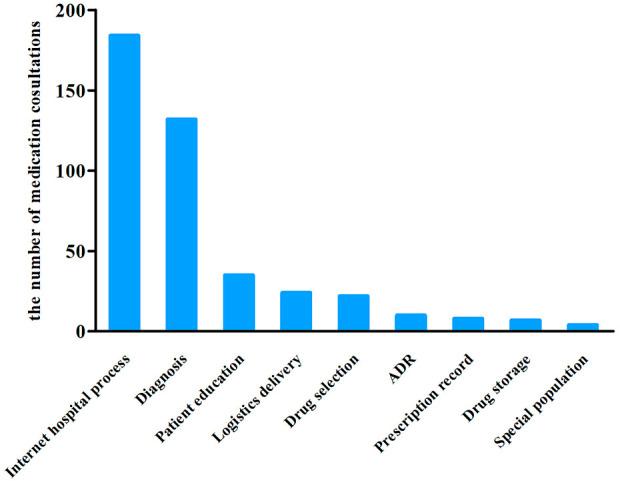
Recently, internet hospitals have been emerging in China, saving patients time and money during the COVID-19 pandemic. In addition, pharmacy services that link doctors and patients are becoming essential in improving patient satisfaction. However, the existing internet hospital pharmacy service mode relies primarily on manual operations, making it cumbersome, inefficient, and high-risk. To establish an internet hospital pharmacy service mode based on artificial intelligence (AI) and provide new insights into pharmacy services in internet hospitals during the COVID-19 pandemic. An AI-based internet hospital pharmacy service mode was established. Initially, prescription rules were formulated and embedded into the internet hospital system to review the prescriptions using AI. Then, the "medicine pick-up code," which is a Quick Response (QR) code that represents a specific offline self-pick-up order, was created. Patients or volunteers could pick up medications at an offline hospital or drugstore by scanning the QR code through the window and wait for the dispensing machine or pharmacist to dispense the drugs. Moreover, the medication consultation function was also operational. The established internet pharmacy service mode had four major functional segments: online drug catalog search, prescription preview by AI, drug dispensing and distribution, and AI-based medication consultation response. The qualified rate of AI preview was 83.65%. Among the 16.35% inappropriate prescriptions, 49% were accepted and modified by physicians proactively and 51.00% were passed after pharmacists intervened. The "offline self-pick-up" mode was preferred by 86% of the patients for collecting their medication in the internet hospital, which made the QR code to be fully applied. A total of 426 medication consultants were served, and 48.83% of them consulted outside working hours. The most frequently asked questions during consultations were about the internet hospital dispensing process, followed by disease diagnosis, and patient education. Therefore, an AI-based medication consultation was proposed to respond immediately when pharmacists were unavailable. The established AI-based internet hospital pharmacy service mode could provide references for pharmacy departments during the COVID-19 pandemic. The significance of this study lies in ensuring safe/rational use of medicines and raising pharmacists' working efficiency.
近年来,互联网医院在中国不断涌现,在新冠疫情期间为患者节省了时间和金钱。此外,连接医生和患者的药学服务对于提高患者满意度正变得至关重要。然而,现有的互联网医院药学服务模式主要依赖人工操作,导致流程繁琐、效率低下且风险较高。为建立一种基于人工智能(AI)的互联网医院药学服务模式,并为新冠疫情期间互联网医院的药学服务提供新的思路。建立了一种基于AI的互联网医院药学服务模式。首先,制定处方规则并嵌入互联网医院系统,以便使用AI审核处方。然后,创建了“取药码”,它是一个代表特定线下自提订单的二维码。患者或志愿者可以在离线医院或药店通过窗口扫描二维码取药,并等待发药机或药剂师配药。此外,用药咨询功能也已投入使用。所建立的互联网药学服务模式有四个主要功能板块:在线药品目录搜索、AI处方预览、药品调配与分发以及基于AI的用药咨询回复。AI预览的合格率为83.65%。在16.35%的不适当处方中,49%被医生主动接受并修改,51.00%在药师干预后通过。86%的患者在互联网医院取药时更喜欢“线下自提”模式,这使得二维码得到了充分应用。共服务了426名用药咨询者,其中48.83%在非工作时间咨询。咨询中最常见的问题是关于互联网医院的配药流程,其次是疾病诊断和患者教育。因此,提出了一种基于AI的用药咨询,以便在药师无法提供服务时立即做出回应。所建立的基于AI的互联网医院药学服务模式可为新冠疫情期间的药学部门提供参考。本研究的意义在于确保安全/合理用药并提高药师的工作效率。



 Zotero 插件