
慢性病毒合并感染会对长新冠的发病概率产生不同影响。
Chronic viral coinfections differentially affect the likelihood of developing long COVID.
机构信息
Division of HIV, Infectious Diseases, and Global Medicine.
Division of Experimental Medicine, and.
出版信息
J Clin Invest. 2023 Feb 1;133(3):e163669. doi: 10.1172/JCI163669.
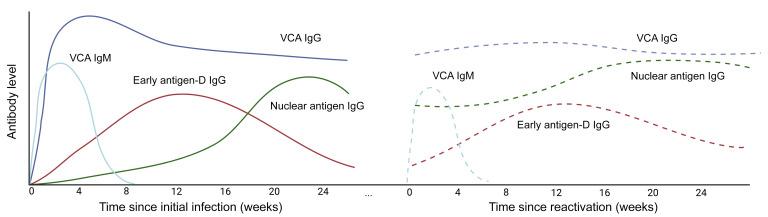
BACKGROUNDThe presence and reactivation of chronic viral infections, such as EBV, CMV, and HIV, have been proposed as potential contributors to long COVID (LC), but studies in well-characterized postacute cohorts of individuals with COVID-19 over a longer time course consistent with current case definitions of LC are limited.METHODSIn a cohort of 280 adults with prior SARS-CoV-2 infection, we assessed the presence and types of LC symptoms and prior medical history (including COVID-19 history and HIV status) and performed serological testing for EBV and CMV using a commercial laboratory. We used covariate-adjusted binary logistic regression models to identify independent associations between variables and LC symptoms.RESULTSWe observed that LC symptoms, such as fatigue and neurocognitive dysfunction, at a median of 4 months following initial diagnosis were independently associated with serological evidence suggesting recent EBV reactivation (early antigen-diffuse IgG positivity) or high nuclear antigen (EBNA) IgG levels but not with ongoing EBV viremia. Serological evidence suggesting recent EBV reactivation (early antigen-diffuse IgG positivity) was most strongly associated with fatigue (OR = 2.12). Underlying HIV infection was also independently associated with neurocognitive LC (OR = 2.5). Interestingly, participants who had serologic evidence of prior CMV infection were less likely to develop neurocognitive LC (OR = 0.52).CONCLUSIONOverall, these findings suggest differential effects of chronic viral coinfections on the likelihood of developing LC and association with distinct syndromic patterns. Further assessment during the acute phase of COVID-19 is warranted.TRIAL REGISTRATIONLong-term Impact of Infection with Novel Coronavirus; ClinicalTrials.gov NCT04362150.FUNDINGThis work was supported by NIH/National Institute of Allergy and Infectious Diseases grants (3R01AI141003-03S1, R01AI158013, and K24AI145806); the Zuckerberg San Francisco General Hospital Department of Medicine and Division of HIV, Infectious Diseases, and Global Medicine; and the UCSF-Bay Area Center for AIDS Research (P30-AI027763).
背景
慢性病毒感染(如 EBV、CMV 和 HIV)的存在和再激活被认为是长新冠(LC)的潜在原因,但在与当前 LC 病例定义一致的更长时间范围内,对新冠病毒感染后具有明确特征的亚急性队列个体进行的研究有限。
方法
在 280 名先前感染 SARS-CoV-2 的成年人队列中,我们评估了 LC 症状的存在和类型以及既往病史(包括 COVID-19 病史和 HIV 状况),并使用商业实验室进行 EBV 和 CMV 的血清学检测。我们使用协变量调整的二项逻辑回归模型来确定变量与 LC 症状之间的独立关联。
结果
我们发现,在初次诊断后中位数为 4 个月时,LC 症状(如疲劳和神经认知功能障碍)与血清学证据表明最近 EBV 再激活(早期抗原弥散 IgG 阳性)或高核抗原(EBNA)IgG 水平独立相关,但与持续 EBV 病毒血症无关。血清学证据表明最近 EBV 再激活(早期抗原弥散 IgG 阳性)与疲劳(OR=2.12)关系最为密切。基础 HIV 感染也与神经认知 LC 独立相关(OR=2.5)。有趣的是,有 CMV 既往感染血清学证据的参与者发生神经认知 LC 的可能性较小(OR=0.52)。
结论
总的来说,这些发现表明慢性病毒合并感染对 LC 发生的可能性有不同的影响,并与不同的综合征模式相关。在新冠病毒感染的急性期进一步评估是必要的。
试验注册
新型冠状病毒感染的长期影响;ClinicalTrials.gov NCT04362150。
资金
这项工作得到了 NIH/National Institute of Allergy and Infectious Diseases 资助(3R01AI141003-03S1、R01AI158013 和 K24AI145806);Zuckerberg 旧金山总医院内科和 HIV、传染病和全球医学科;以及 UCSF-湾区艾滋病研究中心(P30-AI027763)。


 Zotero 插件