
移动医疗干预措施在控制冠心病事件后患者生活方式和心血管危险因素中的效果:系统评价和荟萃分析。
Effectiveness of mHealth Interventions in the Control of Lifestyle and Cardiovascular Risk Factors in Patients After a Coronary Event: Systematic Review and Meta-analysis.
机构信息
Faculty of Nursing and Physiotherapy, University of Cádiz, Cádiz, Spain.
Institute of Biomedical Research and Innovation of Cádiz (INiBICA), Cádiz, Spain.
出版信息
JMIR Mhealth Uhealth. 2022 Dec 2;10(12):e39593. doi: 10.2196/39593.
BACKGROUND
Coronary artery disease is the main cause of death and loss of disability-adjusted life years worldwide. Information and communication technology has become an important part of health care systems, including the innovative cardiac rehabilitation services through mobile phone and mobile health (mHealth) interventions.
OBJECTIVE
In this study, we aimed to determine the effectiveness of different kinds of mHealth programs in changing lifestyle behavior, promoting adherence to treatment, and controlling modifiable cardiovascular risk factors and psychosocial outcomes in patients who have experienced a coronary event.
METHODS
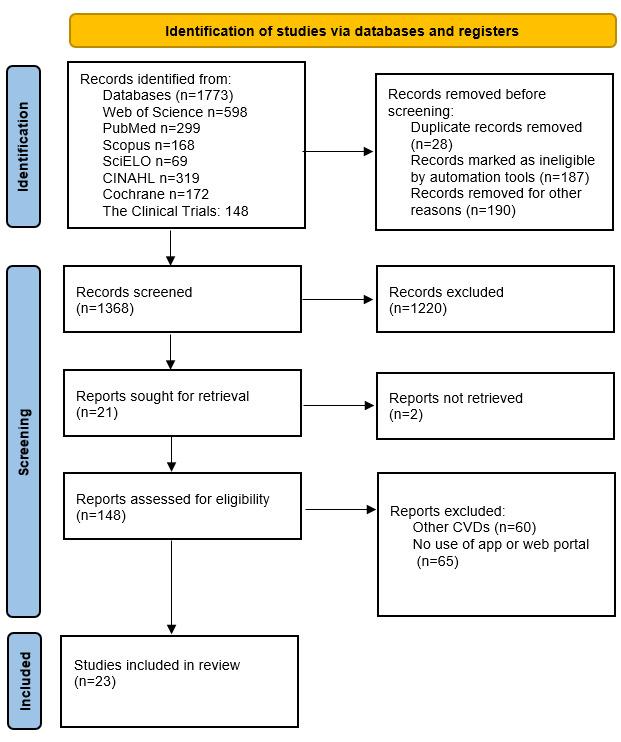
A systematic review of the literature was performed following PRISMA (Preferred Reporting Items for Systematic Reviews and Meta-Analyses) guidelines. A thorough search of the following biomedical databases was conducted: PubMed, Embase, Web of Science, SciELO, CINAHL, Scopus, The Clinical Trial, and Cochrane. Articles that were randomized clinical trials that involved an intervention consisting of an mHealth program using a mobile app in patients after a coronary event were included. The articles analyzed some of the following variables as outcome variables: changes in lifestyle behavior, cardiovascular risk factors, and anthropometric and psychosocial variables. A meta-analysis of the variables studied was performed with the Cochrane tool. The risk of bias was assessed using the Cochrane Collaboration tool; the quality of the evidence was assessed using the Grading of Recommendations, Assessment, Development, and Evaluation tool; and heterogeneity was measured using the I test.
RESULTS
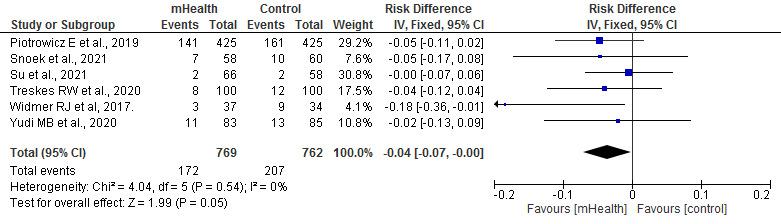
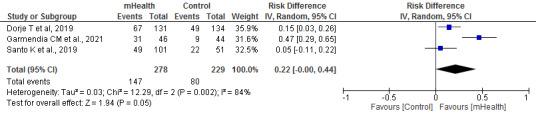
A total of 23 articles were included in the review, and 20 (87%) were included in the meta-analysis, with a total sample size of 4535 patients. Exercise capacity measured using the 6-minute walk test (mean difference=21.64, 95% CI 12.72-30.55; P<.001), physical activity (standardized mean difference [SMD]=0.42, 95% CI 0.04-0.81; P=.03), and adherence to treatment (risk difference=0.19, 95% CI 0.11-0.28; P<.001) were significantly superior in the mHealth group. Furthermore, both the physical and mental dimensions of quality of life were better in the mHealth group (SMD=0.26, 95% CI 0.09-0.44; P=.004 and SMD=0.27, 95% CI 0.06-0.47; P=.01, respectively). In addition, hospital readmissions for all causes and cardiovascular causes were statistically higher in the control group than in the mHealth group (SMD=-0.03, 95% CI -0.05 to -0.00; P=.04 vs SMD=-0.04, 95% CI -0.07 to -0.00; P=.05).
CONCLUSIONS
mHealth technology has a positive effect on patients who have experienced a coronary event in terms of their exercise capacity, physical activity, adherence to medication, and physical and mental quality of life, as well as readmissions for all causes and cardiovascular causes.
TRIAL REGISTRATION
PROSPERO (International Prospective Register of Systematic Reviews) CRD42022299931; https://www.crd.york.ac.uk/prospero/display_record.php?RecordID=299931.
背景
冠心病是全球范围内导致死亡和丧失伤残调整生命年的主要原因。信息和通信技术已成为医疗保健系统的重要组成部分,包括通过移动电话和移动健康(mHealth)干预措施进行创新的心脏康复服务。
目的
本研究旨在确定不同类型的 mHealth 方案在改变生活方式行为、促进治疗依从性以及控制可改变的心血管风险因素和心理社会结果方面的有效性,这些方案适用于经历过冠状动脉事件的患者。
方法
根据 PRISMA(系统评价和荟萃分析的首选报告项目)指南,对文献进行系统评价。对以下生物医学数据库进行了全面搜索:PubMed、Embase、Web of Science、SciELO、CINAHL、Scopus、The Clinical Trial 和 Cochrane。纳入的文章为随机临床试验,涉及使用移动应用程序的 mHealth 方案干预,患者为经历过冠状动脉事件的患者。这些文章分析了一些作为结局变量的变量:生活方式行为的改变、心血管风险因素以及人体测量和心理社会变量。使用 Cochrane 工具对研究的变量进行了荟萃分析。使用 Cochrane 协作工具评估偏倚风险;使用 Grading of Recommendations, Assessment, Development, and Evaluation 工具评估证据质量;使用 I 检验测量异质性。
结果
共纳入 23 篇文章进行综述,其中 20 篇(87%)纳入荟萃分析,总样本量为 4535 例患者。使用 6 分钟步行试验测量的运动能力(平均差异=21.64,95%置信区间 12.72-30.55;P<.001)、体力活动(标准化均数差[SMD]=0.42,95%置信区间 0.04-0.81;P=.03)和治疗依从性(风险差异=0.19,95%置信区间 0.11-0.28;P<.001)在 mHealth 组中显著更高。此外,mHealth 组的身体和心理维度的生活质量均更好(SMD=0.26,95%置信区间 0.09-0.44;P=.004 和 SMD=0.27,95%置信区间 0.06-0.47;P=.01)。此外,对照组的全因和心血管原因再入院率明显高于 mHealth 组(SMD=-0.03,95%置信区间 -0.05 至 -0.00;P=.04 与 SMD=-0.04,95%置信区间 -0.07 至 -0.00;P=.05)。
结论
mHealth 技术对经历过冠状动脉事件的患者具有积极影响,可提高其运动能力、体力活动、药物治疗依从性以及身体和心理生活质量,还可降低全因和心血管原因的再入院率。
试验注册
PROSPERO(国际系统评价注册中心)CRD42022299931;https://www.crd.york.ac.uk/prospero/display_record.php?RecordID=299931。



 Zotero 插件