
肠道微生物群、致病蛋白与神经退行性疾病
Gut microbiota, pathogenic proteins and neurodegenerative diseases.
作者信息
Wei Wei, Wang Shixu, Xu Chongchong, Zhou Xuemei, Lian Xinqing, He Lin, Li Kuan
机构信息
The Mental Hospital of Yunnan Province, Mental Health Center Affiliated to Kunming Medical University, Kunming, China.
School of Forensic Medicine, Kunming Medical University, Kunming, China.
出版信息
Front Microbiol. 2022 Nov 18;13:959856. doi: 10.3389/fmicb.2022.959856. eCollection 2022.
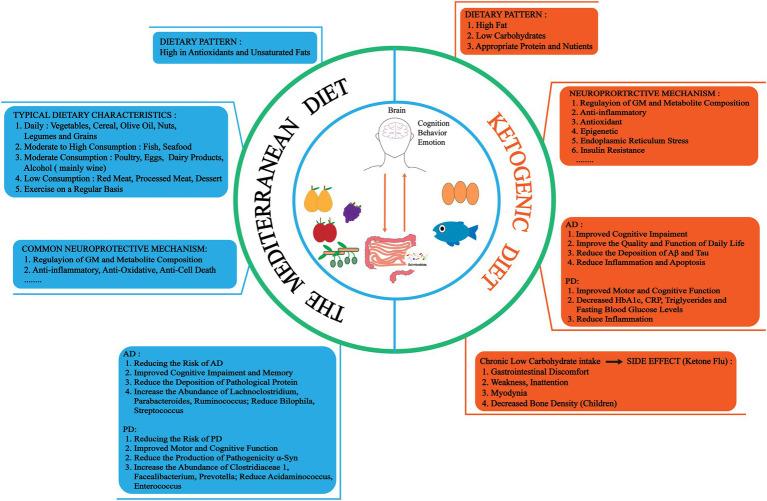
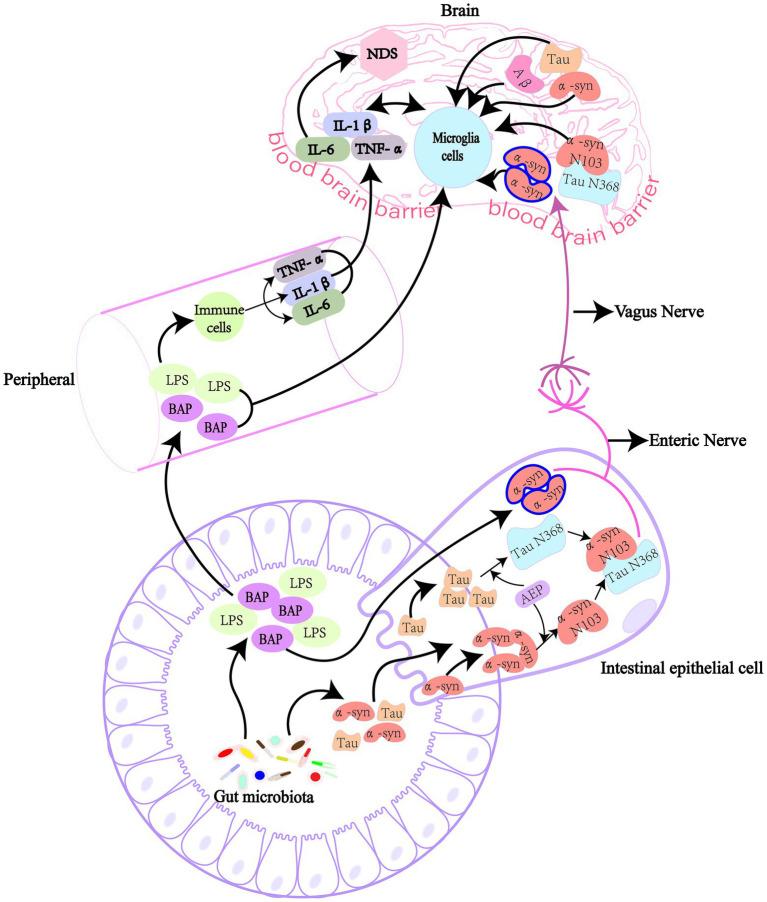
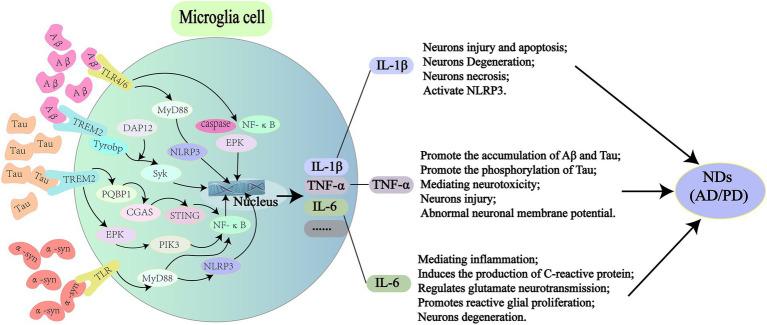
As the world's population ages, neurodegenerative diseases (NDs) have brought a great burden to the world. However, effective treatment measures have not been found to alleviate the occurrence and development of NDs. Abnormal accumulation of pathogenic proteins is an important cause of NDs. Therefore, effective inhibition of the accumulation of pathogenic proteins has become a priority. As the second brain of human, the gut plays an important role in regulate emotion and cognition functions. Recent studies have reported that the disturbance of gut microbiota (GM) is closely related to accumulation of pathogenic proteins in NDs. On the one hand, pathogenic proteins directly produced by GM are transmitted from the gut to the central center vagus nerve. On the other hand, The harmful substances produced by GM enter the peripheral circulation through intestinal barrier and cause inflammation, or cross the blood-brain barrier into the central center to cause inflammation, and cytokines produced by the central center cause the production of pathogenic proteins. These pathogenic proteins can produced by the above two aspects can cause the activation of central microglia and further lead to NDs development. In addition, certain GM and metabolites have been shown to have neuroprotective effects. Therefore, modulating GM may be a potential clinical therapeutic approach for NDs. In this review, we summarized the possible mechanism of NDs caused by abnormal accumulation of pathogenic proteins mediated by GM to induce the activation of central microglia, cause central inflammation and explore the therapeutic potential of dietary therapy and fecal microbiota transplantation (FMT) in NDs.
随着世界人口老龄化,神经退行性疾病给全球带来了沉重负担。然而,尚未找到有效的治疗措施来缓解神经退行性疾病的发生和发展。致病性蛋白质的异常积累是神经退行性疾病的重要病因。因此,有效抑制致病性蛋白质的积累已成为当务之急。肠道作为人类的“第二大脑”,在调节情绪和认知功能方面发挥着重要作用。最近的研究报道,肠道微生物群(GM)的紊乱与神经退行性疾病中致病性蛋白质的积累密切相关。一方面,GM直接产生的致病性蛋白质通过迷走神经从肠道传递到中枢。另一方面,GM产生的有害物质通过肠屏障进入外周循环并引发炎症,或穿过血脑屏障进入中枢引发炎症,中枢产生的细胞因子导致致病性蛋白质的产生。上述两个方面产生的这些致病性蛋白质可导致中枢小胶质细胞激活并进一步导致神经退行性疾病的发展。此外,某些GM及其代谢产物已被证明具有神经保护作用。因此,调节GM可能是治疗神经退行性疾病的一种潜在临床治疗方法。在这篇综述中,我们总结了由GM介导的致病性蛋白质异常积累导致神经退行性疾病的可能机制,该机制诱导中枢小胶质细胞激活、引起中枢炎症,并探讨了饮食疗法和粪便微生物群移植(FMT)在神经退行性疾病中的治疗潜力。
 Zotero 插件