
用于 MALDI 靶标微生物鉴定的自动化设备的诊断检测准确性。
Diagnostic test accuracy of an automated device for the MALDI target preparation for microbial identification.
机构信息
Bacteriology Laboratory, Division of Laboratory Medicine, Department of Diagnostics, Geneva University Hospitals, 4 Rue Gabrielle-Perret-Gentil, 1205, Geneva, Switzerland.
Faculty of Medicine, Geneva, Switzerland.
出版信息
Eur J Clin Microbiol Infect Dis. 2023 Feb;42(2):153-159. doi: 10.1007/s10096-022-04531-3. Epub 2022 Dec 5.
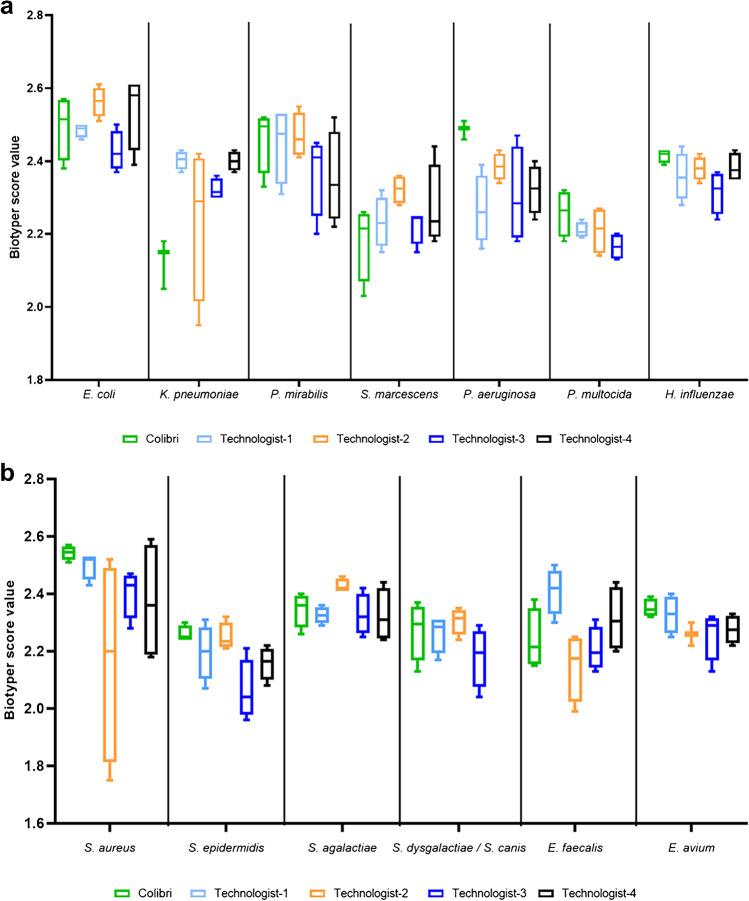
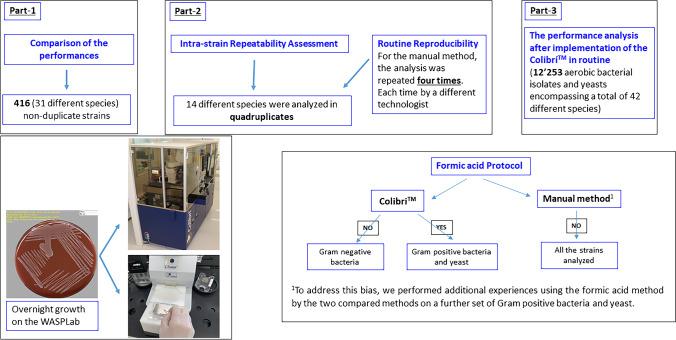
The objective of this study was to evaluate the performance of the Copan Colibrí™ against the manual preparation of the MALDI targets. We analyzed 416 (31 different species) non-duplicate strains covering the most important species identified in clinical routine. We also assessed the intra-strain repeatability between the comparable methods. We then analyzed the performance of this new method after implementation in routine on 12,253 aerobic bacterial isolates and yeasts, encompassing a total of 42 different species. Among the 416 strains analyzed, 6.3% (26/416) and 10.8% (45/416) had a score value < 2 when processed by the Colibri™ and manual method, respectively. Only 5.9% (9/152) of the Gram positive rods and cocci had a score values < 2 by the Colibri™ versus 20.4% (31/152) by the manual method. We confirmed that this relative superiority observed for the Colibri™ was due primarily in the use of the formic acid protocol. For the Gram-negative bacteria, the results of both methods were comparable; 6.6% (17/256) and 4.7% (12/256) had a score value < 2 by the Colibri™ and the manual method, respectively. After implementation in routine, the results according to the Biotyper score cut-off values were distributed as follows: < 1.70: 2.5% (304/12,253), 1.70-1.79: 1.9% (227/12,253), 1.80-1.89: 3.1% (377/12,253), 1.90-1.99: 6.7% (825/12,253), and ≥ 2: 85.9% (10,520/12,253). The Colibrí™ coupled to MALDI-TOF/MS revealed good performances and higher intra-strain repeatability as compared to the manual preparation of the MALDI targets.
本研究旨在评估 Copan Colibrí™ 与手动制备 MALDI 靶之间的性能。我们分析了 416 株(31 种不同种属)非重复的菌株,涵盖了临床常规中鉴定的最重要的种属。我们还评估了可比方法之间的菌株内重复性。然后,我们在常规工作中对 12,253 株需氧细菌和酵母进行了分析,共涵盖了 42 个不同的种属。在分析的 416 株菌株中,通过 Colibri™ 和手动方法处理时,分别有 6.3%(26/416)和 10.8%(45/416)的评分值<2。通过 Colibri™ 处理的革兰氏阳性杆菌和球菌中,评分值<2 的菌株仅有 5.9%(9/152),而通过手动方法处理的则有 20.4%(31/152)。我们证实,Colibri™ 观察到的这种相对优势主要归因于甲酸方案的使用。对于革兰氏阴性菌,两种方法的结果相当;通过 Colibri™ 和手动方法处理时,分别有 6.6%(17/256)和 4.7%(12/256)的评分值<2。在常规应用后,根据 Biotyper 评分截止值的结果分布如下:<1.70:2.5%(304/12,253),1.70-1.79:1.9%(227/12,253),1.80-1.89:3.1%(377/12,253),1.90-1.99:6.7%(825/12,253),≥2:85.9%(10,520/12,253)。Colibrí™ 与 MALDI-TOF/MS 联合使用的性能良好,与手动制备 MALDI 靶相比,菌株内重复性更高。
 Zotero 插件