
老年人健康相关生活质量状况的多重病态模式:利用韩国国家健康和营养检查调查的关联规则和网络分析。
Multimorbidity patterns by health-related quality of life status in older adults: an association rules and network analysis utilizing the Korea National Health and Nutrition Examination Survey.
机构信息
Department of Cancer Control and Population Health, National Cancer Center Graduate School of Cancer Science and Policy, Goyang, Korea.
Department of Preventive Medicine, Kyung Hee University School of Medicine, Seoul, Korea.
出版信息
Epidemiol Health. 2022;44:e2022113. doi: 10.4178/epih.e2022113. Epub 2022 Nov 29.
OBJECTIVES
Improved life expectancy has increased the prevalence of older adults living with multimorbidity which likely deteriorates their health-related quality of life (HRQoL). However, relatively little is known about patterns and the relationships of multimorbidity by HRQoL status in older adults.
METHODS
Individuals aged 65 or older from the Korea National Health and Nutrition Examination Survey V-VII (2010-2018) were analyzed. HRQoL was assessed by the EuroQoL-5 dimensions questionnaire and categorized as poor, normal, or good. The impact of multimorbidity on HRQoL was evaluated using logistic regression. The patterns and inter-relationships between multimorbidity, stratified by HRQoL groups, were analyzed using the association rules and network analysis approach.
RESULTS
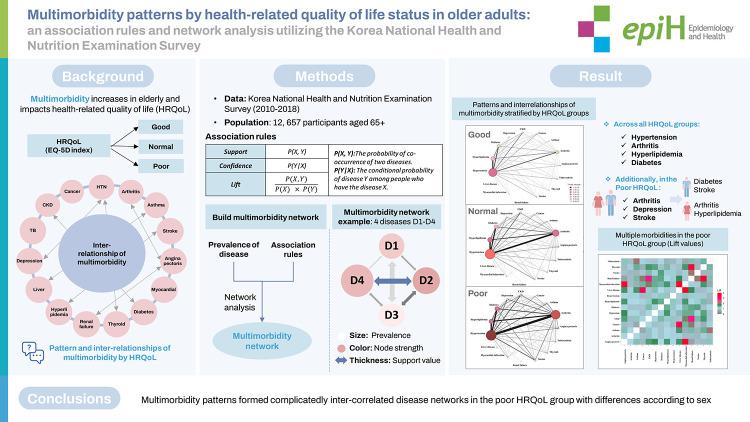
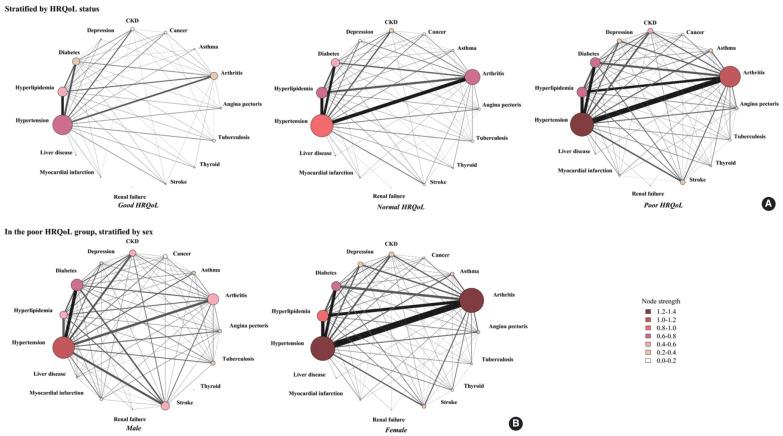
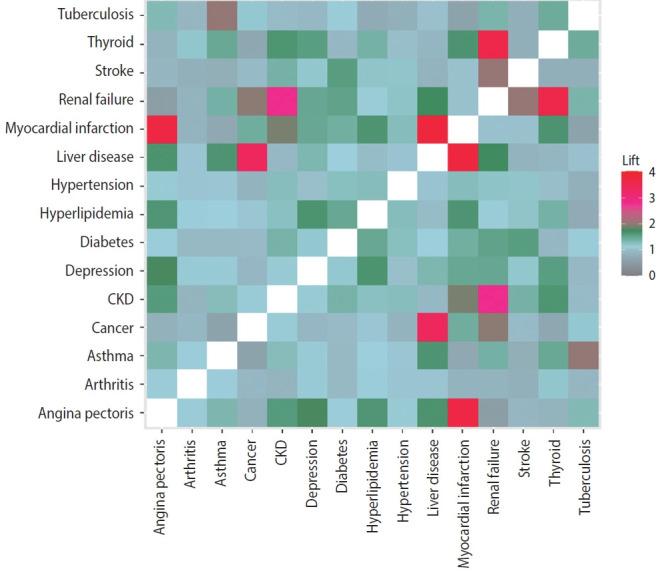
Multimorbidity was significantly associated with poor HRQoL (3 or more diseases vs. none; adjusted odds ratio, 2.70; 95% confidence interval, 2.10 to 3.46). Hypertension, arthritis, hyperlipidemia, and diabetes were the most prevalent diseases across all HRQoL groups. Complex interrelationships of morbidities, higher prevalence, and node strengths in all diseases were observed in the poor HRQoL group, particularly for arthritis, depression, and stroke, compared to other groups (1.5-3.0 times higher, p<0.05 for all). Apart from hypertension, arthritis and hyperlipidemia had a higher prevalence and stronger connections with other diseases in females, whereas this was the case for diabetes and stroke in males with poor HRQoL.
CONCLUSIONS
Multimorbidity patterns formed complicatedly inter-correlated disease networks in the poor HRQoL group with differences according to sex. These findings enhance the understanding of multimorbidity connections and provide information on the healthcare needs of older adults, especially those with poor HRQoL.
目的
预期寿命的提高增加了患有多种疾病的老年人的比例,这可能会降低他们的健康相关生活质量(HRQoL)。然而,对于老年人中多种疾病的模式及其与 HRQoL 状况的关系,人们知之甚少。
方法
本研究分析了韩国国家健康和营养检查调查 V-VII 期(2010-2018 年)中年龄在 65 岁或以上的个体。HRQoL 通过欧洲五维健康量表问卷进行评估,并分为差、正常或好。使用逻辑回归评估多种疾病对 HRQoL 的影响。使用关联规则和网络分析方法分析了按 HRQoL 分组的多种疾病的模式和相互关系。
结果
多种疾病与较差的 HRQoL 显著相关(3 种或更多疾病与无疾病相比;调整后的优势比,2.70;95%置信区间,2.10 至 3.46)。高血压、关节炎、高血脂和糖尿病是所有 HRQoL 组中最常见的疾病。在较差的 HRQoL 组中,观察到多种疾病之间复杂的相互关系、更高的患病率和所有疾病的节点强度,特别是关节炎、抑郁和中风,与其他组相比(所有疾病的患病率高 1.5-3.0 倍,p<0.05)。除高血压外,关节炎和高血脂在女性中具有更高的患病率和与其他疾病更强的联系,而在男性中,糖尿病和中风则是如此,这些男性具有较差的 HRQoL。
结论
在 HRQoL 较差的组中,多种疾病模式形成了复杂相互关联的疾病网络,且这些网络的模式因性别而异。这些发现增强了对多种疾病关系的理解,并为了解老年人,特别是 HRQoL 较差的老年人的医疗保健需求提供了信息。
 Zotero 插件